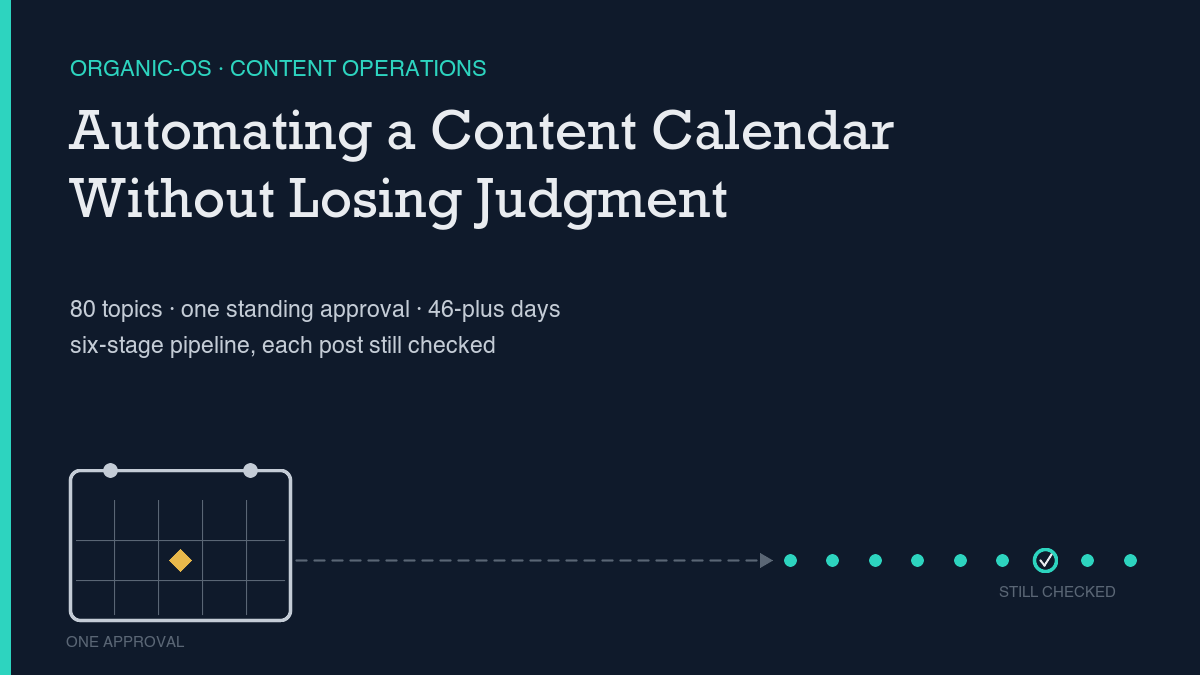
Automating a content calendar means automating the admin around publishing, not the decisions that make a piece worth publishing: scheduling, routing drafts through fixed stages, running the same checks every time, and keeping a dated record of what happened. The actual judgment calls — what to write, whether a claim is verified, whether a draft reads honestly — stay with a person, or with a single standing approval a person gave on purpose. This site runs on exactly that split. One human approval from September 2 covers an 80-topic batch; 52 of those topics had published by the time this one went out, each through the same six-stage pipeline, and at least five of those runs have hit a real bug along the way. None of the bugs were in the writing. All of them were in the plumbing.
Most advice on automating a content calendar stops at the tooling question: which app, which database, which trigger. The more useful question is which specific steps are safe to hand off and which ones need a person reading the actual output before it goes live. I looked at live search results for this exact framing before writing anything here, and the pattern across sources is consistent: automation earns its keep on repetitive, rule-based, easily-reviewed work — reminders, status-triggered routing, drafting support, scheduling — while anything touching brand voice, factual accuracy, or strategic priority stays a human checkpoint. One source frames it as a line-producer-and-showrunner split. That matches how this pipeline is actually built, not as a design choice made in the abstract but as something that got forced into shape by real failures, which is the more useful story to tell.
The process, named stage by stage
Every piece that ships here goes through the same six named stages: research, draft, QA, editor, a featured-image generation step, then publish. Each stage writes its output to a dated folder — a research pack, a QA log, editor notes, the image and payload files — so the record of how a specific piece got made is as persistent as the piece itself. That structure is what automated content operations: what to hand off, what to keep argues for directly: a calendar only becomes automatable once it lives in a structured, inspectable format rather than a spreadsheet or a verbal plan, because the structure is what makes a later stage able to check an earlier one’s work.
What makes this a calendar rather than a one-off script is the batch mechanism sitting above those six stages. Instead of approving each post individually, 80 topics were approved once, in a single decision, with each one shipping on its own day without asking again. That single decision is explicitly revocable — a status change or an emptied queue stops the whole batch — which matters more than it sounds like it should, because a standing approval that cannot be revoked isn’t automation with judgment attached, it’s just a commitment made once and never revisited.
What is automated versus what a human still judges
The honest answer is that “auto-approved” does not mean “unchecked.” Three things from this exact batch’s own run history show where judgment still sits even inside an automated calendar. First, an automated label-leak checker once flagged two false positives — a code snippet demonstrating an escape character, and a quoted historical reference to a label that had leaked in an earlier post — and both were investigated by reading the actual surrounding text rather than mechanically edited to satisfy the checker. Second, a real defect (a featured image reference saved as empty because the upload hadn’t finished yet) was caught on review before the post was ever created, not patched after the fact. Third, every single publish re-fetches the live post afterward and diffs the saved content against what was submitted, rather than trusting the create response — that verification step is itself a designed-in judgment checkpoint, the same discipline why your SEO automation needs an audit trail argues should exist anywhere automation is allowed to touch a live site. None of this is the system catching itself; it’s the system being built to make catching things possible, which is a different claim and a smaller one worth stating precisely.
The same split shows up in what the pipeline is deliberately not allowed to do. The WordPress credential this pipeline runs under can create, edit, and publish posts, but it cannot purge a caching layer that needs broader site permissions — a boundary that has caused real, repeated friction, and one that stays in place on purpose rather than getting “fixed” by widening the credential. Scoping automation to only what a task needs, even when that scoping costs convenience, is the same argument made in guardrails for AI agents that touch your website: a guardrail that gets removed the first time it’s inconvenient was never really a guardrail.
Our own before and after
The clearest before-and-after in this pipeline’s own history is a formatting failure from earlier this year, kept on record rather than quietly fixed and forgotten. Every one of the first seven posts this pipeline produced opened with a visible “In short:” label inside the answer section, and no custom excerpt had been set, so WordPress’s automatic excerpt pulled that exact label text into every listing page a reader would see before clicking through. The fix was specific: a formatting contract was added to the production prompt requiring plain reader-facing prose with no label text anywhere in the body, and a clean excerpt set on every post going forward. All seven live posts were repaired the same day the problem was found, and the rule has been checked on every post since.
A second, related failure is why this pipeline now checks the rendered page rather than trusting an API response. One post went live with eighteen Gutenberg block comments that had been accidentally backslash-escaped during a shell command, which WordPress could not parse — so they rendered as literal garbage text on the actual page, while a content check run against the raw API data looked completely clean. That gap between “the data looks right” and “the page looks right” is why render verification exists as its own separate step now, checked against the live HTML and not the stored content. A third incident, smaller but telling, is a single approved brief that silently dropped out of the queue for weeks because one unescaped character broke its file’s frontmatter — not a crash anyone saw, just an item that quietly stopped existing to the system until a full queue rebuild happened to surface it. Version-controlling every one of these files, the same practice version control for SEO: diffing your own site makes the case for, is what let each of these three incidents be found, dated, and fixed instead of just suspected.
How to tell if the process is helping
A calendar that reliably ships posts is not automatically a calendar that is working — reliability is a claim about the process, not about whether readers or search engines care about the output, and keeping those two claims separate is the same discipline this site’s own measurement posts insist on for any other SEO metric. The way to check this specific page honestly is the same falsifiability test applied to every other piece in this batch: if, sixty days after this publishes, Search Console still shows zero impressions for any query containing its primary keyword terms, despite the page being indexed, the piece did not work and that should be reported plainly rather than dropped from the record. The baseline to check that against is already set: as of today, none of the fifty highest-impression search queries hitting this site contain “automate” and “content calendar” together or in any close variant, which is exactly the clean starting point that test requires — not a projection of what will happen, just a reliable fact about where this page starts from before any answer appears.
What I can say with more confidence, because it is a closed incident rather than a prediction, is that the specific defects named above have not recurred in the forty-six-plus days and roughly fifty posts since the formatting and render-verification contracts were added — every run since has logged a pass against both checks, not a silent skip. That is a narrow claim about two specific, previously-broken gates, not a broader claim that the whole process is “working.” Judging whether an automated content calendar is helping means tracking both kinds of evidence at once: whether the gates that exist because something broke are still holding, and whether the output they protect is actually earning attention once it ships.