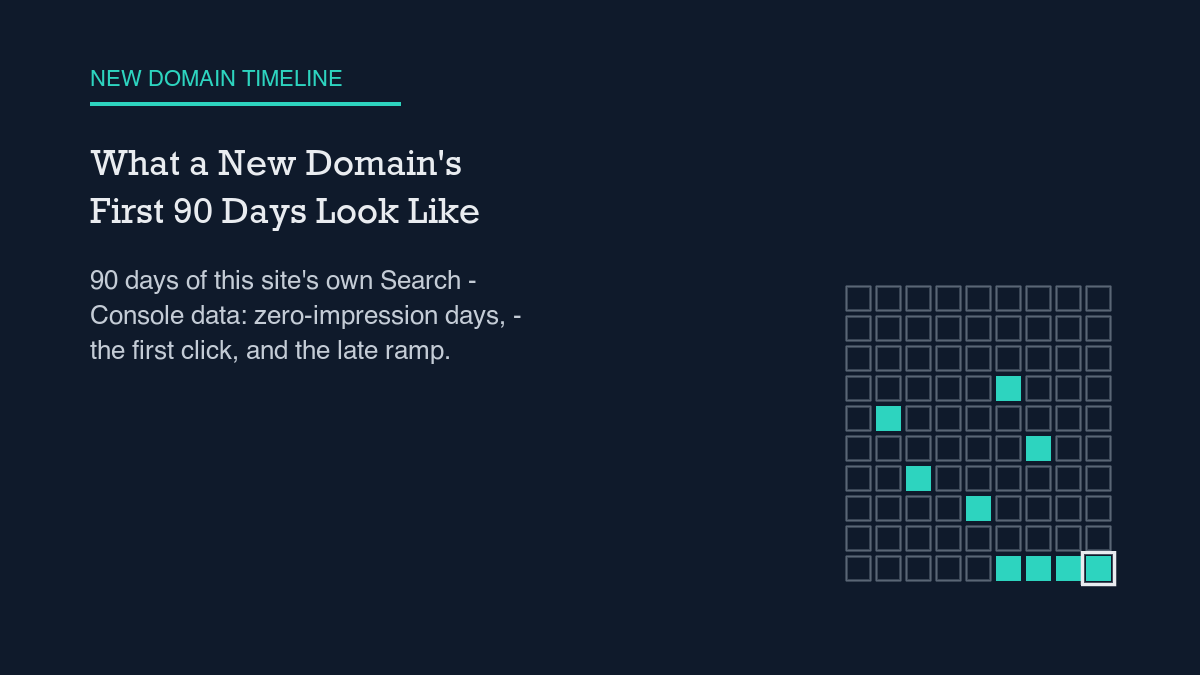
In this site’s own first 90 days of Search Console data, I logged 352 impressions, 2 clicks, and 39 days with zero visibility at all. The one jump worth calling a step change — impressions crossing 41 in a day — landed on day 88, two days before the window closed. That is what a new domain’s first 90 days actually looks like here. Your numbers will differ. The method for reading them honestly should not.
I already wrote about this site’s full 136-day Search Console history in How Long Does SEO Take? This post is narrower on purpose. I pulled only the first 90 days of that same window — 2026-05-31 through 2026-08-28 — because a reader asking “what happens in the first 90 days” shouldn’t have to squint at a 136-day chart and guess where day 90 falls. Below is the method I used, the real numbers from that window, and the parts of the data that would make me wrong.
The method, step by step
I pulled Search Console’s own by-date report for this domain, filtered to exactly 90 days, and did not smooth, average away, or discard any day — including the 39 days that returned nothing. The steps:
- Pick a fixed start date. I used the first day Search Console actually returned non-zero rows for this property (2026-05-31), not the calendar date the site launched — those two dates can differ, and conflating them inflates or deflates the apparent timeline.
- Pull clicks, impressions, and average position by date for exactly 90 days from that start.
- Record every zero-impression day as a zero, not a gap. A missing day in a chart looks different from a logged zero, and only one of those is honest.
- Find the first day with any impression, the first day with any click, and the first day impressions cross a threshold worth calling a “ramp” (I used 30/day, since this site’s daily counts before that point never got close).
- Check the last week inside the window separately from the whole-window average, because a 90-day average can hide a trend that only shows up at the edges.
That is the whole method. It does not require a paid tool beyond Search Console itself, and it produces a number set anyone can reproduce against their own property, which is the point: this is a reproducible method, not a promise about how your first 90 days will go.
This site’s real numbers, first 90 days only
Across the full 90 days: 2 clicks, 352 impressions, a 0.568% click-through rate, and a weighted average position of 41.14. Those are not strong numbers, and I am not presenting them as strong numbers. Here is where they came from day by day.
39 of the 90 days — 43.3% of the window — show zero impressions and zero clicks. That is not a rounding artifact; it is the majority pattern early on and it persists late, too: the last zero-impression day inside this window is 2026-08-22, only six days before the cutoff. A new domain can still post a dead day deep into its first 90.
The first impression showed up on day 24 (2026-06-23: 1 impression, position 10). The first click came 20 days after that, on day 44 (2026-07-13: 1 click, 1 impression, position 3). Only one other day in the entire 90-day window produced a click: 2026-07-17, at position 16. Two click-days out of ninety. Impressions without clicks is not an exception here; across this window, it is the default.
Impressions stayed noisy through the middle of the window — single digits to low double digits per day, with position swinging widely even on the better days. 2026-07-20 logged 12 impressions at position 75.4; four days later, 2026-07-24 logged 19 impressions at position 14. There is no steady climb up the rankings inside this window. Position moves unevenly even as cumulative impressions trend upward.
The one change worth calling a step change happened on day 88: 2026-08-26 logged 41 impressions at position 46.51, followed by 42 on 2026-08-27 and 38 on 2026-08-28 — the final three days of the window. The last 7 days inside this 90-day frame (2026-08-22 through 2026-08-28) total 131 impressions and zero clicks. Visibility climbed right at the edge of the window; conversion to a click did not follow in the same stretch.
The query-level picture tells the same story from a different angle. Across the top 25 queries in this window, every single one shows zero clicks. The highest-impression query was “seo agent” at 12 impressions and position 90.75 — nowhere near page one. No query in the top 25 carries enough share to call it a head term; visibility is spread thin across dozens of long-tail variants, which is itself part of why clicks stay rare even as impressions climb.
Reading these results honestly
Two clicks in 90 days is a small enough number that one more or one fewer click would move the click-through rate a lot in relative terms. I am not treating 0.568% CTR as a stable rate; with this few data points, it is barely a measurement at all. The same caution applies to the weighted average position of 41.14 — a single noisy high-impression day, like 2026-08-28’s position 65.5, can pull that average around more than a dozen quiet days would.
I also did not try to explain why 2026-08-26 was the day impressions crossed 41. I don’t have a verified cause — no specific published post, backlink, or algorithm change I can point to and confirm from a live source. The data shows the change in impressions. It does not show a cause, so this piece asserts none.
Search Console itself has a lag worth knowing before you run this method on your own property — see why Search Console data lags for what that means in practice. And before reporting any of these numbers upward, it’s worth deciding in advance which ones are even worth reporting; I cover that tradeoff in SEO KPIs worth reporting.
What would falsify this
This conclusion is wrong if, 60 days after this post publishes, its own URL shows zero Search Console impressions for any query containing “new domain,” “ranking,” or “timeline,” despite being indexed. That is a checkable claim against this exact page, not a vague promise, and I’ll know if it fails the same way I know the numbers above: by pulling the live report again, not by assuming.
If you want to run this same 90-day method on your own property, the steps above don’t need anything beyond Search Console access and a fixed start date. I’d rather you reproduce the method and get a different answer than take my 90 days as a forecast of yours. For the longer version of this same site’s story, past day 90, see the full 136-day timeline linked above. For a more structured take on running this kind of check on a schedule rather than once, see running a 30-day SEO experiment.
Leave a Reply