Blog

  • Does schema markup increase AI citations? What the data shows

    In short: In the largest controlled test to date, adding schema markup produced no citation gains in AI engines: statistically insignificant moves for ChatGPT and Google AI Mode, and a significant decline for Google AI Overviews. Every page studied was already heavily cited, so this measures marginal returns for established pages, not first-time citation. Schema still earns Google rich results, so keep it – just do not expect it to buy AI citations.

    “Add schema markup to get cited by AI” is one of the most repeated pieces of AEO advice. It is also, on the best available evidence, wrong. The confusion is understandable: pages with schema do tend to get cited more often. But that correlation tracks overall site quality, not the markup itself, and when you isolate the markup in a controlled test, the effect disappears.

    What the study actually did

    Ahrefs ran a difference-in-differences test: they took 1,885 pages that added JSON-LD structured data and compared their change in AI citations against 4,000 matched control pages that did not. The results were mixed and none supported the “schema wins citations” story: ChatGPT and Google AI Mode moved a couple of percentage points, both statistically insignificant, while Google AI Overviews showed a statistically significant decline of about 4.6% – the opposite of the hypothesis. The design matters here: by matching controls and measuring the change around the schema addition, the test separates the markup’s effect from the general “better sites have schema and also get cited more” confound that makes raw correlations misleading.

    One caveat cuts both ways and is worth stating plainly. Every page in the sample was already heavily cited before the test – 100 or more AI Overview citations each. So the study measures whether schema lifts pages that are already winning, not whether it helps a brand-new page get cited for the first time. That second question is still open. What the evidence rules out is treating schema as a reliable lever for more AI citations on established content.

    Why this result is plausible

    Large language models are trained on and retrieve from rendered text, not primarily from a page’s JSON-LD block. The signals that do move AI citations are about the visible content. A controlled experiment across 10,000 queries, the Generative Engine Optimization paper (KDD 2024), found that named quotes, sourced statistics, and inline citations produced double-digit visibility gains in AI answers. Those live in the prose a model reads, not in markup a model largely ignores.

    So should you still add schema?

    Yes – for the reason schema has always been worth adding. Structured data drives Google rich results: review stars, FAQ accordions, breadcrumb trails, sitelinks. That value is well-established and independent of anything to do with AI citations. The honest framing is simple: ship schema for rich results, and do not count it as an AI-visibility tactic. Anyone selling structured data as the way to get cited by ChatGPT is overstating a case the controlled evidence does not support.

    This is the pattern worth internalizing across AEO advice: separate what is measured from what is repeated. We keep a running evidence ranking that labels each tactic strong, moderate, or weak with the study behind it, precisely so schema-style myths do not become load-bearing in a content strategy.

    Frequently asked questions

    Does schema markup help SEO at all?

    Yes, for rich results in traditional Google search – star ratings, FAQ accordions, breadcrumbs, and similar enhancements. That benefit is well-established. The finding here is narrower: schema does not measurably increase citations in AI answer engines.

    If schema does not help AI citations, what does?

    Named statistics with sources, expert quotes, inline citations, server-rendered content that AI crawlers can actually read, and freshness. These are the tactics with controlled evidence behind them.

    Should I remove schema from my pages?

    No. Keep it for Google rich results. Just do not expect it to influence whether AI engines cite you, and do not prioritize it over the content-level signals that do.


    Written by Shivaa Tripathi, who has spent 12+ years in B2B marketing and builds organic-os, an open-source organic-growth plugin. Sources are linked inline; the full evidence ranking is on the What works page.

  • WordPress SEO Automation: What Plugins Still Can’t Do

    WordPress SEO automation today means plugins: they generate meta tags, sitemaps, and schema markup without you touching a setting. What they don’t do is decide which fix matters on your site, write the change, or take responsibility for shipping it. That gap is what this piece covers, using my own product’s gated-apply loop as one worked example.

    What WordPress SEO plugins already automate well

    Rank Math, AIOSEO, and similar plugins have gotten genuinely good at the mechanical layer. Between them, the category now routinely handles: XML sitemap generation and resubmission, dozens of pre-defined schema types (Rank Math’s free tier alone ships 18-20+), automatic image alt-tag insertion, redirect and 404 monitoring, and AI-assisted internal-link suggestions. None of this requires a human to click through page by page – it runs on autopilot once configured, and by most 2026 comparisons the major plugins now cover this baseline about equally well.

    Where it breaks down is scale and judgment. As one AI-driven SEO platform puts it, describing the ceiling of the plugin model: “Your SEO plugin helps with individual pages but you’re still updating meta tags one by one. 1,000 blog posts means 1,000 separate edits. Plugins recommend but don’t deploy at scale” (Alli AI). Even at small scale, “recommend” is doing the heavy lifting in that sentence – a plugin surfaces a suggestion; it does not decide the suggestion is worth acting on.

    The gap: judgment calls plugins don’t make

    A plugin’s rule engine can tell you a title is too long. It cannot tell you this specific title is worth rewriting today, on this page, given what else is competing for your attention. Three examples from running my own site through this exact loop:

    • Should this title actually change? I run a small onpage-fix proposal right now to override two auto-templated post titles that were truncating in search results. The plugin flagged the truncation; deciding these two posts specifically were worth a manual override, and drafting the replacement copy, was not something the plugin did – it was a proposal a human still has to approve.
    • Does this sitemap error actually need fixing, and can the automation even fix it? A recent fix on this same site applied cleanly at the content level, but the sitemap cache purge needed admin-level WordPress permissions the automation’s own account didn’t have – a wall you only find by hitting it, not something the plugin’s settings screen warns you about in advance.
    • Is this the right page to merge, redirect, or leave alone? No plugin I’m aware of makes that call on its own; it flags candidates and leaves the decision to a person.

    None of this is a knock on the plugins. It’s a description of where their job ends and a person’s begins – the same boundary between “tool” and “agent” that shows up in what an AI SEO agent actually is.

    How a gated, human-approved loop works mechanically on WordPress

    organic-os, the agent I build, is one working example of closing that gap without removing the human from it. The mechanism, in its own words: “Every write requires a recorded approval: who decided, when, through which channel. A hand-edited status still fails the gate” (organic-os). Concretely, on a WordPress site that looks like:

    1. Observe – pull performance data (search console, analytics) and read the site itself.
    2. Propose – draft a specific, sourced fix or content brief, not a generic suggestion.
    3. Approve – a person reviews it in a channel they already check (this site uses Telegram) and approves or rejects it.
    4. Apply – only after a recorded approval does anything write to WordPress, via its REST API.
    5. Verify – the change is read back and checked live, not assumed to have worked.

    The onsite module that does the applying “audits any public page with zero credentials,” and “with WordPress connected, applies approved fixes: verified after every write, rollback-capable” (organic-os). That verify-after-write step is what turns “the automation ran” into “the automation ran correctly” – a distinction plugin dashboards don’t always surface either.

    What this doesn’t replace

    A real SEO plugin is still required for the mechanical layer described above – schema, sitemaps, meta templates. Nothing here proposes replacing Rank Math or AIOSEO; a gated approval loop still needs something to write the meta fields into. This also doesn’t guarantee a ranking outcome. No approval workflow, however careful, controls what a search engine or an AI answer engine decides to do with a page afterward.

    Labeling the evidence in this piece

    The Alli AI quote above is a direct quote from a live, fetched source, cited inline. The description of what Rank Math and AIOSEO automate is a paraphrase of aggregated 2026 comparison coverage, not a verbatim quote from any single vendor page – labeled as such because it wasn’t independently re-verified line by line against each vendor’s own feature documentation. The organic-os architecture quotes and the three worked examples (title override, sitemap permissions, page-merge judgment) are first-party claims about my own product and my own site’s operational history, not independent third-party verification.

  • AI SEO agents: what they are and how autonomous organic growth works

    In short: An AI SEO agent is software that runs the search-optimization loop on your site continuously – observing performance, proposing changes, applying approved ones, and measuring outcomes – instead of producing a one-time audit. The useful ones keep a human in the approval path and remember what worked, so the site improves across runs rather than resetting each session.

    Search-optimization tooling has spent a decade producing reports. You run an audit, it lists 200 issues, you fix a few, and the report is stale the moment your site or the SERP changes. An AI SEO agent is a different shape of tool: it does not stop at the report. It runs the loop – observe, decide, apply, verify, learn – on a schedule, and carries what it learned into the next run.

    This matters more now than it did two years ago, because search itself has split. Buyers still type queries into Google, but they also ask ChatGPT, Perplexity, and Google’s AI Overviews, and those engines cite sources by different rules. Optimizing for both at once, continuously, is more work than a person can do by hand and more judgment than a fire-and-forget script can be trusted with. That gap is what agents fill.

    What separates an agent from an audit tool

    Three properties distinguish an AI SEO agent from a traditional audit suite:

    • It runs on a schedule and remembers. A point-in-time audit is blind to what it recommended last month and whether it worked. An agent keeps a persistent record – a per-site playbook – so a change that measurably helped becomes a reusable pattern and a change that did nothing gets retired.
    • It can act, not just advise. An audit hands you a list. An agent can apply the fix – update a title tag, publish a draft – through your CMS, then verify the change actually landed on the live page.
    • It measures outcomes against what it shipped. Because it remembers what it changed and when, it can attribute a movement in clicks or citations to a specific edit, rather than guessing.

    None of this requires the agent to be autonomous in the reckless sense. The trustworthy design keeps a person in the approval path, which we come back to below.

    The loop, step by step

    Observe. The agent pulls signals from the sources you already own – Google Analytics, Search Console, AI-citation checks, competitor content – on a daily or weekly cadence. Nothing is scraped; everything comes from APIs you authorized.

    Decide. Signals become concrete work items, each with the reasoning behind it stated plainly, so a human can judge whether it is worth doing.

    Approve. A person accepts or rejects each proposed change. This is the gate that makes the rest safe.

    Apply. Approved changes are written to the site, typically through the CMS API.

    Verify. The agent re-reads the live page to confirm the change took effect, and keeps the ability to roll it back.

    Learn. Weeks later, the outcome is measured against the specific change, and the result is written into the playbook. The next run starts smarter.

    What an AI SEO agent actually optimizes for in 2026

    The best-supported tactics are not the ones most SEO content repeats. A controlled experiment across 10,000 queries, published as the Generative Engine Optimization paper at KDD 2024, found that adding named expert quotes lifted a page’s visibility in AI-generated answers by 40.9%, statistics paired with named sources by 30.6%, and inline citations to authoritative references by 27.5%. A capable agent bakes those into how it drafts and edits, rather than chasing keyword density.

    Two more findings shape a modern agent’s checklist. Vercel and MERJ, analyzing more than a billion AI-crawler requests, found that the major AI crawlers do not execute JavaScript – so a client-side-only page is invisible to them. And Seer Interactive found that 87% of SearchGPT citations matched Bing’s top organic results, which means Bing indexation, not only Google’s, is now load-bearing for AI visibility. An agent worth its name checks both.

    Why the human-in-the-loop design matters

    The obvious fear with an agent that can edit your site is that it will make a bad change while you sleep. The answer is not to trust the model’s judgment; it is to make unapproved changes impossible by construction. In a well-built agent, every write is gated on a recorded approval – who decided, when, through which channel – and the gate is enforced in code, not by convention. A change with no matching approval record simply cannot be applied.

    This is also where honesty about limits belongs. Google’s own guidance treats mass-produced, low-value pages as spam under its scaled content abuse policy. An agent that lets you dump fifty thin articles overnight is not helping you; it is helping you get penalized. The gate, and the human on the other side of it, is what keeps volume honest.

    How to evaluate one

    • Does it run on a schedule and keep memory across runs, or is it a dressed-up one-time audit?
    • Can you verify its safety claims yourself, or are you asked to take them on faith?
    • Does it label weak tactics honestly? Adding schema markup, for instance, shows no measured lift in AI citations in controlled testing – a tool that sells it as an AI-visibility tactic is overselling.
    • Where does your data live, and does the tool phone home?

    organic-os is one open-source implementation of this pattern, built as a free Claude plugin – you can read exactly how its evidence ranking and live results hold up, or try it against your own site in about ten minutes. But the questions above apply to any agent you evaluate.

    Frequently asked questions

    Is an AI SEO agent the same as an AI writing tool?

    No. A writing tool produces a draft. An agent runs the whole loop – it observes performance, decides what to change, applies approved changes, and measures the result. Drafting is one step inside that loop, not the whole thing.

    Will an AI SEO agent get my site penalized by Google?

    It can, if it encourages mass-producing thin content, which Google treats as spam. A well-designed agent keeps a human approving each change and holds publishing to a believable cadence, which is what keeps the work within Google’s guidelines.

    Does an AI SEO agent replace an SEO specialist?

    No. It removes the repetitive observe-and-measure work and keeps the specialist in the decision seat. The person still approves the strategy; the agent handles the continuous execution and memory.

    What does an AI SEO agent need access to?

    Typically read access to your analytics and Search Console, and – only if you want it to apply changes – a scoped, revocable credential to your CMS. A good agent states which credentials it found and never assumes one exists.


    Written by Shivaa Tripathi, who has spent 12+ years in B2B marketing and builds organic-os, an open-source organic-growth plugin. Sources are linked inline; the site’s full evidence ranking, with the studies behind each claim, is on the What works page.

  • organic-os v0.1: the loop is the product

    organic-os v0.1: the loop is the product

    TL;DR: organic-os v0.1 is out: a free, MIT-licensed Claude plugin that runs a full organic growth loop on your website. It observes GA4, GSC, and AI-answer citations, proposes work with auditable reasoning, gates every mutation on a recorded human approval, applies and verifies changes on WordPress, and learns from measured outcomes. Install it with two commands; audit any site with zero credentials.

    Point-in-time SEO audit tools already exist and are good. What none of them do is run every day and remember what happened last time. organic-os is the layer underneath: daily signals, gated execution on your own site, outcome measurement against what actually shipped, and a per-site playbook that compounds entry by entry as changes are confirmed to work or not.

    What is in v0.1

    • A file-contract core: briefs and proposals with a status lifecycle, approval gates checked in code (require_approved, require_approval_lineage), an append-only skillbook with evidence tags, and channel-neutral approval adapters: in-session, Telegram, Slack or email, and pull-request merge.
    • head-of-organic: a setup interview, orchestrator, daily, weekly, and monthly routines, eight specialist agents, tiered Google Ads keyword intelligence, AI-citation tracking, competitor intelligence, and a weekly reflector.
    • onsite-optimizer: a WordPress REST client over Application Passwords, credential-free audits of any public page, and gated, verified, rollback-capable writes.
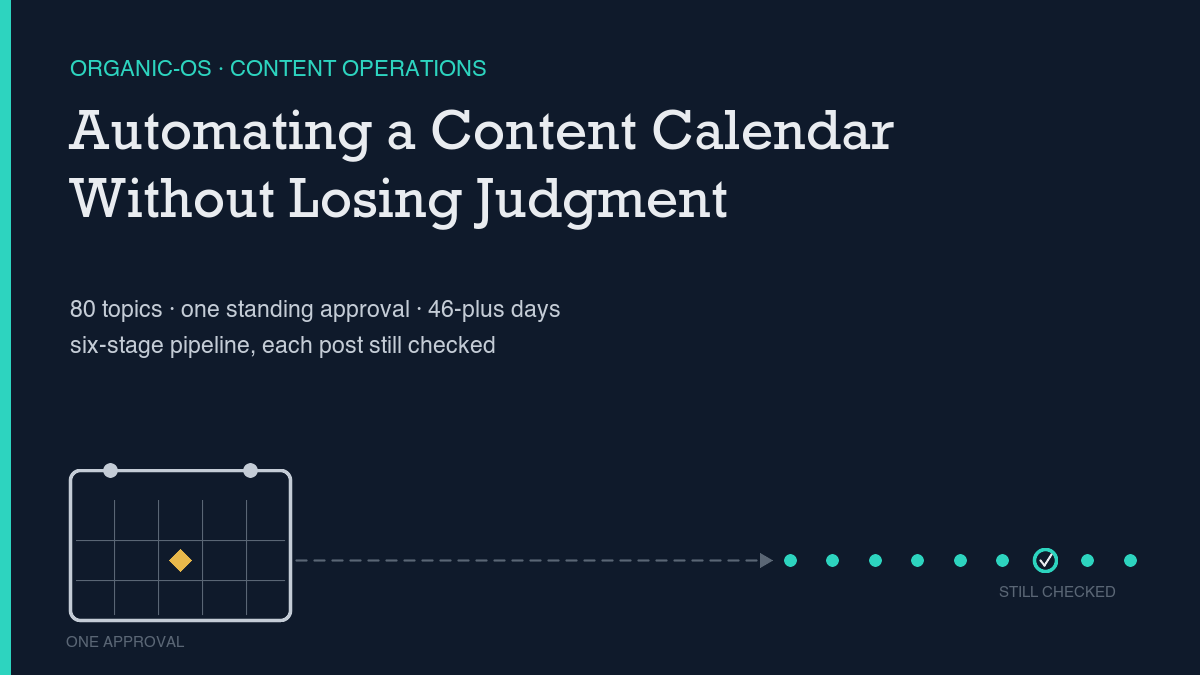
    • content-engine: a six-stage pipeline from approved brief to publish-ready draft, with an optional featured-image step.
    • v0.1.1, same day: Telegram offset persistence, a sites registry with mode-aware setup and a guided reset, README v2, CONTRIBUTING with an enforced data boundary, and the public roadmap.

    Verified inventory at release: 18 skills, 18 slash commands, 14 specialist agents, 52 passing tests.

    What makes it different

    Three design decisions carry the project. First, mutation is impossible without a recorded approval; the gate is enforced in code, and a hand-edited status without an approval entry still fails. Second, there is no telemetry and no scraping; your site’s data lives in a brain repo you own. Third, the docs rank every AEO and GEO tactic by evidence strength and say plainly when a popular tactic, like schema-for-AI-citations or llms.txt, is not supported by controlled studies. The full ranked table is public.

    This site is the test

    organicos.shivaatripathi.com is a live WordPress install that organic-os will operate in public. Every change it ships here, and every outcome, lands on the proof page, failures included.

    Get started

    /plugin marketplace add shalintripathi/organic-os
    /plugin install organic-os@organic-os

    The quickstart takes about 10 minutes with zero credentials. If you try it and something breaks, an issue with a repro is the most useful thing you can send. If it works for you, a star helps other people find it.

  • Why demand gen teams should report on pipeline, not MQLs

    MQL counts are easy to grow and easy to game. Lower the scoring threshold, run a broader webinar, buy a content syndication list, and the number goes up while revenue stays flat.

    Pipeline is harder to fake. A demand gen team that reports on qualified pipeline created per quarter has to care about what sales accepts, what converts, and what closes. That changes channel mix decisions. Paid social that produces cheap leads but no opportunities gets cut. A niche industry newsletter that produces five leads a month, three of which become deals, gets doubled.

    The transition is uncomfortable for one or two quarters because the numbers get smaller. Make the case with a cohort view: show the last four quarters of MQLs, their opportunity conversion rate, and the pipeline they actually produced. Then propose targets on the output, not the input.

  • A practical intro to answer engine optimization for B2B SaaS

    AI assistants now answer a meaningful share of the questions your buyers used to type into Google. Answer engine optimization is the practice of making your content the source those assistants cite.

    The fundamentals overlap with classic SEO: server-rendered pages, clear headings, one question answered per section. What changes is the unit of consumption. An assistant does not send a visitor to your page; it extracts a passage. So each section needs to stand alone: a direct answer in the first sentence, then evidence, then a source-worthy detail like a number or a named method.

    Start by checking whether AI crawlers can fetch your site at all. Then rewrite your top ten organic pages so that every H2 could be quoted verbatim as an answer. Measure referrals from assistant domains in your analytics tool monthly.

  • How to structure a B2B SaaS keyword portfolio

    Treat keywords like a portfolio manager treats positions: grouped by intent, weighted by expected return, reviewed on a schedule.

    Three buckets cover most SaaS businesses. Category terms describe the software category and carry buying intent. Problem terms describe the pain before the buyer knows the category exists. Comparison terms include competitor names and alternatives queries, and convert best of all.

    Most teams overinvest in category terms because they are obvious, and underinvest in problem terms because they require actually talking to customers. The fix is mechanical: for every category page, commission two problem-led essays that link to it. Review rankings monthly, but review the portfolio itself quarterly. Kill pages that have not moved in two quarters and reallocate the effort.

  • Attribution models are maps, not territory

    Every attribution model is wrong in a specific, known direction. First touch overvalues top-of-funnel content. Last touch overvalues brand search and direct. Position-based models split the difference with arbitrary weights.

    The mistake is not using a flawed model. The mistake is forgetting which direction it is flawed in when you make budget decisions. If your model is last touch and brand search looks unbeatable, that is the map talking, not the territory.

    A practical defense: run two models side by side and only act on decisions where they agree. When they disagree, that disagreement is the interesting signal. It usually points at a channel doing early-stage work your reporting cannot see. Self-reported attribution, one open text field on the demo form asking how the buyer heard of you, fills that gap more honestly than any model.

  • The case for fewer, deeper case studies

    Most B2B SaaS case study libraries are wide and shallow: twenty logos, each with a three-paragraph page and a pull quote. Buyers skim one, learn nothing they could not have guessed, and leave.

    The alternative is depth. One case study per segment, written like a story: the state of the world before, the specific rollout including what went wrong, and the numbers after, with enough context to be believable. A 2,000 word case study that names the integration that broke and the workaround that fixed it earns trust that no logo wall can.

    Depth also compounds in search. A detailed case study answers long-tail questions buyers actually ask, gets cited by AI assistants because it contains specifics, and gives sales a document worth sending. Write one per quarter. Retire the shallow ones as the deep ones ship.