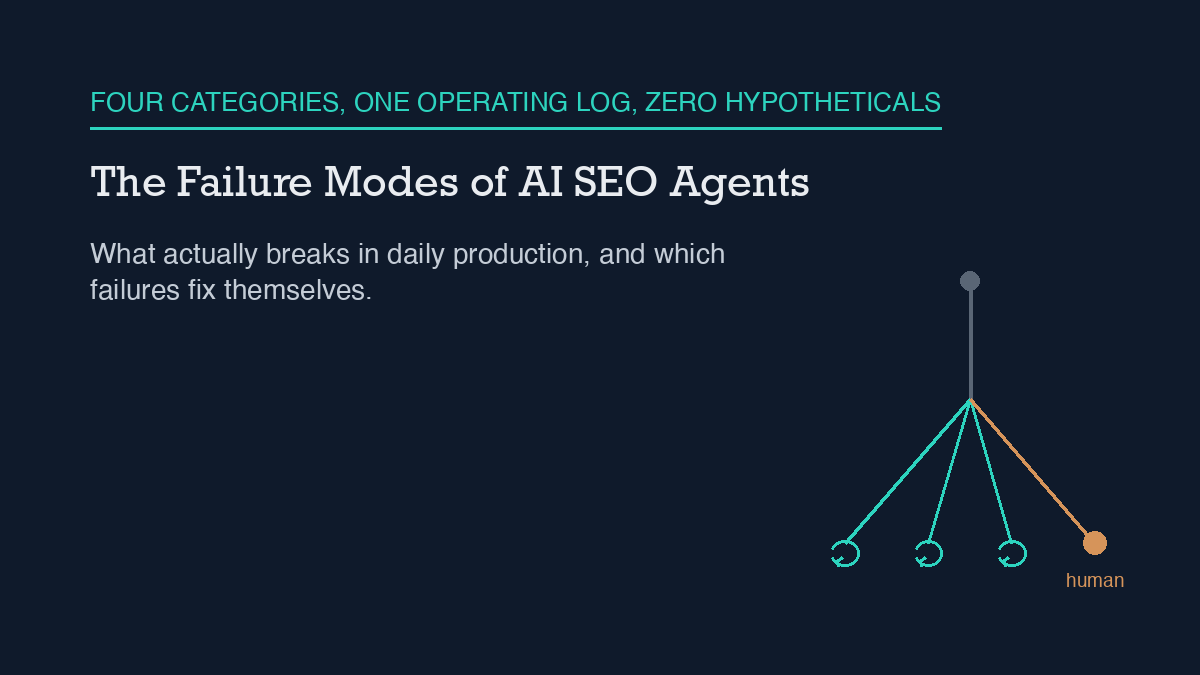
AI SEO agent failure modes rarely look like crashes. This site’s own agent, organic-os, publishes roughly one post a day against a real WordPress install with a public decision log, and its actual failures fall into four repeatable categories: the environment silently blocks a request, a verified fix gets reverted by something outside the agent’s control, an internal delegation step fails and has to be worked around, and a false positive looks like content drift when nothing actually changed. None of the four are dramatic. All four would go unnoticed without a specific, repeatable check built to catch that exact category.
This is not a general framework borrowed from agent-safety research. It is a direct read of this site’s own operating history – the append-only decision log and the curated skillbook of lessons that log has produced – covering incidents from July through September 2026. Each failure mode below is named from something that actually happened here, not a hypothetical.
How it actually works, concretely
organic-os runs a daily pipeline: research a brief, draft an article in the site’s voice, optimize the title and meta, run an evidence-contract QA pass, do an editor pass, then publish through the WordPress REST API using an editor-scoped application password. Every step writes to a file-based brain – briefs, decisions, a skillbook of curated lessons – rather than a database, so the entire operating history is inspectable as plain text. That inspectability is what makes the four failure modes below identifiable at all; none of them were caught by the pipeline congratulating itself on a successful run.
What this site does, and what it refuses to do
The pipeline will not publish on an incomplete approval record – a missing decision, actor, or timestamp field stops the gate outright rather than being treated as an implicit yes, as covered in more depth in this site’s piece on why an SEO automation needs an audit trail. It will not fabricate a statistic or a source; every claim in this article traces to a specific, dated entry in this site’s own skillbook. And it will not silently retry past a failure and call the result clean – each category below exists in the skillbook precisely because something was caught and documented, not smoothed over.
Failure modes observed in production
Four distinct categories show up repeatedly enough in this site’s own log to be worth naming individually, because each one is invisible to a different kind of check.
The environment blocks the agent outright, without saying so clearly. This site sits behind Cloudflare, and a plain Python stdlib HTTP client with no custom User-Agent header gets intermittently blocked with an HTTP 403 and a Cloudflare error code, rather than a normal auth failure. It was confirmed blocked on one date via two independent code paths in the same pipeline, then seen to pass cleanly the very next day with no code change – the trigger is intermittent, not a hard rule. The fix is a browser-style User-Agent header on every request; once a separate internal-link crawler adopted that header as a precaution, it completed a 72-page crawl with zero blocks. The failure mode here is not “the agent got the wrong answer.” It is “the agent got no answer at all, disguised as a normal-looking error.”
A verified fix reverts on its own, from outside the agent’s control. On one occasion, six pages and one post that had each received a verified, applied fix were all reverted within the same four-second window, roughly 34 minutes after the fix was confirmed live. Nothing in the pipeline’s own log caused it. It was caught only because a second, unrelated audit happened to run later the same day and noticed the fix was gone. A pipeline that verifies a fix once, at apply time, and never checks again has no way to see this class of failure – the content silently drifts back to its prior state and nothing downstream flags it unless something re-checks on a shorter cycle than the next scheduled audit.
An internal delegation step fails, and the agent has to fall back to doing the work directly. This pipeline occasionally delegates a sub-task – a specialized research or analytics step – to a separate dispatch mechanism. On at least one recorded run, that dispatch failed outright with a repeated error, in a session where every other part of the pipeline was working normally. The failure did not corrupt the output; it simply meant the delegated step never ran. The fix each time has been the same: fall back to replicating the sub-task’s documented method directly with the same underlying tools it would have used, rather than skipping the step or guessing at its result. That fallback has produced correct, independently verifiable output every time it has been tried across several separate weekly runs – but only because the failure was treated as a hard stop requiring a substitute, not as a step to quietly skip.
Something that looks exactly like drift turns out to be a rendering artifact, not a real change. One WordPress post’s title field was observed flip-flopping between a clean apostrophe and an HTML-entity-encoded apostrophe across four consecutive daily checks – the kind of pattern that would normally trigger a content-drift alert. But the post’s actual last-modified timestamp never changed across any of those checks, which means the underlying content was never edited. The likely explanation is that different API endpoints return different rendering passes of the same stored text, and which one a given check happens to call determines what it sees. This is arguably the most important failure mode of the four, because it is a false positive: a check that fires correctly on the surface but points at the wrong root cause, and would waste real investigation time chasing content drift that never happened.
When a human must take over
Each of the four categories above resolves differently, and that difference is the actual thing worth evaluating in any AI SEO agent, not just whether it publishes clean copy. The Cloudflare block and the delegation failure are both things the pipeline can detect and route around itself, by adjusting a request header or substituting a direct method for a failed one. The silent revert and the title-rendering artifact are different: the revert can only be caught by re-checking on a shorter cycle than the next scheduled audit, and closing that gap for good would need a change to how often verification runs, not just a smarter one-time check. The rendering artifact needs a person to eventually decide it really is benign, by comparing both API endpoints back-to-back – a judgment call the pipeline has documented but not fully automated. A useful guardrail set for an SEO agent should make that distinction explicit: which failures the system repairs on its own, and which ones it can only flag for a person to close out. The publishing credential itself reinforces this boundary elsewhere in the pipeline too – it is scoped to editor-level actions and, as covered in this site’s two-week evaluation framework, deliberately cannot fix everything it is able to detect.
None of this is a case against running an AI SEO agent in production. It is a case for logging failures specifically enough to sort them into categories like the four above, rather than lumping every anomaly into one undifferentiated “something went wrong” bucket – because the fix, and who has to apply it, is different for each one. Anyone evaluating what an AI SEO agent can and cannot do on its own should ask to see this kind of breakdown directly, not a summary that treats every incident as equally automatic to resolve.
Frequently asked questions
What are the most common AI SEO agent failure modes?
Based on this site’s own operating history, four categories recur: the environment silently blocking a request (such as a Cloudflare 403 with no clear cause), a verified fix reverting from outside the agent’s control, an internal delegation or sub-task step failing and needing a manual fallback, and a false positive where a rendering artifact looks like content drift but nothing actually changed.
Can an AI SEO agent catch its own failures?
Some, not all. On this site, environment blocks and delegation failures can be detected and routed around automatically – by adjusting a request header or substituting a direct method for a failed one. Silent reverts and rendering-artifact false positives are harder: they need a shorter re-check cycle or a person comparing two data sources back-to-back before they can be confidently closed out.
Why did a WordPress post’s title appear to change without being edited?
On this site, one post’s title flip-flopped between a clean apostrophe and an HTML-entity form across several daily checks, while its last-modified timestamp never changed – pointing to different API endpoints returning different rendering passes of the same stored text, rather than an actual content edit.
Does documenting these failures mean the pipeline is unreliable?
No – it means the pipeline has checks specific enough to catch and categorize each failure type in the first place. A system that reports zero incidents is more likely under-checking than perfectly reliable; the goal is sorting failures into what the agent can fix itself versus what needs a person, not eliminating every incident from the log.
Leave a Reply