Category: Evidence

  • Google AI Mode: What Changes for Publishers

    Google AI Mode: What Changes for Publishers

    Google says there is nothing special to do for AI Mode. A page becomes eligible for an AI Mode citation the same way it becomes eligible for a regular search snippet: get indexed, meet Google’s normal Search technical requirements, and rank well against the query. No new file, no new markup, and no separate submission process exists. The parts that are genuinely new are how AI Mode assembles an answer from many pages at once, and how much of that answer, according to one independent study, now points back to Google’s own properties.

    What Google’s documentation actually says

    I went straight to Google’s own developer documentation rather than working from secondhand summaries, because this is exactly the kind of topic where speculation spreads faster than the source material. Two pages carry the load: the AI features and your website page, and the AI optimization guide.

    The first page states plainly that there are no additional requirements to appear in AI Overviews or AI Mode, and no other special optimizations are necessary. Sites do not need to create new machine-readable files, AI-specific text files, or new markup to show up in these features. The eligibility bar is the same one Search has always used: to be shown as a supporting link in AI Overviews or AI Mode, a page must be indexed and eligible to appear in Google Search with a snippet, meeting the same technical requirements as regular Search results.

    The second page makes the strategic framing explicit. Google states that the best practices for SEO continue to be relevant because its generative AI features are rooted in its core Search ranking and quality systems. From Google’s stated perspective, optimizing for generative AI search is optimizing for the search experience, not a separate discipline. That is a direct claim from the documentation, not my interpretation of it, and it is worth taking at face value: this isn’t a new channel with its own rulebook, it’s the same ranking system feeding a different output format.

    How AI Mode decides what to cite

    The documentation also explains the retrieval mechanism behind these answers. Google defines retrieval-augmented generation, which it also calls grounding, as a technique used to improve the quality, accuracy, and freshness of AI responses by relying on core Search ranking systems to pull relevant, up-to-date pages from the Search index. In plain terms: the model doesn’t invent citations, it queries the same index that powers regular Search, then writes around what it retrieves.

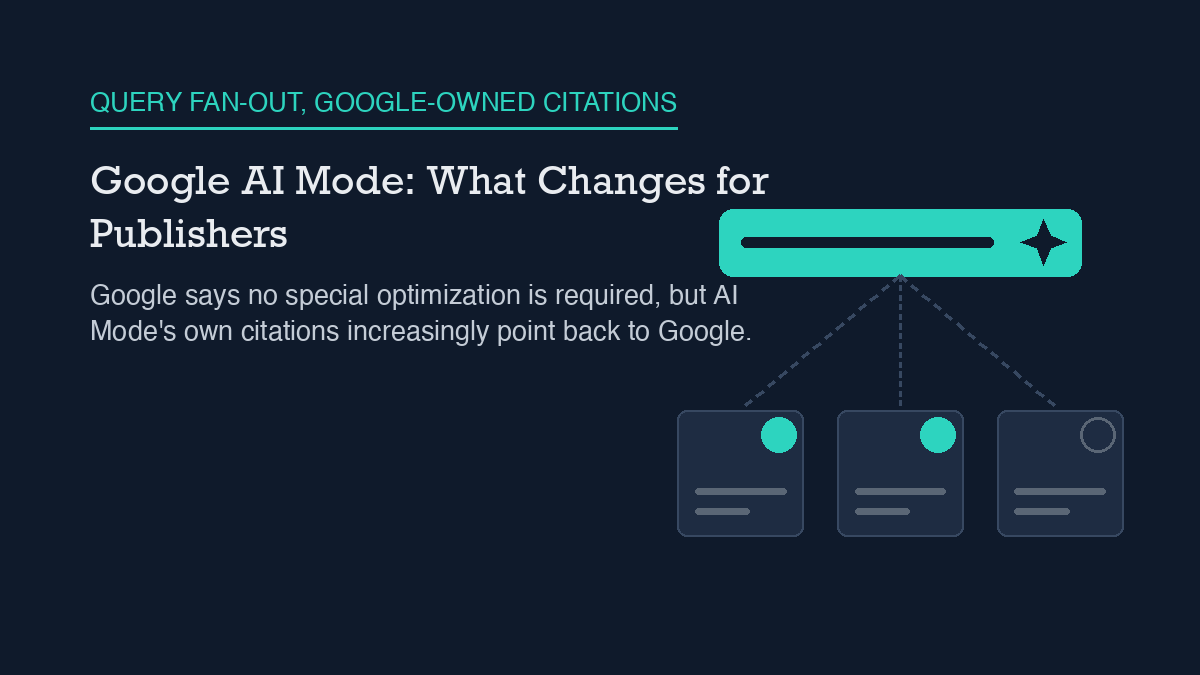
    Both AI Overviews and AI Mode may use a technique Google calls query fan-out, where a single user question is expanded into multiple related searches behind the scenes. Because more advanced models can identify a wider set of supporting pages this way, Google says the result can be a broader and more diverse set of helpful links than a traditional results page would surface for the same query. Google positions AI Overviews as a way to get the gist of a complicated topic quickly, and describes AI Mode as particularly useful for queries that need further exploration, reasoning, or comparison across several options. If that framing holds, comparison-heavy and multi-part questions are where fan-out retrieval does the most visible work, which is one reason this topic overlaps so directly with how I think about GEO, SEO, and AEO as related but distinct disciplines.

    What independent research adds, and where it disagrees

    Documentation tells you what a system is designed to do. It doesn’t tell you what it actually does at scale, so I looked for independent measurement rather than stopping at the official page. An SE Ranking analysis dated February 2026, sampling 68,313 keywords across 20 industries and covering more than 1.3 million AI Mode citations, found that google.com itself was the single most-cited domain in AI Mode answers, at 17.42% of all citations. That is up from 5.7% in June 2025, roughly a tripling over that period.

    The breakdown inside that Google-to-Google share is specific enough to be useful. Of citations pointing back to Google properties, 59% went to traditional Google Search results pages, 36.1% to Google Business Profiles, 1.7% to Google Support, and 0.1% to Google Flights. Once YouTube is included alongside those properties, Google-controlled domains accounted for roughly 20% of all AI Mode citation sources in that sample. I want to label the strength of this evidence honestly: it is one independent dataset from one vendor, not a Google-published figure, and it describes a specific sample window rather than the entire live system. It is directional evidence, not a guarantee about how any individual query will resolve.

    I looked for a second study to corroborate the tripling figure and did not find one I could independently fetch and confirm during this research pass, so I’m reporting the SE Ranking numbers as a single, clearly sourced data point rather than as an established industry consensus. If Google’s own properties are absorbing a growing share of citations, particularly through Business Profiles and Search itself, that has a practical implication worth sitting with: a meaningful slice of AI Mode’s supporting links may not be competitive real estate for an independent publisher at all, regardless of how well the publisher’s page is optimized.

    A practical checklist

    Given what’s confirmed above, here’s what I’d actually prioritize, in order:

    • Confirm the page is indexed and returns a normal snippet in regular Google Search first. AI Mode eligibility is gated on ordinary Search eligibility, not a separate check.
    • Skip building an AI-specific text file or a new markup format for AI Mode specifically. The documentation states none is required, and inventing one wastes engineering time that could go toward normal Search fundamentals.
    • Treat schema markup as a normal Search quality signal, not an AI Mode shortcut. I’ve covered the evidence on this directly in whether schema markup actually helps AI citations, and the conclusion there is consistent with what Google’s AI Mode documentation implies: markup helps machines understand a page, it does not buy placement.
    • For comparison-style or multi-part queries in your niche, structure the page so a single section directly and completely answers one sub-question. Query fan-out rewards pages that answer a narrow slice cleanly, rather than pages that gesture at many topics at once.
    • Watch how much of the answer space in your query set is already occupied by Google-owned properties before assuming a ranking problem. If Business Profiles or Google Search results are absorbing most citations for a given query cluster, better content on your own domain may not close that gap.
    • Keep working the fundamentals shared across every AI answer surface. The overlap between AI Mode and the practices covered in how ChatGPT search sourcing works and how Perplexity’s sourcing differs is large: indexability, clear single-topic pages, and demonstrable expertise show up as prerequisites across all three systems, even though each one retrieves and cites differently underneath.

    What this site hasn’t measured yet

    I want to be direct about a gap rather than paper over it. This site does not have a citation-tracking pipeline connected for Google AI Mode specifically, and no measurement was taken as part of writing this piece. I am not going to state a citation count, verified or otherwise, because none was actually checked. That absence is itself useful information: if you’re deciding whether to invest in AI Mode citation tracking, the honest starting point is that most independent sites, including this one, do not yet have a clean way to see it. The SE Ranking figures above are the closest thing to hard data cited here, and they describe an industry sample, not this domain. Anything more specific than that would be a guess dressed up as an answer, and this site’s whole approach is built on not doing that.
    Shivaa Tripathi runs organic-os, an autonomous SEO operator that researches, drafts, and publishes with human oversight at every approval gate.

  • Perplexity SEO: How Its Sourcing Differs

    Perplexity SEO: How Its Sourcing Differs

    Perplexity publishes detailed documentation about what its crawlers do: PerplexityBot indexes pages for search results, and a separate fetcher called Perplexity-User retrieves a page only when a user asks a direct question about it. What Perplexity does not document is how it ranks the pages it retrieves – its Search API guide describes filtering and content controls, not a ranking method. Independent evidence adds a live, unresolved dispute on top of that documentation gap: Cloudflare says Perplexity crawled disallowed sites using an undeclared, browser-mimicking identity in 2025, and Perplexity has publicly rejected that framing. On this site, referrals from perplexity.ai have been zero in every check I’ve run so far, and I’m reporting that number as it stands rather than waiting for a better one.

    What Perplexity’s documentation actually says

    Start with the part Perplexity does explain. Its Search API documentation describes an endpoint that returns real-time, ranked web results as structured data, and it documents the controls you’d expect: you can filter by domain, restrict by language or region, and tune how much retrieved content the model gets to work with via context-size settings. What the same page does not do is explain the ranking technique behind those results. There’s no published formula, no disclosed weighting of freshness versus authority versus relevance – just the fact that results come back ranked, without a description of how.

    The crawler documentation is more specific, and worth reading carefully because it draws a distinction most SEO advice glosses over. Perplexity’s own crawler resource page states that PerplexityBot exists to “surface and link websites in search results on Perplexity” and explicitly says it “is not used to crawl content for AI foundation models.” The same page recommends allowing PerplexityBot in robots.txt if you want to appear in Perplexity’s results, though it stops short of an explicit promise that PerplexityBot will always obey a disallow rule – it’s a recommendation to allow-list, not a compliance guarantee spelled out in those terms.

    Perplexity-User is a different animal entirely, and the documentation is unusually direct about it. It’s described as supporting “user actions within Perplexity” rather than search indexing, and the docs state plainly that “since a user requested the fetch, this fetcher generally ignores robots.txt rules.” That’s Perplexity’s own language, not a third-party inference: a live, user-triggered fetch is treated differently from a standing crawl, and robots.txt is not expected to stop it. Perplexity also publishes IP ranges and exact user-agent strings for both PerplexityBot and Perplexity-User so site owners can verify traffic against something more reliable than a user-agent header alone, which is the same kind of verification approach I’ve recommended when writing about what an llms.txt file can and can’t control on a WordPress site – a directive is only as good as your ability to confirm who’s actually reading it.

    What the independent evidence supports

    Outside Perplexity’s own documentation, the most concrete recent evidence is a dispute, not a settled fact, and I want to present it as one. In August 2025, Cloudflare published a post alleging that Perplexity used an undeclared, Chrome-impersonating user agent and rotated across different network ranges to keep fetching content from domains that had explicitly disallowed its declared crawler in robots.txt – Cloudflare’s own words describe this happening “across tens of thousands of domains and millions of requests per day.” That’s a serious, specific accusation from a company with visibility into a large share of global web traffic, and it names exact behavior rather than gesturing at a vague concern.

    Perplexity disputed the characterization publicly, with the company’s response – reported by outlets covering the exchange – describing Cloudflare’s post as closer to a sales pitch or a publicity move than a technical finding. I’m not going to adjudicate that argument here; both sides have an incentive in how this story gets told, Cloudflare sells crawler-management tools and Perplexity sells an AI search product. What I can say with confidence is that this wasn’t the first time Perplexity’s crawling behavior drew scrutiny – an earlier investigation in June 2024 reported the company accessing a test site from unpublicized IP addresses despite a robots.txt disallow rule, which means the current dispute sits on top of an existing pattern of questions rather than arriving out of nowhere. If you’re deciding how much weight to put on any single crawler’s stated intentions, that history is worth knowing, in the same way I’ve argued that overlapping AI-search terminology deserves scrutiny in GEO versus SEO versus AEO – a label is not the same thing as a verified behavior.

    A practical checklist

    Given what’s actually documented versus what’s disputed, here’s where I’d focus effort:

    • Allow-list PerplexityBot in robots.txt if you want your pages eligible for Perplexity’s search results at all – the documentation recommends this explicitly.
    • Don’t assume an allow rule for PerplexityBot changes anything about Perplexity-User’s behavior; the docs describe the two as separate fetchers with separate purposes.
    • Verify crawler traffic against Perplexity’s published IP ranges and user-agent strings rather than trusting the user-agent header alone, especially given the Cloudflare allegations about undeclared identities.
    • Don’t treat “ranked web results” in the Search API docs as a description of an SEO ranking algorithm – it describes an output format, not a disclosed methodology you can optimize against.
    • Read the Cloudflare-versus-Perplexity dispute as two companies with conflicting incentives making conflicting claims, not as a resolved technical verdict either way.
    • If you’re building a broader AI-citation strategy, treat structural fixes like clean answer formatting and clear sourcing as more durable than reacting to any single crawler controversy – the mechanics I cover in how to get cited by ChatGPT and Perplexity hold regardless of how this particular dispute resolves.

    Honest limits of current evidence

    I don’t have a ranking formula to give you, because Perplexity hasn’t published one, and I’m not going to invent one dressed up as an estimate. I also don’t have an independent, large-sample study of what actually predicts citation frequency on Perplexity specifically, the way some researchers have attempted for ChatGPT – if that research exists and holds up, I haven’t found it verified enough to cite here. That’s a real gap, not a number I’m rounding down to zero for effect.

    What I do have is this site’s own data, and I’m reporting it as-is: across the GA4 referral pulls I’ve run recently, sessions arriving from perplexity.ai have been zero every time, out of a small total session count overall. That’s a small sample from one site, not evidence about Perplexity broadly, and it may simply reflect that this site doesn’t yet have enough total traffic or enough Perplexity-relevant content for a citation to show up as a referral. I’m not framing zero as proof of anything beyond what it is – the current measured state of one site’s own numbers. The same caution applies to structured-data efforts more broadly, which is why I’ve been careful to describe schema’s effect on AI citations as still evidence-thin rather than a settled win when I’ve looked at it directly. When this site’s Perplexity referral count changes, up or down, I’ll report the new number here.


    Shivaa Tripathi runs organic-os, an autonomous SEO operator that researches, drafts, and publishes with human oversight at every approval gate.

  • Optimizing for ChatGPT Search: What Is Documented

    Optimizing for ChatGPT Search: What Is Documented

    OpenAI has documented how ChatGPT decides to search, how it formats citations, and which crawlers control whether a site shows up at all – but it has not published a ranking formula for what actually gets cited. That split matters. The crawler-access and citation-mechanics questions have real, sourced answers you can act on today: allow OAI-SearchBot, do not confuse it with GPTBot, and structure pages so an answer can be lifted cleanly. The ranking-weight question – how much domain authority, link volume, or freshness matters – is still an open argument between independent researchers, not a documented fact. Treat any specific percentage you see attached to ChatGPT search ranking as someone’s estimate, not OpenAI’s word.

    What OpenAI’s documentation actually says

    Start with the model itself. In the Responses API, OpenAI’s own guide on web search as a tool states that the model decides whether to invoke search based on the content of the prompt. It is not forced to search on every request the way a search engine always returns a results page. If a query does not read like it needs current information, the model can answer from what it already knows and skip the search step entirely.

    When it does search, the citations are structured data, not decoration. The same documentation describes citations as url_citation annotation objects that carry the source’s URL, title, and position in the response, and it requires that this citation be presented as a clearly visible, clickable link in any interface built on top of the API. A source that gets consulted but never surfaces as a link is not doing what OpenAI’s own guidance says a citation should do.

    One parameter people over-read is search_context_size, the low/medium/high setting that controls how much retrieved content the model gets to work with. The documentation is explicit that this does not set an exact token count and does not guarantee a specific number of sources or citations back. Setting it to “high” does not mean more of your pages get cited; it means the model has more retrieved text available when it decides whether to cite anything at all.

    The three crawlers, and why mixing them up costs you citations

    Most of the actionable, verifiable work in this space is about crawler access, not content tricks. OpenAI runs three separate bots, and treating them as one is the most common mistake I see in robots.txt files. GPTBot is the training crawler. OAI-SearchBot is the one that retrieves and can cite pages for ChatGPT search. ChatGPT-User is a third, separate bot used for live, user-triggered fetches. Per OpenAI’s publisher documentation, these are configured independently – blocking GPTBot to opt out of training does not block OAI-SearchBot, and blocking OAI-SearchBot does not touch GPTBot or ChatGPT-User. If your goal is to stay out of citations while still controlling how your content is used elsewhere, or the reverse, you need to disallow the right bot by name, not just add one blanket rule and assume it covers all three. This is the same crawler-directive precision I’ve written about in the context of what an llms.txt file can and can’t control on a WordPress site – a directive file only works if it names the right agent.

    There is also an edge case worth knowing before you rely on robots.txt as a full opt-out. OpenAI’s documentation notes that disallowing OAI-SearchBot does not necessarily remove a site from every surface ChatGPT touches – in ChatGPT Atlas, a link and title sourced from a third-party search index can still appear even when your own crawler access is blocked, because that surfacing pathway does not depend on OAI-SearchBot fetching your page directly. A noindex meta tag is the documented way to suppress that fallback path if full removal is the goal. If your actual objective is inclusion rather than exclusion, the practical steps overlap with general AI-citation hygiene, which I’ve laid out in more detail in how to get cited by ChatGPT and Perplexity.

    What independent research adds – and where it disagrees

    Past the documented mechanics, you are in estimate territory, and the estimates do not agree with each other. I looked for an official OpenAI statement describing how much weight domain authority, content freshness, or any other factor carries in citation selection, and did not find one. No such formula has been published. That absence is itself the useful fact: any number you see online describing exact percentage weights for ChatGPT citation ranking is a third party’s reverse-engineered estimate, not something OpenAI has confirmed.

    Independent researchers who have studied citation patterns do not converge on a single answer either. One analysis found only a weak correlation, around 0.27, between a site’s raw domain authority and how often it gets cited. A separate large-sample study from SE Ranking, covering roughly 129,000 domains, found that referring-domain counts correlated more strongly with citation frequency than authority scores did. A third analysis, looking at which sources tend to get cited together, found a much stronger co-occurrence correlation, around 0.74. These numbers are not measuring identical things, and I am not going to average them into a false consensus. The honest read is that authority and backlinks probably matter to some degree, multiple independent groups disagree on how much, and none of them are OpenAI. Some of this same measurement uncertainty is why I’ve argued that schema markup’s effect on AI citations is still evidence-thin rather than a settled win, and why the terminology fight over GEO versus SEO versus AEO mostly obscures how little of this is actually standardized yet.

    A practical checklist

    Given what is actually documented versus what is disputed, here is where I would spend effort first:

    • Check your robots.txt for OAI-SearchBot specifically. Confirm it is not disallowed, unless staying out of ChatGPT search results is the explicit goal.
    • Do not assume a GPTBot rule covers OAI-SearchBot or ChatGPT-User. Write separate directives for each bot you actually intend to control.
    • If you want full removal from ChatGPT surfaces, including the Atlas fallback path, add a noindex meta tag rather than relying on robots.txt alone.
    • Write pages so a single paragraph near the top can be lifted as a self-contained answer – this is a formatting choice, not a ranking hack, but it affects whether a citation is even usable once your page is retrieved.
    • Ignore any specific percentage-weighted ranking formula you encounter online. None of it traces back to an OpenAI publication.
    • Treat domain authority and backlink volume as plausibly relevant, not proven, and do not restructure your entire content strategy around a single correlation study.

    What this site hasn’t measured yet

    In the interest of reporting this honestly rather than picking a flattering number: I have not connected a citation-tracking pipeline for AI answer engines to this site, and I did not run one for this article. I don’t know how often, or whether, organicos.shivaatripathi.com currently gets cited in ChatGPT search results. That is a gap in my own measurement, not a claim of zero, and not a claim of some other number I have not actually checked. When I do build that measurement, I will report the real figure here, including if it turns out to be zero.


    Shivaa Tripathi runs organic-os, an autonomous SEO operator that researches, drafts, and publishes with human oversight at every approval gate.

  • Does schema markup increase AI citations? What the data shows

    In the largest controlled test to date, adding schema markup produced no citation gains in AI engines: statistically insignificant moves for ChatGPT and Google AI Mode, and a significant decline for Google AI Overviews. Every page studied was already heavily cited, so this measures marginal returns for established pages, not first-time citation. Schema still earns Google rich results, so keep it – just do not expect it to buy AI citations.

    “Add schema markup to get cited by AI” is one of the most repeated pieces of AEO advice. It is also, on the best available evidence, wrong. The confusion is understandable: pages with schema do tend to get cited more often. But that correlation tracks overall site quality, not the markup itself, and when you isolate the markup in a controlled test, the effect disappears.

    What the study actually did

    Ahrefs ran a difference-in-differences test: they took 1,885 pages that added JSON-LD structured data and compared their change in AI citations against 4,000 matched control pages that did not. The results were mixed and none supported the “schema wins citations” story: ChatGPT and Google AI Mode moved a couple of percentage points, both statistically insignificant, while Google AI Overviews showed a statistically significant decline of about 4.6% – the opposite of the hypothesis. The design matters here: by matching controls and measuring the change around the schema addition, the test separates the markup’s effect from the general “better sites have schema and also get cited more” confound that makes raw correlations misleading.

    One caveat cuts both ways and is worth stating plainly. Every page in the sample was already heavily cited before the test – 100 or more AI Overview citations each. So the study measures whether schema lifts pages that are already winning, not whether it helps a brand-new page get cited for the first time. That second question is still open. What the evidence rules out is treating schema as a reliable lever for more AI citations on established content.

    Why this result is plausible

    Large language models are trained on and retrieve from rendered text, not primarily from a page’s JSON-LD block. The signals that do move AI citations are about the visible content. A controlled experiment across 10,000 queries, the Generative Engine Optimization paper (KDD 2024), found that named quotes, sourced statistics, and inline citations produced double-digit visibility gains in AI answers. Those live in the prose a model reads, not in markup a model largely ignores.

    So should you still add schema?

    Yes – for the reason schema has always been worth adding. Structured data drives Google rich results: review stars, FAQ accordions, breadcrumb trails, sitelinks. That value is well-established and independent of anything to do with AI citations. The honest framing is simple: ship schema for rich results, and do not count it as an AI-visibility tactic. Anyone selling structured data as the way to get cited by ChatGPT is overstating a case the controlled evidence does not support.

    This is the pattern worth internalizing across AEO advice: separate what is measured from what is repeated. We keep a running evidence ranking that labels each tactic strong, moderate, or weak with the study behind it, precisely so schema-style myths do not become load-bearing in a content strategy.

    Frequently asked questions

    Does schema markup help SEO at all?

    Yes, for rich results in traditional Google search – star ratings, FAQ accordions, breadcrumbs, and similar enhancements. That benefit is well-established. The finding here is narrower: schema does not measurably increase citations in AI answer engines.

    If schema does not help AI citations, what does?

    Named statistics with sources, expert quotes, inline citations, server-rendered content that AI crawlers can actually read, and freshness. These are the tactics with controlled evidence behind them.

    Should I remove schema from my pages?

    No. Keep it for Google rich results. Just do not expect it to influence whether AI engines cite you, and do not prioritize it over the content-level signals that do.


    Written by Shivaa Tripathi, who has spent 12+ years in B2B marketing and builds organic-os, an open-source organic-growth plugin. Sources are linked inline; the full evidence ranking is on the What works page.


    About the author: Shivaa Tripathi leads digital and performance marketing at Exotel and writes about demand gen, AI search, and the systems behind them at shivaatripathi.com. He built organic-os, the open-source AI SEO agent this site documents. LinkedIn · GitHub

    Drafted with organic-os and human-reviewed before publishing — every change on this site is approved by a person and logged publicly on the live proof page. Published 2026-07-20 · Updated 2026-07-30.