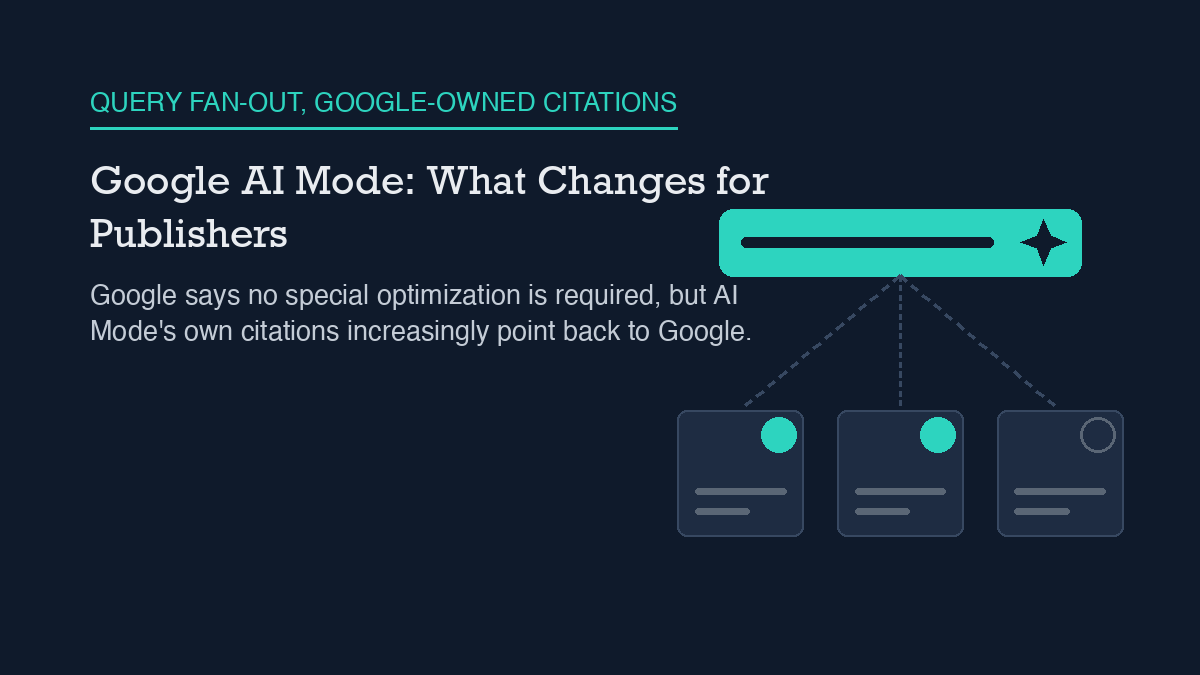
Google says there is nothing special to do for AI Mode. A page becomes eligible for an AI Mode citation the same way it becomes eligible for a regular search snippet: get indexed, meet Google’s normal Search technical requirements, and rank well against the query. No new file, no new markup, and no separate submission process exists. The parts that are genuinely new are how AI Mode assembles an answer from many pages at once, and how much of that answer, according to one independent study, now points back to Google’s own properties.
What Google’s documentation actually says
I went straight to Google’s own developer documentation rather than working from secondhand summaries, because this is exactly the kind of topic where speculation spreads faster than the source material. Two pages carry the load: the AI features and your website page, and the AI optimization guide.
The first page states plainly that there are no additional requirements to appear in AI Overviews or AI Mode, and no other special optimizations are necessary. Sites do not need to create new machine-readable files, AI-specific text files, or new markup to show up in these features. The eligibility bar is the same one Search has always used: to be shown as a supporting link in AI Overviews or AI Mode, a page must be indexed and eligible to appear in Google Search with a snippet, meeting the same technical requirements as regular Search results.
The second page makes the strategic framing explicit. Google states that the best practices for SEO continue to be relevant because its generative AI features are rooted in its core Search ranking and quality systems. From Google’s stated perspective, optimizing for generative AI search is optimizing for the search experience, not a separate discipline. That is a direct claim from the documentation, not my interpretation of it, and it is worth taking at face value: this isn’t a new channel with its own rulebook, it’s the same ranking system feeding a different output format.
How AI Mode decides what to cite
The documentation also explains the retrieval mechanism behind these answers. Google defines retrieval-augmented generation, which it also calls grounding, as a technique used to improve the quality, accuracy, and freshness of AI responses by relying on core Search ranking systems to pull relevant, up-to-date pages from the Search index. In plain terms: the model doesn’t invent citations, it queries the same index that powers regular Search, then writes around what it retrieves.
Both AI Overviews and AI Mode may use a technique Google calls query fan-out, where a single user question is expanded into multiple related searches behind the scenes. Because more advanced models can identify a wider set of supporting pages this way, Google says the result can be a broader and more diverse set of helpful links than a traditional results page would surface for the same query. Google positions AI Overviews as a way to get the gist of a complicated topic quickly, and describes AI Mode as particularly useful for queries that need further exploration, reasoning, or comparison across several options. If that framing holds, comparison-heavy and multi-part questions are where fan-out retrieval does the most visible work, which is one reason this topic overlaps so directly with how I think about GEO, SEO, and AEO as related but distinct disciplines.
What independent research adds, and where it disagrees
Documentation tells you what a system is designed to do. It doesn’t tell you what it actually does at scale, so I looked for independent measurement rather than stopping at the official page. An SE Ranking analysis dated February 2026, sampling 68,313 keywords across 20 industries and covering more than 1.3 million AI Mode citations, found that google.com itself was the single most-cited domain in AI Mode answers, at 17.42% of all citations. That is up from 5.7% in June 2025, roughly a tripling over that period.
The breakdown inside that Google-to-Google share is specific enough to be useful. Of citations pointing back to Google properties, 59% went to traditional Google Search results pages, 36.1% to Google Business Profiles, 1.7% to Google Support, and 0.1% to Google Flights. Once YouTube is included alongside those properties, Google-controlled domains accounted for roughly 20% of all AI Mode citation sources in that sample. I want to label the strength of this evidence honestly: it is one independent dataset from one vendor, not a Google-published figure, and it describes a specific sample window rather than the entire live system. It is directional evidence, not a guarantee about how any individual query will resolve.
I looked for a second study to corroborate the tripling figure and did not find one I could independently fetch and confirm during this research pass, so I’m reporting the SE Ranking numbers as a single, clearly sourced data point rather than as an established industry consensus. If Google’s own properties are absorbing a growing share of citations, particularly through Business Profiles and Search itself, that has a practical implication worth sitting with: a meaningful slice of AI Mode’s supporting links may not be competitive real estate for an independent publisher at all, regardless of how well the publisher’s page is optimized.
A practical checklist
Given what’s confirmed above, here’s what I’d actually prioritize, in order:
- Confirm the page is indexed and returns a normal snippet in regular Google Search first. AI Mode eligibility is gated on ordinary Search eligibility, not a separate check.
- Skip building an AI-specific text file or a new markup format for AI Mode specifically. The documentation states none is required, and inventing one wastes engineering time that could go toward normal Search fundamentals.
- Treat schema markup as a normal Search quality signal, not an AI Mode shortcut. I’ve covered the evidence on this directly in whether schema markup actually helps AI citations, and the conclusion there is consistent with what Google’s AI Mode documentation implies: markup helps machines understand a page, it does not buy placement.
- For comparison-style or multi-part queries in your niche, structure the page so a single section directly and completely answers one sub-question. Query fan-out rewards pages that answer a narrow slice cleanly, rather than pages that gesture at many topics at once.
- Watch how much of the answer space in your query set is already occupied by Google-owned properties before assuming a ranking problem. If Business Profiles or Google Search results are absorbing most citations for a given query cluster, better content on your own domain may not close that gap.
- Keep working the fundamentals shared across every AI answer surface. The overlap between AI Mode and the practices covered in how ChatGPT search sourcing works and how Perplexity’s sourcing differs is large: indexability, clear single-topic pages, and demonstrable expertise show up as prerequisites across all three systems, even though each one retrieves and cites differently underneath.
What this site hasn’t measured yet
I want to be direct about a gap rather than paper over it. This site does not have a citation-tracking pipeline connected for Google AI Mode specifically, and no measurement was taken as part of writing this piece. I am not going to state a citation count, verified or otherwise, because none was actually checked. That absence is itself useful information: if you’re deciding whether to invest in AI Mode citation tracking, the honest starting point is that most independent sites, including this one, do not yet have a clean way to see it. The SE Ranking figures above are the closest thing to hard data cited here, and they describe an industry sample, not this domain. Anything more specific than that would be a guess dressed up as an answer, and this site’s whole approach is built on not doing that.
Leave a Reply