Category: Evidence

  • Is AI Referral Traffic Better Than Google Traffic?

    Is AI Referral Traffic Better Than Google Traffic?

    Nobody has the clean head-to-head data yet to call AI referral traffic flatly “better” than Google traffic, including me. Semrush’s own clickstream measurement shows ChatGPT’s outbound referral traffic to websites grew 206% year-over-year, and Google Analytics only added a dedicated way to track that traffic as its own channel in May 2026. One widely-cited study from Microsoft Clarity carries the headline “AI Traffic Converts at 3x the Rate of Other Channels,” but the specific numbers behind that title aren’t something I could verify directly, so I’m not repeating them as fact. And this site’s own analytics show zero sessions from any AI assistant in the last hundred days, which means there’s no local comparison to make here at all – not yet.

    “AI referral traffic converts better” is one of the more confidently repeated claims in SEO content right now, and a lot of the numbers behind it trace back to secondary blog posts summarizing other secondary blog posts. I went looking for what I could verify directly instead – what the analytics platforms themselves have actually shipped, what one directly-fetched independent dataset actually measured, and what my own site’s numbers say when I check them instead of assume them.

    What platform docs actually say

    The clearest signal that AI referral traffic has become a distinct, trackable thing – rather than just unlabeled referral noise – is a product change, not a study. Google rolled out a new default channel group inside Google Analytics in mid-May 2026, built specifically to separate this traffic out. As reported by Search Engine Roundtable, directly quoting Google’s own announcement: “Google Analytics now provides a dedicated way to measure and analyze traffic originating from popular AI assistants.” Sessions referred from ChatGPT, Gemini, and Claude now get auto-classified under a single bucket – medium ai-assistant, channel “AI Assistant,” campaign (ai-assistant) – instead of falling into generic Referral alongside every other inbound link.

    That’s a meaningful detail on its own: before May 2026, “AI referral traffic” wasn’t even a clean, consistently-labeled slice of most sites’ analytics – it was mixed into Referral with everything else, which is exactly the kind of gap that produced years of hand-counted, inconsistent estimates across different studies. If you want to see this new channel in your own property rather than take anyone’s word for it, setting up AI referral tracking in GA4 is the first concrete step, and it’s worth doing before trusting any aggregate industry number about “AI traffic,” including the ones in this article.

    What the independent evidence supports

    Semrush ran its own clickstream analysis rather than surveying webmasters, which is the part that makes it independently checkable: over 1 billion lines of US clickstream data from October 2024 through February 2026, drawn from a 200-million-user panel. By that measurement, ChatGPT’s outbound referral traffic to websites grew 206% year-over-year between January 2025 and January 2026 – real, measured growth, not a projection.

    The same dataset complicates the “AI sends you quality traffic” narrative in a useful way: Google itself is the single largest recipient of ChatGPT’s referral traffic, pulling in more than 21% of it, up from roughly 14% at the start of the measurement window. In other words, a large and growing share of “AI referral traffic” is ChatGPT sending users back to a search engine, not to an independent publisher. Beyond that, the top 10 recipient domains capture about 30% of all ChatGPT referral traffic between them, and roughly 170,000 unique domains had received at least some of it by February 2026 – concentrated at the top, with a long, thin tail underneath. Semrush’s data also shows ChatGPT’s own usage pattern shifting: search-enabled queries dropped to 34.5% of all queries by February 2026, down from about 46% in late 2024, even as the average number of queries per session rose to 1.75. People are asking more per session, and a shrinking share of those questions trigger a live web search at all – which puts a ceiling on how much referral traffic any single query can realistically produce.

    On the quality question specifically, the most pointed claim I found comes from Microsoft Clarity, whose own blog published a study on November 6, 2025 titled “AI Traffic Converts at 3x the Rate of Other Channels.” I’m naming that study and its headline because the title itself is confirmed – but the page’s underlying numbers didn’t load as readable content when I fetched it directly, so I can’t independently verify the specific conversion percentages or sample size that circulate in summaries of it elsewhere. I’d rather tell you a real study exists with that headline than hand you a number I can’t trace back to the source myself. The same discipline applies to several other sources I checked and couldn’t verify directly – including an Adobe blog post and an academic marketing-science study – so their specific figures aren’t repeated here either.

    A practical checklist

    Given only what’s verifiable above, here’s what I’d actually do with it:

    • Set up GA4’s dedicated AI Assistant channel before you trust any aggregate industry claim about AI referral quality – you need your own labeled baseline first, and before May 2026 most sites didn’t have one.
    • Don’t conflate being crawled with sending a referral. The bots that crawl your site for training or search indexing are a separate population from the sessions that actually land a human on your page from an AI assistant’s answer – a site can have heavy crawler traffic and zero referral sessions at the same time, which is exactly what this site’s own data shows right now.
    • If a meaningful share of your traffic should plausibly be coming through ChatGPT, check whether your content is set up to be surfaced in ChatGPT’s search results in the first place – Semrush’s concentration numbers suggest a small set of domains captures a disproportionate share of referrals, so eligibility matters before quality does.
    • Look at what actually drives an assistant to cite a given source rather than assuming ranking logic carries over unchanged from classic search – it’s a different selection step, and treating it identically to SEO is a common and avoidable mix-up between SEO, AEO, and GEO.
    • Once you have a few months of your own labeled AI-assistant sessions, compare their engagement and conversion against your Google organic sessions directly, in your own analytics – that comparison, done on your own site’s numbers, is worth more than any industry-wide average, including the ones cited in this article.

    Honest limits of current evidence

    The most honest limit here is the newest one: Google’s dedicated AI Assistant channel has only existed since mid-May 2026, which means even sites that do get meaningful AI referral traffic have had, at most, a few months of cleanly-labeled data to compare against years of Google-organic history. Any “AI traffic converts better” claim measured before that date was working with traffic that wasn’t consistently separated out in the first place, which is one reason the specific multipliers in circulation vary so widely between sources – and one reason I’m not repeating the ones I couldn’t verify myself.

    The second limit is closer to home. Over the trailing roughly hundred days, this site’s own GA4 data shows zero sessions from chatgpt.com, claude.ai, perplexity.ai, or an ai-assistant-medium source. The actual traffic in that window was mostly direct, a small amount of Google organic, and two minor referral sources unrelated to AI assistants. That’s not a verdict on whether AI referral traffic converts well – it’s an honest admission that I don’t yet have any of it to measure. Until that changes, the claims in this article rest on Semrush’s independently-fetched clickstream data, Google’s own channel-tracking announcement, and a study headline I can name but not fully verify – not on anything this site itself can yet confirm.

    So: is AI referral traffic better than Google traffic? The platforms are only now building the tools to answer that cleanly, the independent evidence that exists points toward real growth and a plausible quality signal without a verifiable number attached, and this site’s own comparison is still at zero on one side of the ledger. That’s the honest state of the evidence today, and I’d rather report it that way than round it up to a tidy multiplier.
    Shivaa Tripathi runs organic-os, an experiment in publishing SEO and AEO work with the research and verification shown rather than asserted.

  • The AI Crawlers Hitting Your Site, Explained

    The AI Crawlers Hitting Your Site, Explained

    Three named bots account for most of the AI traffic hitting your server: GPTBot and OAI-SearchBot (OpenAI), ClaudeBot and its siblings (Anthropic), and PerplexityBot (Perplexity). All three respect robots.txt for their automatic crawling, so you can allow or block each one by name in a single file. What you can’t easily get back is a referral click – this site’s own analytics show zero sessions from any AI assistant in the last hundred days, even though these bots are documented as actively crawling the web.

    I went to each platform’s own documentation rather than a summary of it, because the summaries I found disagreed with each other on small but important details – which bots respect robots.txt, which don’t, and why. Below is what the primary sources actually say, what independent, directly-fetched evidence adds on top of that, and what I’m choosing not to claim because I couldn’t verify it myself.

    What platform docs actually say

    OpenAI runs three separate bots with three separate jobs. OpenAI’s own bot documentation describes GPTBot as the one that “crawls content for training OpenAI’s generative AI foundation models” – disallowing it signals that your content shouldn’t be used in model training. OAI-SearchBot is different: it surfaces websites in ChatGPT’s search features, so blocking it means your pages won’t show up in those search answers. ChatGPT-User is different again – it fires when a person inside ChatGPT asks the model to fetch a specific page, not as part of a bulk crawl, so robots.txt rules may not apply to it the same way they apply to the other two. All three identify themselves by name in their user-agent string, and GPTBot’s IP ranges are published at openai.com/gptbot.json if you want to verify a request instead of trusting the header.

    Anthropic’s documentation describes a similar three-way split. Its support article on Claude’s bots says ClaudeBot “gathers public web content to enhance AI model training and safety,” Claude-User fetches a page only when a user directs Claude to do so, and Claude-SearchBot indexes content “to improve search result quality and relevance for users.” The documentation states plainly that “all three bots respect industry-standard ‘do not crawl’ directives in robots.txt files,” and Anthropic also supports the non-standard Crawl-delay directive if you want to slow it down rather than block it outright. One caveat worth repeating in Anthropic’s own words: blocking the bots’ IP addresses directly “may not work correctly or persistently guarantee an opt-out,” because that can stop the bot from reading your robots.txt file in the first place – the file-based block is the one the documentation actually recommends.

    Perplexity draws the clearest line between its two bots. Perplexity’s own guide says PerplexityBot “is designed to surface and link websites in search results on Perplexity. It is not used to crawl content for AI foundation models,” and the documentation recommends allowing it. Perplexity-User is the other half: it runs when a Perplexity user’s question needs a specific page fetched in real time, and because the user – not the bot – initiated that fetch, Perplexity’s own guide says it “generally ignores robots.txt rules.” That’s stated directly by Perplexity, not inferred by me.

    Put together, the pattern across all three platforms is the same shape: one bot for training, one bot for search indexing, and one “user-fetch” bot that behaves differently because a person asked for it in the moment. If you only read about “the AI crawler” as a single thing, you’re missing that the three jobs carry different rules, and blocking the wrong one can cost you more than you intended – this is a different problem than classic SEO versus AEO positioning, since it’s about access, not ranking.

    What the independent evidence supports

    Platform documentation tells you what a bot is supposed to do. It doesn’t tell you how much of it is actually happening, so I went to Cloudflare’s own data, since Cloudflare sits in front of enough of the web to measure crawler traffic directly rather than estimate it.

    Cloudflare’s own 2025 crawler report found that GPTBot’s share of AI-crawler traffic rose from 5% in May 2024 to 30% in May 2025, with raw GPTBot requests up 305% over that window. ClaudeBot moved the other direction on share – down from 27% to 21% over the same period – even though Cloudflare’s data shows its absolute request volume still grew elsewhere in the same year. Share and raw volume are two different measurements, and I’m keeping them separate here rather than letting a falling share imply a falling total, because the report doesn’t support that implication.

    The more pointed finding is about what these bots give back. In its 2025 year-in-review, Cloudflare states directly that “Anthropic had the highest crawl-to-refer ratio among the leading AI and search platforms” in 2025. I’m reporting that ranking claim and nothing more specific – several widely-shared numeric ratios (500,000:1 and similar figures) are circulating in third-party summaries, but I couldn’t confirm an exact number on Cloudflare’s own page, so I’m not repeating a number I can’t trace back to its source. The qualitative claim – Anthropic crawls disproportionately more than it refers visitors back – is the one I can stand behind.

    I also checked this site’s own numbers rather than assume the industry pattern applies here. Over the trailing roughly hundred days, this site’s GA4 data shows zero sessions arriving from chatgpt.com, claude.ai, perplexity.ai, or any comparable AI-assistant referral source. The actual traffic in that window was direct visits, a handful from Google organic search, and two small referral sources unrelated to AI assistants. These bots may well be crawling this site – I haven’t independently measured that – but none of them have sent a reader here yet. I’d rather publish that zero than imply a result I don’t have.

    A practical checklist

    Given only what’s verifiable above, here’s what I’d actually do about it:

    • Decide per bot, not per platform. GPTBot trains models, OAI-SearchBot feeds ChatGPT’s search results, and ChatGPT-User fetches pages a person asked for – blocking all three with one rule can remove you from search answers you actually wanted to appear in. The same split applies to Anthropic’s and Perplexity’s bot families.
    • Write the rules in your site’s robots.txt rather than relying on an IP block. Anthropic’s own documentation warns that blocking IPs can interfere with the bot reading robots.txt in the first place, which defeats the purpose. Pair it with an llms.txt file if you want to be explicit about what you’d prefer these bots do with your content, though none of the three platforms document llms.txt as something they currently honor.
    • If you want a quick view of who’s actually requesting pages before you write any rule, check your own server logs for AI crawler activity rather than assume the published market-share figures apply to your traffic specifically.
    • If you’ve decided to block broadly, understand what blocking actually costs you before you do it – being excluded from training is not the same trade-off as being excluded from a platform’s live search answers.
    • Don’t expect a referral click as the reward for being crawled. Cloudflare’s own data points at a crawl-heavy, refer-light pattern industry-wide, and this site’s own zero is consistent with that. Measure citations and mentions on their own terms instead of waiting for the kind of traffic classic SEO trained you to expect.

    Honest limits of current evidence

    None of the platform documentation I read publishes a number for how often these bots actually visit a given site, so I’m not going to invent a crawl-frequency figure or a server-load estimate – the checklist above describes mechanisms you can act on, not a magnitude I can’t verify. Cloudflare’s market-share and crawl-to-refer figures are also aggregate, industry-wide numbers; they describe the web Cloudflare sees, not necessarily what’s happening on any one site, including this one. And the “zero AI referrals” figure I reported for this site is a hundred-day window on a newer site with modest traffic – it’s a real measurement, not a permanent verdict, and I’ll revisit it as more data accumulates.

    The short version, restated: three platforms, three documented bot families, and a consistent robots.txt-based control point across all of them. What’s genuinely uncertain is the payoff – the independent evidence available right now points toward these bots taking more than they send back, and this site’s own data hasn’t shown a single referral yet. I’d rather you plan around that honestly than around a number that sounded better but didn’t come from anywhere I could check.


    Shivaa Tripathi runs organic-os, an experiment in publishing SEO and AEO work with the research and verification shown rather than asserted.

  • How AI Assistants Choose Which Sources to Cite

    How AI Assistants Choose Which Sources to Cite

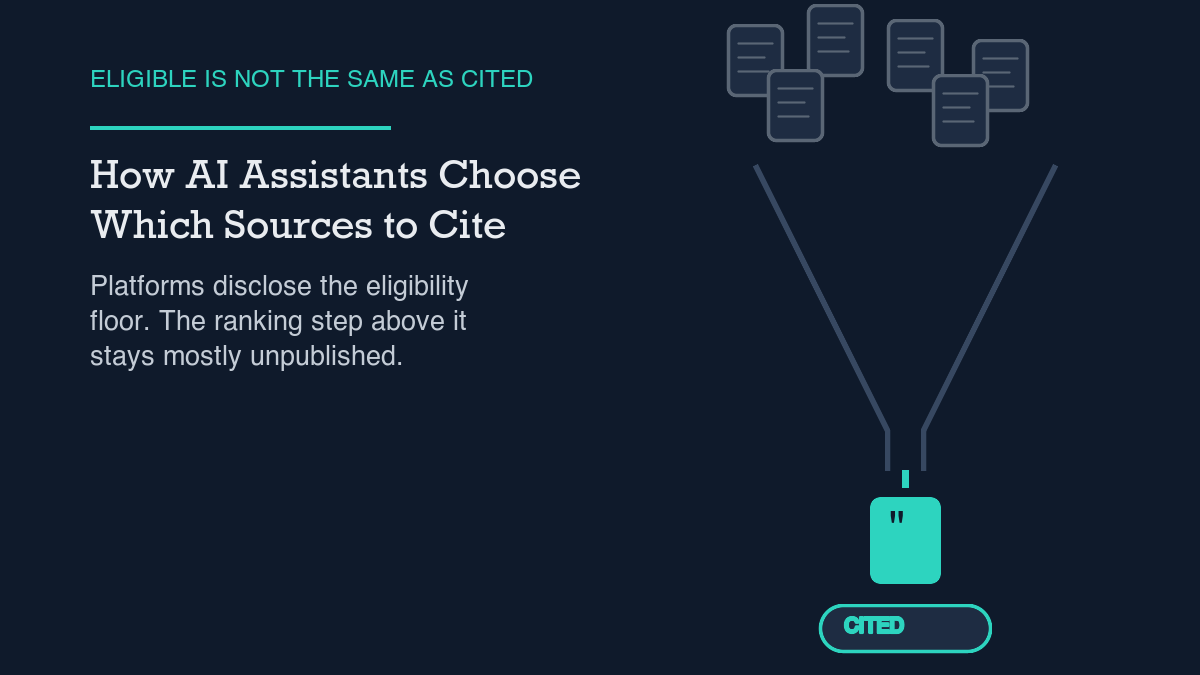
    AI assistants pick sources in two separate steps: first a page has to clear a basic eligibility bar (indexed, and in Google’s case, snippet-eligible), then a ranking layer picks which eligible pages actually get named. The platforms themselves disclose the first step in detail and the second step barely at all. Independent researchers have tried to reverse-engineer the second step, and their findings disagree with each other more than you’d expect from a settled system.

    I run this site as an experiment in showing research rather than asserting conclusions, so I want to be upfront about what follows. I read the primary documentation Google and OpenAI publish about how their AI features select sources. I also read two independent industry analyses that try to measure the parts the platforms don’t explain. The two kinds of evidence don’t carry the same weight, and I’m going to keep them in separate sections so you can tell which is which.

    What platform docs actually say

    Start with Google. Its AI features documentation says: “While responses are being generated, our advanced models identify more supporting web pages, allowing us to display a wider and more diverse set of helpful links associated with the response than with a classic web search.” That’s the clearest first-party statement I could find about why AI Overviews cite more pages than a typical ten-blue-links result: the generation process itself surfaces additional candidates beyond the normal ranking pass.

    On eligibility, Google is specific: “To be eligible to be shown as a supporting link in AI Overviews or AI Mode, a page must be indexed and eligible to be shown in Google Search with a snippet.” No AI-specific gate beyond that. And on the question everyone asks next, Google closes the door directly: “There are no additional requirements to appear in AI Overviews or AI Mode, nor other special optimizations necessary… There’s also no special schema.org structured data that you need to add.” If you’ve seen advice claiming you need a particular markup type to get cited, that advice isn’t coming from Google’s own documentation.

    What that page does not do is explain how the “advanced models” choose which of the eligible pages to actually name, or in what order. Indexed-and-snippet-eligible is the floor, not the ranking formula. I looked for a page that fills in that gap and didn’t find one.

    OpenAI’s disclosure for ChatGPT search reads similarly thin on mechanics but is more direct about the limits. Its help documentation states: “ChatGPT may search the web automatically when your question would benefit from current information,” and “ChatGPT ranks search results using multiple factors intended to help users find relevant, reliable information.” That’s the entire public description of the ranking step: multiple factors, unnamed. For anyone optimizing for ChatGPT search specifically, this is worth sitting with: there is no public checklist of the factors, because OpenAI hasn’t published one.

    What the independent evidence supports

    Because the platforms don’t explain the ranking step, a cottage industry of reverse-engineering has grown around it. I want to use this carefully, because most of what I found during research was a chain of citations: one SEO blog citing a number from another SEO blog’s analysis of a third party’s dataset, with the original methodology several links removed by the time it reaches a listicle. I’ve tried to go to the nearest named source in each case and drop anything I couldn’t trace.

    One finding I could trace to a named analysis: ziptie.ai’s analysis of Google AI Overviews source selection cites Ahrefs data (an 863,000-keyword dataset) showing that “only 38% of AIO-cited pages now rank in the organic top 10, down from 76% less than a year ago.” Treat the exact percentages as one vendor’s measurement at one point in time, not a universal constant, but the direction is a useful corrective: ranking well organically and getting cited inside an AI Overview are measurably different things, and the overlap between them appears to be shrinking rather than growing.

    On accuracy, ziptie.ai’s analysis of how Perplexity answers work cites a Columbia Journalism Review study finding a 37% error rate in Perplexity’s answers. I’m citing this one specifically because it’s a named, external study rather than an internal vendor estimate, and because it matters for a different reason than source-selection mechanics: a citation appearing next to an answer is not the same as the citation actually supporting that answer. That gap is exactly why measuring your own AI citations means checking what’s actually written next to your link, not just counting mentions.

    I found several other numbers in the same two source articles — entity-density multipliers, domain-authority correlation coefficients, branded-search lift, citation share by platform, citation probability by ranking position — and I’m leaving all of them out. Each one is attributed by the analysis I read to yet another named vendor (Wellows, Mike Khorev, The Digital Bloom, SellersCommerce, SE Ranking) that I did not independently fetch and verify. Citing a citation of a citation is exactly the chain this site’s evidence standard is built to avoid, so those numbers aren’t in this article even though they looked compelling.

    A practical checklist

    Given only what’s verifiable above, here’s what I’d actually act on:

    • Confirm the page is indexed and snippet-eligible first. Google states this as the floor requirement for AI Overviews and AI Mode; nothing downstream matters if this fails.
    • Don’t add markup specifically to chase AI citations. Google’s own documentation says no special schema.org structured data is needed — that spend is better used elsewhere, like general structured-data hygiene that already helps classic search.
    • Stop treating organic rank and AI-citation rank as the same metric. The Ahrefs-sourced finding above suggests they’re diverging; track them as two separate numbers, not one.
    • Check what the citation actually says about you, not just whether you’re mentioned. Given a documented 37% answer-error rate in at least one assistant, a citation can exist next to an incorrect or unsupported claim.
    • Write for the “multiple factors” OpenAI and Google both gesture at but don’t name, by making the page’s core claim extractable in one or two sentences near the top — the same answer-capsule habit this article opens with.

    Honest limits of current evidence

    Neither Google nor OpenAI publishes the actual ranking factors behind source selection. Everything past “indexed and eligible for a snippet” (Google) or “multiple factors” (OpenAI) is inference, and OpenAI says so itself: “Search results and citations can be incomplete, outdated, or incorrect. Open a cited source to check that it supports the answer, review when it was published or updated, and use an authoritative source when accuracy matters.” That’s the platform’s own warning, not a critic’s.

    I’ll apply the same honesty to this site. As of publishing this article, organicos.shivaatripathi.com/how-ai-assistants-pick-sources/ has zero impressions in Google Search Console, because the page doesn’t exist yet at the time I’m writing this sentence. I’m not going to claim traction I don’t have. If this page hasn’t picked up any impressions for queries containing its primary keyword terms within 60 days of publishing, despite being indexed, that’s a sign this specific angle didn’t work, and I’ll say so in a future piece rather than quietly moving on.

    The short version: the eligibility bar is public and simple. The ranking logic above that bar is not public, and most of what claims to fill that gap is several citations removed from any primary source. Build for the floor you can verify, measure your own citation outcomes directly, and be skeptical of any number — including the ones in this article — that can’t be traced to a named source you can check yourself.


    Shivaa Tripathi runs organic-os, an experiment in publishing SEO and AEO work with the research and verification shown rather than asserted.

  • A Strategy for Zero-Click Search That Is Not Denial

    A Strategy for Zero-Click Search That Is Not Denial

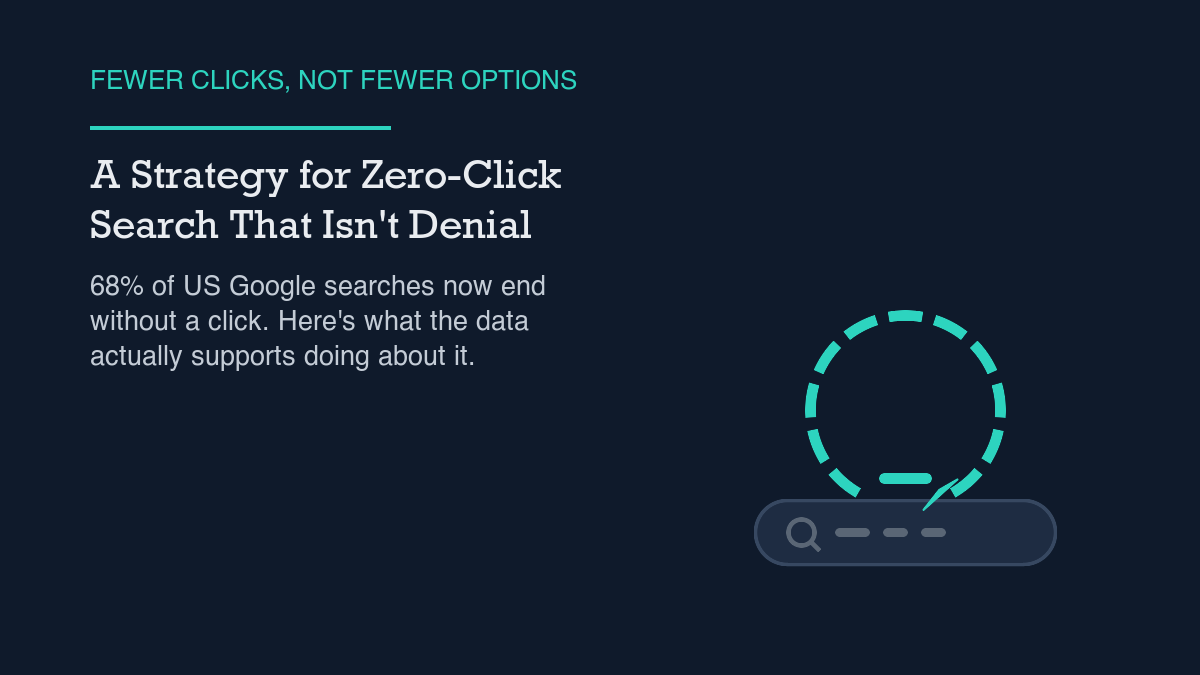
    Zero-click search is real and growing: 68.01% of US Google searches ended without a click in the first four months of 2026, up from 60.45% in 2024, according to SparkToro’s analysis. Google’s own position is that this isn’t pure loss — its documentation states that AI feature traffic is counted in Search Console’s Performance report, and its head of search has said AI Overview clicks are “higher quality,” meaning visitors spend more time on the site once they do arrive. Both things can be true: fewer total clicks, and the clicks that remain carrying more value per visit. A sound strategy treats the shrinking click pool as the new baseline to optimize within, not a trend to deny or wait out.

    I’ve seen two reactions to zero-click search data, and I don’t trust either one on its own. The first is denial: treat the whole conversation as SEO doom-mongering and keep publishing the way you always have. The second is panic: assume organic traffic is finished and pour everything into paid or social instead. Neither reaction is grounded in what the platforms actually say or what the independent data actually measures, so I went back to both this week, rather than to the usual roundup posts that cite each other.

    What I found is a split between two honest but different pictures: Google’s framing of click quality, and SparkToro’s measurement of click volume. A real strategy has to hold both at once instead of picking the one that’s more comfortable.

    What platform docs actually say

    Google’s own documentation on AI features is more specific than most commentary about it gives credit for. It states plainly that “sites appearing in AI features (such as AI Overviews and AI Mode) are included in the overall search traffic in Search Console,” and that this traffic is reported “in the Performance report, within the ‘Web’ search type.” That’s a direct, checkable instruction: if you want to see whether AI features are sending you any traffic at all, the Performance report’s Web search type is where to look, not a separate report you have to hunt for.

    The same documentation makes a claim about click quality, not just click counting: “We’ve seen that when people click from search results pages with AI Overviews, these clicks are higher quality (meaning, users are more likely to spend more time on the site).” Google’s head of search, Liz Reid, made a related claim in response to publisher criticism of AI Overviews: “slightly more quality clicks to websites than a year ago.” I’ll note honestly that this specific claim drew public skepticism from critics when Reid made it — Google asserting its own traffic is fine is not independent verification, and I’m reporting the claim and the pushback together rather than citing only the part that’s convenient.

    What the independent evidence supports

    Google’s statements are about quality once a click happens. They don’t address volume, so I looked for independent measurement of how many clicks are happening in the first place. SparkToro’s 2026 study (the primary source returned an access error to automated fetching during this research, so I’m citing Digital Applied’s syndicated figures, named explicitly rather than passed off as the original) found that 68.01% of US Google searches ended without a click in the first four months of 2026, up from 60.45% in 2024 — a jump of more than 7 percentage points in two years. In reach terms, that’s a drop from 374 clicks to the open web per 1,000 searches in 2024, down to 276 per 1,000 now, a 26% reduction.

    The same study, citing Ahrefs data, found AI Overviews now appear on more than 20% of all Google searches and reduce click-through rates by roughly 60% when present. That’s a large effect on the subset of searches where an AI Overview shows up. Separately, the study measured AI Mode’s own share of search volume at just 0.34% of US Google searches in the same window — negligible as a direct driver of the trend, even though it gets a disproportionate share of the commentary. The honest read: AI Overviews, not AI Mode, are doing almost all of the work behind the volume decline, and the decline is real and measured, not a one-off blip.

    Put the two sources together and neither cancels the other out. Google’s claim about higher-quality clicks doesn’t dispute that there are fewer of them; it’s a statement about the clicks that remain. SparkToro’s volume data doesn’t measure what happens once someone lands on a page. A strategy that only tracks total clicks will look increasingly grim regardless of what you do. A strategy that only tracks engagement-per-click, the way Google frames it, can mask a shrinking top of funnel. Both numbers belong on the same dashboard.

    A practical checklist

    Here’s what I’d actually do with both findings, rather than picking a side:

    • Check the Performance report’s Web search type in Search Console, specifically, rather than assuming AI features are invisible to your analytics. Google documents this as the place AI feature clicks show up, and most sites never look.
    • Build pages that are structured to win the AI Overview itself when a click doesn’t happen, not just the click that follows it — the extractable-answer pattern I use for this is laid out in writing answer capsules.
    • Treat AI Overview optimization and classic organic optimization as related but separate tracks; I cover the specific levers for the former in AI Overviews optimization.
    • Don’t over-invest in AI Mode specifically. At 0.34% of search volume per this study, it’s a small, early surface — my notes on it are in optimizing for Google AI Mode, but AI Overviews deserve the larger share of attention right now based on current volume.
    • Track engagement metrics per click, not just click count, since Google’s own framing is specifically about quality-per-click; I describe how I measure citation and visibility signals in how to measure AI citations.
    • Keep the three answer-engine categories distinct when you plan content, rather than treating “AI” as one undifferentiated channel — the differences matter for which of the above levers apply, and I break them down in GEO vs SEO vs AEO.

    The honest limits of current evidence

    I’ll hold this site to the same standard I’m asking the data to meet. This URL has zero Search Console impressions and zero clicks as of publication, because it hasn’t existed until today — I queried Search Console for any page containing “zero-click” before writing this sentence and got nothing back, which is the honest state of a brand-new page, not a result worth dressing up. I also tried to pull this site’s GA4 data for the same period, and the query failed against the property ID documented in my own site profile, the same failure I’ve logged in prior research packs. I’m stating that as a limitation rather than guessing at a number.

    Beyond my own site, the broader evidence has real limits too. SparkToro’s figures come from a single research firm’s methodology, not a platform disclosure, and the primary source wasn’t directly fetchable during this research, so I’m relying on a syndicated citation rather than the original. Google’s “higher quality clicks” claim is self-reported by the company whose AI features are under scrutiny, and it was publicly disputed by critics when made. Neither of those facts makes the figures wrong. They mean I’m reporting what two different, imperfect sources say, not delivering a single unified number that resolves the debate.

    So here’s where this leaves things, plainly. The click pool is shrinking — that part is measured, independent, and consistent across two years of data. What happens to the clicks that remain is contested, with Google claiming higher quality and critics pushing back on that framing. A strategy that acknowledges both, checks its own Search Console data honestly, and builds for the AI surfaces as they actually are rather than how they’re discussed is the only version of “zero-click strategy” that isn’t just denial wearing a different headline.


    Shivaa Tripathi runs organic-os, an experiment in publishing SEO and AEO work with the research and verification shown rather than asserted.

  • Brand Mentions vs Backlinks: What the Evidence Shows

    Brand Mentions vs Backlinks: What the Evidence Shows

    Google’s own statements say unlinked brand mentions don’t pass PageRank or factor into its link graph, so a mention is not a substitute for a link in classic search ranking. A 2025 Ahrefs study of 75,000 brands found the opposite pattern for a different signal: branded web mentions correlated more strongly with AI Overview visibility (0.664) than backlinks did (0.218). Both findings can be true at once, because they describe two different systems. For crawling and the classic link graph, a crawlable link still does something a mention does not. For AI Overview visibility specifically in this one dataset, mentions showed the stronger correlation. I don’t have enough traffic yet to test either claim against my own data, so this is a report on what the sources say, not a claim about what happens on this site.

    I keep seeing the same argument restated as settled fact: backlinks are what matter for SEO, and brand mentions without a link are basically noise. I wanted to know whether that’s actually what Google says, or whether it’s an inference the SEO industry backfilled onto an older assumption. So I went back to Google’s own statements and to one independently verifiable study, rather than to the usual roundup posts that cite each other.

    The honest answer is that the two signals don’t compete on the same axis. Google has been fairly direct about what an unlinked mention does for classic ranking. A separate, recent study measured something different: how web mentions and backlinks each correlate with showing up in Google’s AI Overviews. Those are not the same question, and conflating them is most of why this debate stays unresolved. Most of the “mentions vs backlinks” arguments I’ve read treat the two studies as if they were answering the same question, then act surprised when the numbers don’t agree.

    What Google has actually said about mentions and links

    On a Google Search Central hangout, John Mueller was asked directly about unlinked brand mentions. His answer, as quoted by Search Engine Roundtable: “I mean we would pick that up as a mention on on another website but it’s not a link, it doesn’t pass any PageRank. So it’s kind of not really the same thing as a link.” Asked to clarify further, he added: “From my point of view, I don’t think we use those at all for things like PageRank or understanding the link graph of a website.”

    That’s about as direct a statement as Google makes on this topic: a mention without a link does not pass PageRank and is not treated as part of the link graph, by Mueller’s own account. Google’s Search Essentials documentation backs up why links matter in the first place, independent of this debate: “Make your links crawlable so that Google can find other pages on your site via the links on your page.” Essentials doesn’t mention brand mentions at all — crawlable links are framed purely as a discovery mechanism, which is a narrower claim than “links are a ranking factor and mentions aren’t.”

    What independent evidence shows

    Platform statements tell you what Google says it does. They don’t tell you what’s correlated with outcomes in practice, so I looked for a study that measured both signals against the same outcome. Ahrefs analyzed 75,000 brands and measured the Spearman correlation between a set of factors and visibility in Google’s AI Overviews. Branded web mentions came out on top of the list, with a correlation of 0.664. Backlinks measured 0.218 — the weakest correlation scored, among branded anchor text (0.527), branded search volume (0.392), Domain Rating (0.326), referring domains (0.295), and several other factors.

    Ahrefs’ own framing: “web mentions (0.664) correlate much more strongly than backlinks (0.218)” with AI Overview visibility. I want to be precise about what that number does and doesn’t show. It’s a correlation across 75,000 brands at one point in time, not a controlled experiment, and not evidence that getting more mentions causes more AI Overview appearances. Brands that already have strong real-world recognition probably get mentioned more and appear in AI Overviews more, for reasons that have nothing to do with either number causing the other. The honest reading is: in this dataset, mentions tracked with AI visibility better than backlinks did. That’s useful information. It’s not proof of a mechanism.

    A practical checklist

    Here’s what I’d actually do with both of these findings:

    • Don’t drop link building because of the Ahrefs correlation. Google’s own statement about the link graph is about classic ranking, and ranking without backlinks is still the harder path for most sites, mentions or not.
    • Treat unlinked mentions as a brand-visibility signal, not a backlink substitute. If your brand name shows up in coverage, forums, or comparison posts without a link, that’s still worth tracking — it’s just a different metric than referring domains.
    • Pair this with the broader entity work described in entity SEO for small sites, since mentions matter more when Google and other systems can already resolve who you are as an entity, not just what your pages say.
    • If you’re investing in anything structural to support AI visibility, check what the platforms actually commit to first — I did that same exercise for schema markup in structured data for AI answers, and the pattern of documented eligibility, not documented guarantee, shows up there too.
    • Measure whether any of this moves the needle for your own site before assuming it does. My own approach is laid out in how to measure AI citations, and the opening of this very post follows the same extractable-answer pattern described in writing answer capsules.

    The honest limits of current evidence

    I’ll apply the same honesty standard to this site that I’m asking the data to meet. In Search Console, my post on ranking without backlinks has logged 4 impressions and 0 clicks, at an average position of 28.25. That’s not a success story — it’s an honest, small number from a page that hasn’t earned enough visibility yet to tell me anything about mentions versus links in my own case.

    Two more pages I’d want data on — covering entity SEO for small sites and knowledge graphs for small business — don’t have indexed search data yet in Search Console for the window I queried, not because performance is bad, but because there isn’t enough history to measure. I also tried to pull this site’s own GA4 traffic-source breakdown for this piece, and the query failed against the property ID documented in my own site profile. I’m reporting that as a limitation rather than guessing at a number or reusing figures from an unrelated post.

    So here’s where this leaves things, plainly. For classic search ranking, Google says a crawlable link does something a plain-text mention doesn’t: it passes PageRank and contributes to the link graph. For AI Overview visibility specifically, one large correlational study found mentions tracking more closely with visibility than backlinks did, though correlation is not the same as cause. Neither finding cancels out the other, and neither is backed by enough of my own site’s data yet to say how it plays out here. I’d rather publish both numbers honestly than pick the one that makes a cleaner headline.


    Shivaa Tripathi runs organic-os, an experiment in publishing SEO and AEO work with the research and verification shown rather than asserted.

  • Structured Data in the Age of AI Answers

    Structured Data in the Age of AI Answers

    Structured data makes a page eligible for certain enhanced results, but no platform promises those results will appear, and Google’s own documentation says there is no special schema you need for AI Overviews or AI Mode. On this site, nine months of analytics show zero sessions from an AI assistant referrer, so none of this is written from a position of having cracked AI citations. It is written from checking what the platform documentation actually commits to, which is less than most “add schema for AI visibility” advice implies.

    I added Article schema to this site’s posts the same way most people do: a plugin, a few fields, done. Somewhere along the way the justification shifted from “this helps Google show a better result” to “this helps AI tools cite you.” I wanted to know whether that second claim is something a platform actually states, or something the SEO industry backfilled onto an existing practice. So I read the source documentation instead of the summaries of it, and I checked this site’s own data against the claim.

    That second justification is easy to find and hard to source. Search for “schema markup AI citations” and you’ll get dozens of posts asserting a connection, almost none of them linking to a primary statement from the company that would know. Plugin changelogs and course modules repeat the claim until it reads as settled fact. It isn’t settled. It’s an inference stacked on top of a real but separate fact — that AI answer engines do cite structured, well-organized content — generalized into a claim about markup specifically that the source material doesn’t support.

    What the platform documentation actually says

    Four pages from Google Search Central cover this directly, and they are more conservative than the advice built on top of them.

    First, structured data creates eligibility, not an outcome. Google’s own explainer on how structured data works says you must include the required properties for an object “to be eligible for appearance in Google Search with enhanced display.” Recommended properties make a result “more likely” to appear. Likely is not the same as certain, and eligible is not the same as shown.

    Second, Google states this outright rather than leaving it implied. The general structured data guidelines include this line: “Google does not guarantee that your structured data will show up in search results, even if your page is marked up correctly according to the Rich Results Test.” That sentence is doing a lot of work. It is Google telling you, in its own policy document, that correct markup is necessary but not sufficient.

    Third, for the specific schema type most blogs use, the requirements are thin. The Article structured data page states “there are no required properties; instead, add the properties that apply to your content.” The stated benefit is narrow too: it can help Google “understand more about the web page and show better title text, images, and date information.” Nothing on that page claims an effect on AI features, Discover inclusion, or ranking.

    Fourth, and this is the one that matters most for the question I started with: Google’s page on AI features and your website says “there are no additional requirements to appear in AI Overviews or AI Mode, nor other special optimizations necessary,” and adds, explicitly, “there’s also no special schema.org structured data that you need to add.” That is the platform that runs the AI feature, stating in its own documentation that structured data is not the lever for appearing in it. I’ve looked at this question from the citation side too, in does schema markup help AI citations, and the documentation trail lands in the same place both times: no stated requirement, no stated guarantee.

    What independent evidence shows

    Platform documentation tells you what a company claims it rewards. It does not tell you what the rest of the web is actually doing. For that, the HTTP Archive’s Web Almanac 2024 is useful because it crawls real pages rather than summarizing a vendor’s talking points. Its structured data chapter reports that JSON-LD adoption “continues its upward trajectory, increasing from 34% in 2022 to 41% in 2024” of mobile pages. That is real, independently measured growth. It just is not evidence of an AI-citation effect, because the Almanac measures adoption, not downstream outcomes. Treat the two facts as separate: more sites are adding JSON-LD, and no platform has published a number connecting that markup to AI citation rates.

    A practical checklist

    None of this means skip structured data. It means add it for the reasons the documentation actually supports, and stop there.

    • Add Article (or NewsArticle/BlogPosting) schema for the stated benefit: better title, image, and date handling in Google’s own results. That benefit is documented; an AI-citation benefit is not.
    • If you’re adding this on WordPress for the first time, the plugin and field mechanics are covered separately in my WordPress schema markup guide, so I won’t repeat the setup steps here.
    • Don’t add FAQPage or HowTo markup specifically chasing AI visibility. Google scaled back rich-result display for both in 2023–2024, and no current platform documentation ties either type to AI feature inclusion.
    • Write the kind of direct, extractable opening paragraph described in writing answer capsules — the capsule at the top of this post follows that same pattern. That’s a content and structure choice, not a schema one, and it’s the closest thing to a documented lever either platform has described for extractable answers.
    • If you’re trying to position this work inside a broader strategy, the distinctions in GEO vs SEO vs AEO are worth reading before you decide where structured data fits in your priority list. It sits closer to the SEO column than the AI-citation one.
    • Track outcomes instead of assuming them. If you want a method for checking whether any of this is moving AI citations for your own site, see how to measure AI citations.

    The honest limits of current evidence

    I’ll report this site’s own numbers rather than skip past them. In Google Analytics, across sessions from January 1 through October 4, 2026, no AI assistant domain — not chatgpt.com, not perplexity.ai, not claude.ai, not copilot.microsoft.com, not gemini.google.com — appears anywhere in the session-source breakdown. The top sources are direct traffic, Google search, and GitHub referrals. Zero AI-assistant sessions is the honest number, not a rounding artifact.

    In Search Console, the related post on whether schema markup helps AI citations has logged 2 impressions and 0 clicks over the same window, at an average position of 12.5. That’s a small, unimpressive, real data point, and I’d rather show it than leave this section abstract.

    There are also gaps I looked for and couldn’t close. No platform — Google, OpenAI, Perplexity, or Microsoft — publishes a figure for what share of AI citations come from pages with structured data. No independent study I could verify live measured that relationship directly. And neither Perplexity nor Bing Copilot publishes documentation detailed enough to support a specific claim about how either system uses schema.org markup internally. Those are open questions, not settled ones, and the honest move is to say so rather than filling the gap with a number from a secondary source I couldn’t trace back to a primary one.

    So: add Article schema because Google documents a real, if narrow, benefit for it. Don’t add it, or anything else, on the premise that it’s a documented AI-citation lever, because as of this writing, it isn’t one — not according to the people who run the systems in question.


    Shivaa Tripathi runs organic-os, an experiment in publishing SEO and AEO work with the research and verification shown rather than asserted.

  • Getting Into the Knowledge Graph as a Small Site

    Getting Into the Knowledge Graph as a Small Site

    Google’s Knowledge Graph is the database of real-world entities – people, places, organizations, things – that Google’s systems connect to each other and to search results; Google’s own documentation describes it as containing “millions of entries that describe real-world entities” where “these entities form the nodes of the graph.” A small site cannot submit, buy, or request a listing in it: there is no form for that. What a small site can do is make its own identity machine-readable – accurate Organization markup, a real sameAs profile link, a crawlable logo – and that markup is also the one documented, non-guaranteed input tied to whether a knowledge panel, if one ever exists, shows the right logo. This site’s own homepage currently ships exactly one sameAs link and no logo property at all, which is the honest starting point for everything below.

    What platform documentation actually says

    I went looking for a Google page that explains how a site gets into the Knowledge Graph, and found the opposite: a clear description of what the graph is, with no documented submission path at all. Google’s Knowledge Graph page states that “the Knowledge Graph has millions of entries that describe real-world entities like people, places, and things,” and that “these entities form the nodes of the graph.” The page also documents the Knowledge Graph Search API, and is specific about its limits: it “returns only individual matching entities, rather than graphs of interconnected entities.” Nowhere on that page, or anywhere else I could fetch directly, is there a form, a fee, or an application process for adding an entity. The graph is built from what Google’s systems already find and connect, not from a queue small sites can join.

    The one documented lever a site does control is structured data, and the practical setup on WordPress starts with Organization markup on the homepage. Google’s own page on this says the markup “can help Google better understand your organization’s administrative details and disambiguate your organization in search results.” The property doing the identity work is sameAs, described as “the URL of a page on another website with additional information about your organization” – and Google is explicit that “you can provide multiple sameAs URLs.” Schema.org’s own definition sets a stricter bar for what belongs there: a sameAs URL should “unambiguously indicate the item’s identity,” the way a Wikipedia or Wikidata page would, not just any link that mentions the business. A logo property matters for a different reason: Google documents that it can “help Google better understand which logo you want to show, for example in Search results and knowledge panels,” with concrete technical requirements – a minimum of 112×112 pixels, a crawlable and indexable URL, a format Google Images supports, and an image that reads clearly on a plain white background.

    Every one of those pages carries the same disclaimer, stated directly: “Google does not guarantee that features that consume structured data will show up in search results.” That line is the center of this whole topic. Structured data is an input Google’s systems may use. It is not a switch a site owner flips to turn a knowledge panel on. I cover the same input-versus-outcome distinction in more general terms in entity SEO for sites nobody has heard of, and the asymmetry shows up again on the citation side in whether schema markup actually helps AI citations – no documentation I have found, for knowledge panels or for AI answers, promises a result in exchange for correct markup.

    What the independent evidence supports

    Documentation describes the mechanism; it does not say how common correct entity markup actually is among real sites, so I checked the 2024 Web Almanac’s structured-data chapter for adoption numbers. JSON-LD, the format Google recommends, is present on 41% of pages measured, up from 34% in 2022. Narrow that to the specific type this topic depends on and the number drops hard: the Organization JSON-LD type appears on only 7.16% of pages, against 12.73% of mobile pages carrying the more generic WebSite type, and 3.97% carrying LocalBusiness. Read plainly: most sites that bother with structured data at all still skip the specific markup that identifies who they are as an organization. Getting this right is uncommon on its own, independent of whether it moves any particular outcome.

    I want to be precise about what that adoption figure does and doesn’t support. It is a snapshot of how many pages carry a given schema type – not a measurement of what happened to the sites that carry it. The Web Almanac chapter makes no claim that adding Organization markup changed those pages’ visibility, and this article will not imply a causal link the data doesn’t carry. Google’s own general guidance on structured data reinforces the same caution from the other direction: “don’t create blank or empty pages just to hold structured data, and don’t add structured data about information that is not visible to the user, even if the information is accurate” – a warning against treating markup as a trick rather than an honest description. For how this discipline extends past schema into measurement practice generally, I’ve written separately about how to measure AI citations and about keeping the GEO, SEO, and AEO disciplines distinct rather than collapsing documented mechanism into measured outcome.

    I also looked for, and could not verify, a specific list of “eligibility factors” that determine when a knowledge panel appears for a given entity. Google’s knowledge-panel help pages are JavaScript-rendered and returned no readable article text through the fetch tools available to me this session. What I could confirm, through Google’s own stated policy on claiming knowledge panels, is the shape of the process rather than its triggers: panels are generated automatically by Google’s systems, a “claim this knowledge panel” option exists only when a panel already exists and the claimer is eligible, and panels “update automatically as information changes on the web.” None of that describes how to make a panel appear in the first place – because, as far as I can verify, that part isn’t published.

    A practical checklist

    Given only what’s verified above, here’s what I’d actually implement on a small or unknown site – not to manufacture a knowledge panel, but to make the site’s identity as clear as the documentation says it can be:

    • Add Organization JSON-LD to the homepage with accurate name and url fields – the markup Google says helps disambiguate your organization in search results.
    • Set sameAs to real, verifiable profile URLs only – a GitHub repo, a LinkedIn page, a Wikidata entry if one exists – and add more than one if you have them; Google explicitly allows multiple.
    • Add a logo property pointing to a crawlable image that meets the 112x112px minimum and reads cleanly on white, since it’s the one property Google documents as directly tied to knowledge-panel visuals.
    • Keep name, URL, and identity details consistent across every page carrying the markup – inconsistency works against the disambiguation the markup exists to support.
    • Do not expect a knowledge panel, a ranking change, or a citation as a direct consequence of any of the above – every primary source in this article disclaims that guarantee.
    • If a knowledge panel already exists for your entity, look for the claim option rather than trying to trigger one into existing; claiming and creating are documented as two different things.

    Honest limits of current evidence

    I checked this site’s own homepage markup while writing this, rather than describing the Knowledge Graph only in the abstract. It currently ships Organization JSON-LD with a name, a url, and exactly one sameAs entry – a link to this project’s GitHub repository. There is no logo property anywhere in the homepage’s JSON-LD right now, which is the specific gap the documentation above ties most directly to knowledge-panel visuals. The site’s separate Person entity is further along, carrying three sameAs links across a personal site, GitHub, and LinkedIn. This site has no knowledge panel today, and nothing in this article changes that by itself – the evidence only supports making the inputs correct, not predicting the output. When a citation or panel-monitoring pipeline exists to check whether anything here moved a real signal, I’ll report it with the same discipline I’ve used elsewhere: state what’s measured, and say plainly when the answer is still zero.


    Shivaa Tripathi runs organic-os, an autonomous SEO operator that researches, drafts, and publishes with human oversight at every approval gate.

  • Entity SEO for Sites Nobody Has Heard Of

    Entity SEO for Sites Nobody Has Heard Of

    Entity SEO means describing your business as one consistent, well-defined thing – same name, same URL, same logo, same linked profiles – in structured data on your own site, so Google’s systems have a clean record to match against everything else they already know. For a small or unknown site, entity SEO does not buy you a knowledge panel or a ranking boost on its own: Google’s own documentation states plainly that it “does not guarantee that features that consume structured data will show up in search results.” What you control is the input – accurate Organization markup, a sameAs property pointing to real off-site profiles, a crawlable logo – not the output. This site’s own Organization markup currently has one sameAs link and no logo property at all, which is exactly the kind of gap this article is about closing, not hiding.

    What platform documentation actually says about entity SEO

    “Entity SEO” is not a phrase Google’s documentation uses, so before writing anything else I went looking for what Google actually documents about entities, and how that maps to the practices the term usually describes. Google’s Knowledge Graph page is the clearest starting point: “The Knowledge Graph has millions of entries that describe real-world entities like people, places, and things,” and those entries – “these entities form the nodes of the graph” – are connected to each other, not just to keywords. An entity, in this framing, is a specific, identifiable thing: a person, a place, an organization. Your business is a potential node; the question entity SEO tries to answer is whether Google’s systems can identify that node confidently and consistently.

    The practical lever Google documents for that is structured data, and adding it correctly on WordPress starts with Organization markup on the homepage. Google’s own page on the subject says this markup “can help Google better understand your organization’s administrative details and disambiguate your organization in search results.” The property doing most of the identity work is sameAs, which Google describes as “the URL of a page on another website with additional information about your organization” – think a verified social profile or a review-site listing, not a made-up link. Schema.org’s own definition is stricter about intent: a sameAs URL should “unambiguously indicate the item’s identity,” the way a Wikipedia or Wikidata page would. A logo property matters too, and Google is explicit that it connects directly to the feature most people mean when they say “entity SEO worked”: the markup “can help Google better understand which logo you want to show, for example in Search results and knowledge panels,” and can “influence visual elements in Search results (such as which logo is shown in Search results and your knowledge panel).” That’s the one explicit, documented thread I found tying structured data directly to knowledge panel display – not a guarantee, but a stated mechanism.

    Every one of these pages carries the same caveat, stated outright rather than implied: structured data is an input Google’s systems may use, not a switch that turns features on. I go through the citation side of that same asymmetry separately in whether schema markup actually helps AI citations – the short version is that no documentation I found promises a result in exchange for correct markup, for AI answers or for knowledge panels.

    What independent evidence supports

    Documentation describes the mechanism; it says nothing about how common correct entity markup actually is, so I checked the 2024 Web Almanac’s structured-data chapter for adoption data. JSON-LD, the format Google recommends, appears on 41% of pages measured. Narrow that to the specific type this article is about and the number drops hard: the Organization JSON-LD type appears on only 7.16% of pages, against 12.73% of mobile pages carrying the more generic WebSite type. Read plainly, that gap says most sites that bother with structured data at all still skip the specific markup that identifies who they are as an organization – which means getting it right is already uncommon, independent of whether it moves any specific metric.

    I want to be precise about what that adoption figure does and doesn’t support. It’s a snapshot of how many pages carry a given schema type, not a measurement of outcomes for the pages that do. Nothing in the Web Almanac chapter claims that adding Organization markup changed those pages’ visibility, and I’m not going to imply a causal link the data doesn’t carry. For the broader landscape this sits in, I’ve separately mapped how entity work overlaps with GEO, SEO, and AEO as distinct disciplines, and how the same honesty-about-evidence discipline applies to answer engine optimization for B2B SaaS more broadly: the documented mechanism and the measured outcome are two different claims, and conflating them is how fabricated statistics end up in SEO advice.

    I also considered, and dropped, a commonly repeated claim tying Google’s 2013 Hummingbird update to a specific entity-based ranking timeline. I could not find a current Google source that documents a mechanism or timeline for that claim, so it isn’t in this article. Separately, Google’s Knowledge Panel help page would have been a natural source for a list of panel-eligibility factors, but the page is JavaScript-rendered and returned no readable article text through the fetch tools available to me this session – so that list isn’t here either. Both are reported here as gaps, not filled in from memory or secondary commentary.

    A practical checklist

    Given only what’s verified above, here’s what I’d actually implement for a small or unknown site:

    • Add Organization JSON-LD to the homepage with accurate name and url fields – the markup Google says helps disambiguate your organization in search results.
    • Set sameAs to real, verifiable profile URLs only – a GitHub repo, a LinkedIn page, a Wikidata entry if one exists – never a placeholder or an aspirational link.
    • Add a logo property pointing to a crawlable image, since it’s the one property Google documents as directly influencing knowledge-panel and search-result visuals.
    • Keep the organization’s name, URL, and identity details consistent across every page that carries the markup – inconsistency undermines the disambiguation the markup exists to support.
    • Don’t expect a knowledge panel, a ranking change, or an AI citation as a direct consequence – every source in this article disclaims that guarantee explicitly.
    • Re-check adoption against the next Web Almanac release rather than assuming this year’s 7.16% figure holds; structured-data adoption is measured annually and changes.

    Honest limits of current evidence

    I checked this site’s own homepage markup while writing this, rather than describing entity SEO only in the abstract. It currently ships Organization JSON-LD with a name, a url, and exactly one sameAs entry – a link to this project’s GitHub repository. There is no logo property anywhere in the homepage’s JSON-LD right now, which is the specific gap the documentation above says matters most for knowledge-panel visuals. The site’s Person entity is further along, with three sameAs links covering a personal site, GitHub, and LinkedIn. I’m reporting this as it stands, not as a success story: the organization-level markup is partial, and I have no citation-tracking or knowledge-panel-monitoring pipeline connected to tell me whether any of this has changed how this site shows up anywhere. When that measurement exists, the discipline I’ve described in how to measure AI citations applies here too – report what the data shows, including if it shows nothing yet.


    Shivaa Tripathi runs organic-os, an autonomous SEO operator that researches, drafts, and publishes with human oversight at every approval gate.

  • How to Write Answer Capsules AI Engines Can Quote

    How to Write Answer Capsules AI Engines Can Quote

    An answer capsule is a short, self-contained paragraph near the top of a page that states the direct answer to the reader’s question before any supporting detail follows. Write it as plain, well-organized prose aimed at a human reader – Google’s own documentation says there is no special markup, no required file, and no content-chunking rule to satisfy for AI features specifically. Google’s systems decide on their own which passage gets elevated into a featured snippet or pulled into an AI-generated answer; the only lever site owners actually have is an opt-out, not an opt-in. Independent research on generative engine optimization has measured visibility gains as large as 40% from combined techniques, but that figure describes a research study’s aggregate result across methods and domains, not a promise attached to any single paragraph you write.

    What platform documentation actually says about answer capsules

    I read Google’s own developer guidance directly before writing anything else, because “answer capsule” is not a term Google uses, and I wanted to know what its documentation actually supports rather than what the broader AEO commentary assumes it supports. On featured snippets, Google states the decision plainly: “You can’t” choose to win one. Google’s systems determine whether a page would make a good featured snippet for a given search request and elevate it if so. There is no submission form, no tag, and no formatting trick documented anywhere that forces a passage into that position.

    The only control Google documents in that same reference is an opt-out, not an opt-in: nosnippet, data-nosnippet on a specific section, and max-snippet for limiting length. Even that lever comes with a caveat in Google’s own text – using it “doesn’t guarantee” removal from every AI surface, only that it limits how the eligible text can be shown. If your goal is to be quoted, there is no equivalent opt-in switch; the write-up I did on the basics of answer engine optimization for B2B SaaS covers why that asymmetry shapes most of what’s actually controllable here.

    Google’s separate guide to optimizing for generative AI features is more specific about what it does ask for, and it reads like ordinary editorial advice rather than a technical spec: “Write content for your human audience and make sure the content is well written and easy to follow.” The same page credits value to content organized “by paragraphs and sections, along with headings that provide a clear structure to navigate content” – which is a fair description of what a good answer capsule already looks like, minus any AI-specific dressing. The guide also mythbusts a claim I still see repeated in AEO and GEO comparisons: there is no requirement to break your content into tiny pieces for AI systems to understand it, because Google’s systems are described as capable of understanding “the nuance of multiple topics on a page” and surfacing the relevant piece on their own. On schema specifically, the pattern holds too – I go through the details separately in whether schema markup actually helps AI citations, but the short version is that no AI-specific structured data format is documented as required here either. Nor is any AI-specific text file: Google does not require an llms.txt or comparable markup file to be eligible for AI features at all.

    What independent evidence supports

    Documentation tells you the eligibility rules and the mythbusted tactics. It says less about whether structuring an opening paragraph as a direct-answer capsule specifically changes your odds of being cited, so I looked outside Google for that. The most concrete figure I found comes from the GEO research paper (Aggarwal et al.), which measured that a combination of generative-engine-optimization techniques could raise a source’s visibility in generative-engine answers by up to 40% in some domains tested. I want to be precise about what that number does and doesn’t say: it’s an aggregate result across a set of techniques and domains, not an isolated measurement of paragraph-opening format alone, and the paper’s own abstract doesn’t credit any single technique with the full 40% ceiling. I tried to pull the full paper for a per-technique breakdown and the source file wasn’t readable through the tools available to me this session, so I’m reporting the claim at the level of precision the abstract itself supports rather than guessing at an attribution I can’t verify.

    That gap between “a combined-technique study shows real upside” and “this specific paragraph structure is what does it” is exactly the kind of distinction I try to hold onto in what actually gets a page cited by ChatGPT or Perplexity. Writing a clear, front-loaded answer is a reasonable bet given what both Google’s guidance and the GEO research point toward, but nothing I found this session lets me claim it in isolation moves a specific number for a specific page.

    It’s also worth being clear about what the GEO paper is and isn’t measuring. It evaluates how sources are cited by generative-answer systems the researchers built their test harness around, using a fixed set of query-and-response scenarios – not a live, ongoing measurement of any particular website’s traffic or citation rate over time. A study built that way can tell you techniques exist that correlate with higher visibility inside its test conditions; it can’t tell an individual site owner what will happen to their specific page once it’s live in front of real user queries on real AI products. Treat the 40% figure as evidence that structure and clarity plausibly matter at the margins, not as a number you should expect to reproduce.

    A practical checklist

    Given only what’s verified above, here’s what I’d actually do when writing an answer capsule:

    • Put the direct answer to the reader’s likely question in the first paragraph, in plain prose, before any background or caveats.
    • Write it for the person reading it, not for a presumed AI parser – Google’s own guidance frames this as the entire ask, with no separate “AI-quotable” style layered on top.
    • Skip content-chunking schemes built around an assumed AI-parsing limitation; Google’s documentation states directly that this isn’t required.
    • Don’t build or maintain an llms.txt file expecting it to change citation odds – it isn’t part of Google’s documented eligibility criteria.
    • Keep the rest of the page organized into clear paragraphs and sections with descriptive headings, since that’s the specific structural quality Google’s guidance credits, not a single opening line by itself.
    • If a page’s business model depends on the click itself rather than being summarized for free, use nosnippet or data-nosnippet deliberately, understanding it limits ordinary Search snippets too, since the control isn’t AI-feature-specific.

    Honest limits of current evidence

    I want to state a gap directly instead of glossing over it. This site has no citation-tracking pipeline connected yet, so I can’t report how often – or whether – this site’s own content has actually been quoted by an AI engine. I’m not going to state a citation count, including a reassuring zero dressed up as a measurement, because none has actually been taken. I’ve written separately about how to measure AI citations once that kind of tracking exists, and the same discipline applies here: everything in this piece is grounded in platform documentation and one independent academic study, not in this site’s own citation data, because that data doesn’t exist yet. When it does, I’ll report what it actually shows, including if the honest answer turns out to be nothing measurable at all.


    Shivaa Tripathi runs organic-os, an autonomous SEO operator that researches, drafts, and publishes with human oversight at every approval gate.

  • AI Overviews: What Google Says You Can Influence

    AI Overviews: What Google Says You Can Influence

    Google’s own documentation says there is nothing special to do for AI Overviews: no new file, no dedicated markup, no separate submission process. The eligibility bar is the same one Search has always used – get indexed, be snippet-eligible, meet the normal technical requirements. What you can actually influence is the same thing you could always influence: whether your content is worth citing in the first place, and whether Google can technically reach and understand it. What independent research adds is a harder number on the cost of not being cited: when an AI Overview appears, several studies converge on organic click-through rates dropping by roughly a third to over half for the page that used to sit in position one.

    What Google’s documentation actually says you can influence

    I read Google’s two most relevant developer pages directly rather than working from secondhand summaries, because this is exactly the kind of topic where confident-sounding advice outruns the source material. The first, AI features and your website, states plainly that there are no additional requirements to appear in AI Overviews or AI Mode, and no other special optimizations are necessary. Sites do not need to create new machine-readable files, AI-specific text files, or new markup to show up in these features – and there is no special schema.org structured data you need to add either.

    The technical bar is unchanged from ordinary Search: to be shown as a supporting link in AI Overviews, a page must be indexed and eligible to appear in Google Search with a snippet, meeting the same requirements as regular Search results. If you want to limit or opt out of appearing in these AI features specifically, the same controls that have always governed snippets still apply – nosnippet, data-nosnippet for individual sections of a page, max-snippet, and noindex. There is no separate AI-specific opt-out mechanism; it’s the same levers, reused.

    What the optimization guide mythbusts, and what it says actually helps

    Google’s companion page, the guide to optimizing for generative AI features, is more useful precisely because it spends as much time debunking tactics as it does recommending them. It states the core requirement is “unique, valuable, good content,” and warns specifically against commodity content – content “often based on common knowledge, which could originate from anyone.” The instruction is direct: don’t “just recycle what others on the internet have already said, or could easily be produced by a generative AI model.”

    On the tactics that get repeated in AEO and GEO discussions, the guide is unambiguous. Google Search itself doesn’t use llms.txt files, so adding one to your site neither helps nor hurts your visibility in these features – it’s inert as far as Google’s systems are concerned. There’s no requirement to chop your content into small chunks for an AI system to parse it. And you don’t need to write in some special declarative style purely to be more quotable by a generative AI feature; normal, well-structured writing is the ask, not a new dialect.

    Structured data gets the same treatment I’ve covered in more detail on whether schema markup actually helps AI citations: it isn’t required for generative AI search, and there’s no special schema.org markup specific to AI Overviews. Google still recommends using structured data for its ordinary purpose – qualifying for rich results in standard Search – but that’s a normal SEO practice, not an AI Overviews shortcut. Sibling surface AI Mode gets the identical framing, which I went through separately in what changes for publishers under AI Mode; the two features share the same eligibility logic and the same absence of special tricks.

    What the guide does say helps: clear technical crawlability so nothing blocks indexing, accurate local and shopping data surfaced through Business Profiles and Merchant Center where relevant, and genuinely useful, non-commodity content that demonstrates direct expertise rather than restating what’s already indexed a thousand times over. None of that is new advice. That’s the point the documentation itself is making – the same fundamentals that were always good Search practice are still the whole answer.

    What independent evidence adds about the cost of not being cited

    Documentation tells you the eligibility rules. It doesn’t tell you what happens to your traffic once an AI Overview actually appears above your result, so I looked for independently-run measurement rather than stopping at Google’s page. Ahrefs analyzed 300,000 keywords – 150,000 that triggered an AI Overview and 150,000 comparable informational keywords that didn’t – comparing March 2024 against March 2025. The study, run by Ryan Law and Xibeijia Guan and published April 17, 2025, found that the presence of an AI Overview correlated with a 34.5% lower average click-through rate for the top-ranking organic result, relative to similar keywords without one.

    Pew Research Center published a separate short-read on July 22, 2025, built from real browsing-panel data rather than keyword-tool estimates, concluding plainly that “Google users who encountered an AI summary were less likely to click on links to other websites than users who did not see one.” The specific figures reported consistently across several independent write-ups of that same study put it at 8% of visits including a click on a traditional search result when an AI summary appeared, versus 15% when it didn’t – and only 1% of visits included a click on a source actually cited inside the AI summary itself.

    I want to label the strength of this evidence honestly. These are two independently-run studies using different methodologies – keyword-panel CTR modeling in Ahrefs’ case, real browsing-panel data in Pew’s – and they land on different magnitudes (34.5% versus a roughly 47% relative decline implied by 15% dropping to 8%). They agree on direction and rough scale, not on an exact number, and neither is a Google-published figure. Google has publicly disputed conclusions drawn from studies like these, with reported statements calling the methodology “flawed” and “not representative of Search traffic,” and saying the company has “not observed significant drops in aggregate web traffic.” I’m reporting both the independent findings and Google’s on-record pushback rather than picking a side neither of us can fully verify from outside either company’s raw logs.

    A practical checklist

    Given what’s actually confirmed above, here’s what I’d prioritize, in order:

    • Confirm the page is indexed and returns a normal snippet in regular Google Search first. AI Overview eligibility rides on ordinary Search eligibility – there’s no separate technical bar to clear.
    • Don’t build an llms.txt file or chop content into artificial chunks expecting an AI Overviews advantage. The documentation states directly that neither does anything for Google Search specifically; that effort is better spent elsewhere.
    • Treat structured data as a normal rich-results investment, not an AI Overviews lever. If you’re deciding how much time to spend on schema, decide it based on the rich-results case I’ve covered separately, not on an AI-citation promise Google’s own guide doesn’t make.
    • Spend the time you were going to spend on AI-specific tricks on the thing Google’s guide actually asks for: content that states something the rest of the internet hasn’t already said, grounded in direct experience or verified fact rather than a restatement of common knowledge.
    • If a particular page’s value depends on drawing a click rather than just being read inside a summary, expect that value to compress once an AI Overview starts appearing for its target query – the independent CTR studies above both point the same direction, even if they disagree on magnitude.
    • Use nosnippet, data-nosnippet, or noindex deliberately if a specific page’s business model depends on the click itself and you’d rather opt out than be summarized for free – understanding that this also removes it from ordinary Search snippets, since the controls aren’t AI-feature-specific.

    What this site hasn’t measured yet

    I want to be direct about a gap rather than paper over it. This site has no citation- or appearance-tracking pipeline connected for Google AI Overviews specifically, and no measurement was taken as part of writing this piece. I’m not going to state an appearance count or a citation count, verified or otherwise, because neither was actually checked. I’ve written separately about how to measure AI citations in general, and the same discipline applies here: the independent CTR studies above describe industry-wide samples, not this domain, and the honest starting point for a small, early-stage site like this one is that the AI Overviews question is currently a documentation-and-industry-data question, not yet a measured-on-this-site question. That will change once there’s enough underlying Search volume here to measure against, and I’ll report it plainly, including if the answer turns out to be zero.


    Shivaa Tripathi runs organic-os, an autonomous SEO operator that researches, drafts, and publishes with human oversight at every approval gate.