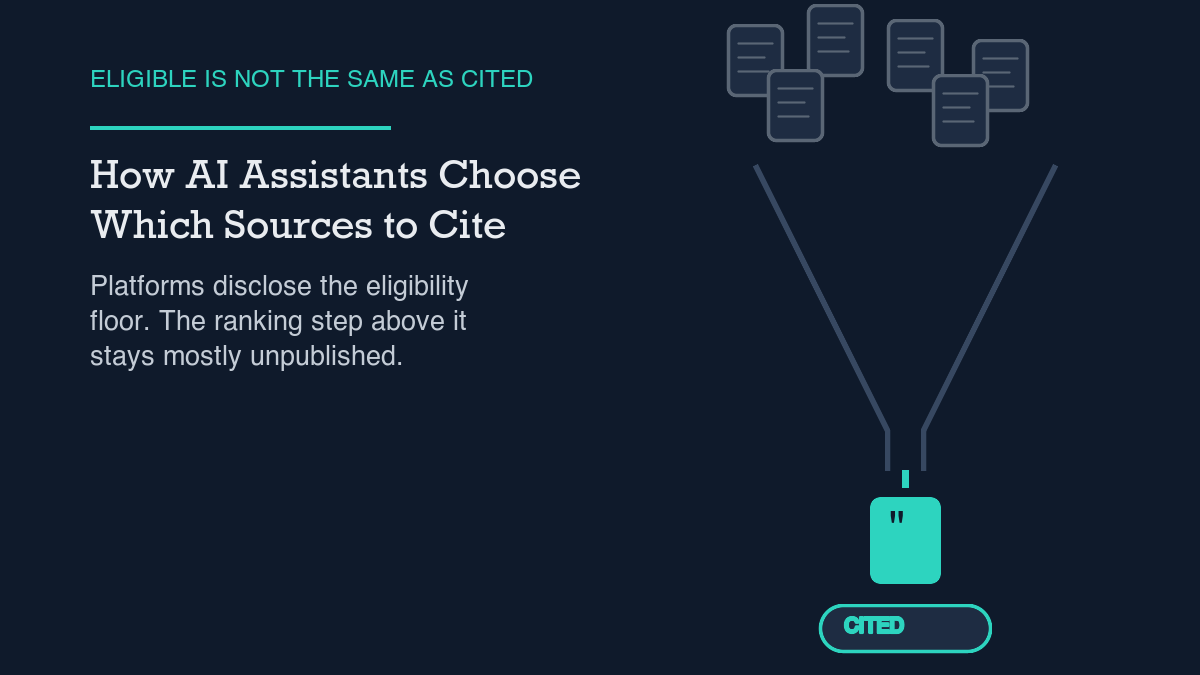
AI assistants pick sources in two separate steps: first a page has to clear a basic eligibility bar (indexed, and in Google’s case, snippet-eligible), then a ranking layer picks which eligible pages actually get named. The platforms themselves disclose the first step in detail and the second step barely at all. Independent researchers have tried to reverse-engineer the second step, and their findings disagree with each other more than you’d expect from a settled system.
I run this site as an experiment in showing research rather than asserting conclusions, so I want to be upfront about what follows. I read the primary documentation Google and OpenAI publish about how their AI features select sources. I also read two independent industry analyses that try to measure the parts the platforms don’t explain. The two kinds of evidence don’t carry the same weight, and I’m going to keep them in separate sections so you can tell which is which.
What platform docs actually say
Start with Google. Its AI features documentation says: “While responses are being generated, our advanced models identify more supporting web pages, allowing us to display a wider and more diverse set of helpful links associated with the response than with a classic web search.” That’s the clearest first-party statement I could find about why AI Overviews cite more pages than a typical ten-blue-links result: the generation process itself surfaces additional candidates beyond the normal ranking pass.
On eligibility, Google is specific: “To be eligible to be shown as a supporting link in AI Overviews or AI Mode, a page must be indexed and eligible to be shown in Google Search with a snippet.” No AI-specific gate beyond that. And on the question everyone asks next, Google closes the door directly: “There are no additional requirements to appear in AI Overviews or AI Mode, nor other special optimizations necessary… There’s also no special schema.org structured data that you need to add.” If you’ve seen advice claiming you need a particular markup type to get cited, that advice isn’t coming from Google’s own documentation.
What that page does not do is explain how the “advanced models” choose which of the eligible pages to actually name, or in what order. Indexed-and-snippet-eligible is the floor, not the ranking formula. I looked for a page that fills in that gap and didn’t find one.
OpenAI’s disclosure for ChatGPT search reads similarly thin on mechanics but is more direct about the limits. Its help documentation states: “ChatGPT may search the web automatically when your question would benefit from current information,” and “ChatGPT ranks search results using multiple factors intended to help users find relevant, reliable information.” That’s the entire public description of the ranking step: multiple factors, unnamed. For anyone optimizing for ChatGPT search specifically, this is worth sitting with: there is no public checklist of the factors, because OpenAI hasn’t published one.
What the independent evidence supports
Because the platforms don’t explain the ranking step, a cottage industry of reverse-engineering has grown around it. I want to use this carefully, because most of what I found during research was a chain of citations: one SEO blog citing a number from another SEO blog’s analysis of a third party’s dataset, with the original methodology several links removed by the time it reaches a listicle. I’ve tried to go to the nearest named source in each case and drop anything I couldn’t trace.
One finding I could trace to a named analysis: ziptie.ai’s analysis of Google AI Overviews source selection cites Ahrefs data (an 863,000-keyword dataset) showing that “only 38% of AIO-cited pages now rank in the organic top 10, down from 76% less than a year ago.” Treat the exact percentages as one vendor’s measurement at one point in time, not a universal constant, but the direction is a useful corrective: ranking well organically and getting cited inside an AI Overview are measurably different things, and the overlap between them appears to be shrinking rather than growing.
On accuracy, ziptie.ai’s analysis of how Perplexity answers work cites a Columbia Journalism Review study finding a 37% error rate in Perplexity’s answers. I’m citing this one specifically because it’s a named, external study rather than an internal vendor estimate, and because it matters for a different reason than source-selection mechanics: a citation appearing next to an answer is not the same as the citation actually supporting that answer. That gap is exactly why measuring your own AI citations means checking what’s actually written next to your link, not just counting mentions.
I found several other numbers in the same two source articles — entity-density multipliers, domain-authority correlation coefficients, branded-search lift, citation share by platform, citation probability by ranking position — and I’m leaving all of them out. Each one is attributed by the analysis I read to yet another named vendor (Wellows, Mike Khorev, The Digital Bloom, SellersCommerce, SE Ranking) that I did not independently fetch and verify. Citing a citation of a citation is exactly the chain this site’s evidence standard is built to avoid, so those numbers aren’t in this article even though they looked compelling.
A practical checklist
Given only what’s verifiable above, here’s what I’d actually act on:
- Confirm the page is indexed and snippet-eligible first. Google states this as the floor requirement for AI Overviews and AI Mode; nothing downstream matters if this fails.
- Don’t add markup specifically to chase AI citations. Google’s own documentation says no special schema.org structured data is needed — that spend is better used elsewhere, like general structured-data hygiene that already helps classic search.
- Stop treating organic rank and AI-citation rank as the same metric. The Ahrefs-sourced finding above suggests they’re diverging; track them as two separate numbers, not one.
- Check what the citation actually says about you, not just whether you’re mentioned. Given a documented 37% answer-error rate in at least one assistant, a citation can exist next to an incorrect or unsupported claim.
- Write for the “multiple factors” OpenAI and Google both gesture at but don’t name, by making the page’s core claim extractable in one or two sentences near the top — the same answer-capsule habit this article opens with.
Honest limits of current evidence
Neither Google nor OpenAI publishes the actual ranking factors behind source selection. Everything past “indexed and eligible for a snippet” (Google) or “multiple factors” (OpenAI) is inference, and OpenAI says so itself: “Search results and citations can be incomplete, outdated, or incorrect. Open a cited source to check that it supports the answer, review when it was published or updated, and use an authoritative source when accuracy matters.” That’s the platform’s own warning, not a critic’s.
I’ll apply the same honesty to this site. As of publishing this article, organicos.shivaatripathi.com/how-ai-assistants-pick-sources/ has zero impressions in Google Search Console, because the page doesn’t exist yet at the time I’m writing this sentence. I’m not going to claim traction I don’t have. If this page hasn’t picked up any impressions for queries containing its primary keyword terms within 60 days of publishing, despite being indexed, that’s a sign this specific angle didn’t work, and I’ll say so in a future piece rather than quietly moving on.
The short version: the eligibility bar is public and simple. The ranking logic above that bar is not public, and most of what claims to fill that gap is several citations removed from any primary source. Build for the floor you can verify, measure your own citation outcomes directly, and be skeptical of any number — including the ones in this article — that can’t be traced to a named source you can check yourself.
Leave a Reply