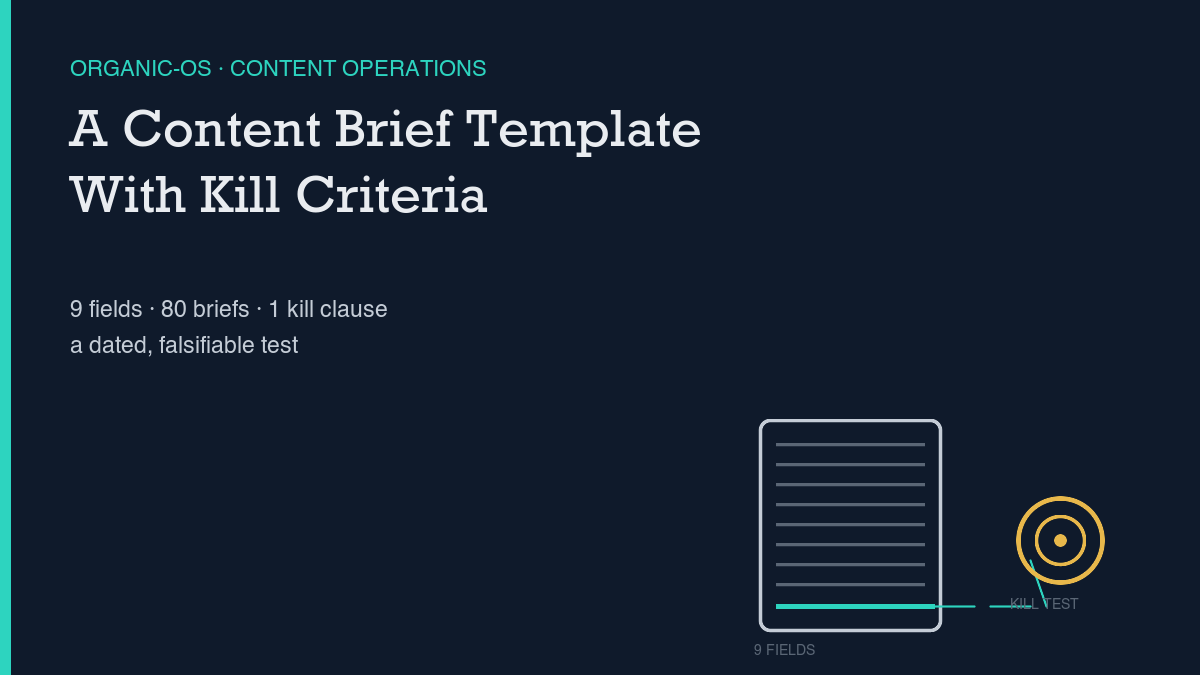
A content brief that is worth reusing needs nine fields, and the one that matters most is the one most templates skip: a kill criterion. On this site every brief names a target keyword, defers search intent to the research stage instead of guessing it up front, discloses plainly when a search-volume figure cannot be verified rather than inventing one, carries two standing contracts for evidence and formatting, and ends with a dated, falsifiable condition that says exactly what would prove the piece wrong. That last field is what turns a brief from a writing prompt into something you can actually grade after the fact.
Most content brief templates stop at keyword, audience, and outline. This one keeps going, because a brief that only tells a writer what to cover never tells anyone, including the person who approved it, whether the resulting page did what it was supposed to do. I read four of this site’s own brief files end to end to write this, including the one this exact article was produced from, and all four share the identical nine-field structure below, word for word in two of the fields.
The nine fields, and why each one is in there
The first four fields are the ordinary ones: a target keyword in backticks, a search-intent line that is deliberately left unresolved (“the research stage must confirm intent against live SERP evidence before drafting”), a standing disclosure that this account’s Keyword Planner access is non-functional so no volume figure gets fabricated, and a working title with an explicit character ceiling. The fifth, angle, is one or two sentences naming the real constraint for that specific piece rather than generic guidance. The sixth, a suggested outline, almost always opens with “direct-answer capsule” as its first line, which is the same unlabeled-paragraph rule writing answer capsules AI engines can quote covers in more depth. The seventh field, internal links, instructs 2-3 links from the existing published cluster and explicitly forbids linking to an unpublished slug, which matters because this batch runs dozens of these briefs at once and half of them have not gone live yet on any given day.
The eighth field is where the template stops being generic. It carries two contracts, verbatim, across every brief checked. The evidence contract: every factual claim must be verified against a live source at draft time and linked, and anything that cannot be verified gets dropped, not hedged. The formatting contract: no meta-label text anywhere in the body, the answer capsule as the real opening paragraph, a custom excerpt set by hand, a generated featured image, and a rendered-page check after publish confirming exactly one author box and no leaked markup. Neither contract is decorative language. Both exist because something specific broke in production and the fix was written into the template so it would not have to be relearned.
What is automated versus what a human still judges
The brief itself is mostly fixed boilerplate, which is exactly the point. The fields that vary piece to piece are judgment calls deferred to a later stage on purpose: intent is confirmed against live search results at draft time, not assumed while the brief is being written, and the specific sources a claim gets verified against are picked by whoever drafts the piece, not prescribed in advance. What is automated is the structure itself, the standing approval that lets a brief ship without a new sign-off, and the mechanical checks, like whether an internal link target is actually published yet. That split is the same one human-in-the-loop content workflows describes more generally: the template does the repeatable part, and a drafting pass still does the part that requires reading an actual source and deciding whether a claim survives contact with it.
The two contracts inside field eight exist because of three specific incidents, not as abstract best practice. The first seven posts this pipeline ever produced opened with a visible “In short:” label inside the answer section, and because no custom excerpt had been set, WordPress’s automatic excerpt pulled that exact label text onto every listing page. The formatting contract’s excerpt-and-no-label-text language is the direct fix, written into the template the same day. Separately, one published post had eighteen Gutenberg block comments that were accidentally backslash-escaped during a shell command, so the live page rendered literal garbage text while the API response describing the same post looked completely clean — which is why the formatting contract now names a rendered-page check specifically, not just an API check. A third incident, unrelated to either contract, is a single approved brief that silently dropped out of the approval queue for weeks because one unescaped apostrophe in its YAML frontmatter broke parsing; a full sweep across all 80 briefs in this batch confirmed it was isolated to that one file, and the fix was switching that field to double-quoted YAML.
The kill criterion, specifically
Field nine, falsifiability, is the field that makes this a template worth defending rather than just a checklist. Every brief in this batch uses the same dated condition: the piece is wrong if, 60 days after publish, Search Console still shows zero impressions for any query containing the primary keyword terms, despite the page being indexed. That is a real kill criterion because it names a specific tool, a specific window, and a specific outcome that would count as failure, rather than leaving success undefined until someone decides after the fact whether the piece “worked.” The same discipline is what running SEO experiments over 30 days argues for across this site’s broader testing practice: a result only means something if there was a stated way for it to come back negative.
For this piece specifically, that baseline is checked before publish, not assumed. A live Search Console pull across this site’s queries from June 1 through October 21 shows zero rows containing “content brief,” “brief template,” or “kill criteria” in any form. That is the clean starting point the falsifiability field needs: if a query containing this piece’s own target terms shows up with real impressions within 60 days, something worked; if the page stays indexed with nothing to show for it on those exact terms by then, the stated condition has been met and that should be reported as a failure, not quietly dropped from the record.
This brief, as a worked example
This article is itself an instance of the template it describes, which is the most concrete evidence available for whether the nine fields actually work end to end. The brief it came from carries the same angle language as its siblings (“concrete process over theory; include the gates that exist because something broke”), the same five-part outline starting with a direct-answer capsule, and the same falsifiability clause described above. It is also not a one-off: this is the 55th of 80 briefs in the same standing batch to reach publish, following a single approval given once on 2026-09-02 and never revised since, the same batch mechanics automating a content calendar without losing judgment walks through in more detail. A template that only works for one piece is a draft. One that has now produced 55 separate, individually verified pages from the same nine fields, each with its own checked evidence and its own rendered-page verification, is closer to infrastructure than to advice.
None of that is a claim that the template produces a good result every time. Several fields in it, like the standing Keyword Planner disclosure, exist specifically to admit a limitation rather than paper over it, and the falsifiability field exists because some fraction of these 55 pages will fail their own stated test. What the template buys is narrower and harder to overstate: every piece produced from it carries a stated way to check, later, whether it was worth writing, instead of leaving that question unanswered the way most outlines do.
- Name the kill criterion before drafting, not after publishing, so there is no room to redefine success once the result is in.
- Carry the evidence and formatting contracts in the brief itself, not in a separate style guide nobody rereads mid-draft.
- Defer search intent and source selection to the drafting stage, and keep the brief’s own boilerplate fixed, so judgment stays where it belongs and the repeatable parts stay repeatable.
Leave a Reply