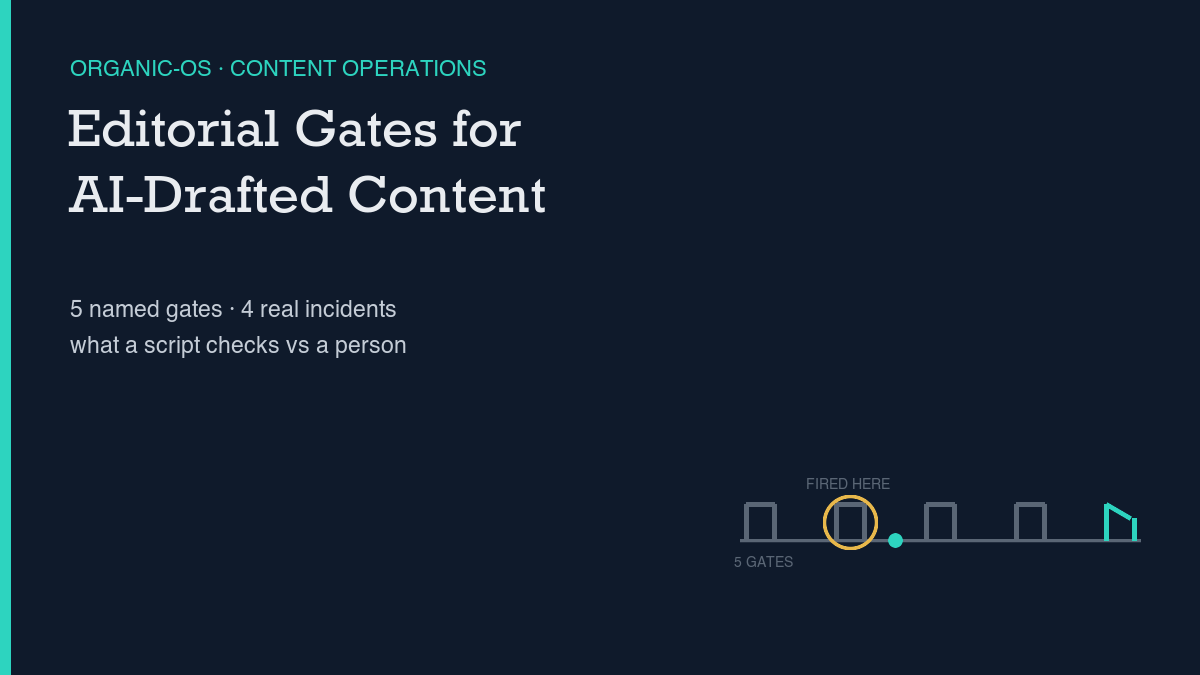
Five concrete gates stand between an AI-drafted paragraph on this site and a live URL: a written brief with a dated kill criterion, a research pass that drops any claim it cannot verify against a live source, a structural QA check that scans for leaked label text and broken markup, a voice-and-banned-phrase edit pass, and a post-publish check against the actual rendered HTML, not just the API response that created it. None of those five exist because someone read a best-practices list. Each one was added after a specific defect reached, or nearly reached, a live page, and this article names which defect built which gate.
“Editorial process” sounds like a diagram. In practice it is a short list of checkpoints a draft has to clear before it is readable by anyone who is not on the team producing it, and the honest test of any such list is whether a failed check actually stops the page from going live. Below is what that list looks like on this specific site, what runs as code versus what still needs a person, and the real incidents that put each gate there.
The gates, named stage by stage
Every piece here starts as a content brief with a dated kill criterion, not a blank prompt. The brief names a target keyword, defers search intent to the next stage instead of guessing it, and states up front what would make the piece wrong 60 days after publish. Research comes next: every statistic or named source in the draft gets checked against a live page at draft time, and anything that cannot be traced to a real source gets deleted rather than softened with a hedge word. Drafting follows, written to match a fixed voice profile. Then a structural QA pass runs a set of mechanical checks against the draft file itself – word count, Gutenberg block balance, banned-phrase and label-leak scans. An edit pass checks voice and sets the SEO fields by hand. A featured image gets generated and uploaded. Only then does the post go live, and even that is not the last gate: the live HTML gets fetched and re-checked after publish, separately from the API response that created it.
That order is not arbitrary. A 2026 analysis of AI content workflows found teams repeatedly building the opposite shape by accident – review scattered across every stage with no single accountable checkpoint, summarized bluntly as “everyone reviewed something, nobody owned a gate.” The fix it recommends is a small number of clearly separated gates rather than diffuse review, which is the same reason this pipeline keeps structural QA, voice editing, and post-publish verification as three distinct steps instead of one combined “look it over” pass.
What a script checks and what a person still has to judge
The mechanical gates are genuinely mechanical: a regex can count whether wp:paragraph tags are balanced, whether any word on a fixed banned-phrase list appears, whether the word count sits inside a target range, or whether a slug already exists as a draft so the pipeline updates instead of duplicating a post. None of that requires judgment, which is exactly why it is automated – a person checking block-tag balance by eye is a waste of a person.
What a script cannot do is decide whether a cited claim actually means what the draft says it means, whether an internal link is contextually honest or just keyword-stuffed, or whether the piece’s voice reads as this site rather than as generic AI output. That split matches what human-in-the-loop content workflows argues more generally: automation should own the repeatable, rule-based work, and judgment should stay wherever a wrong call is expensive or hard to detect automatically. It also matches updated external guidance directly – Google’s AI content guidance, updated October 2026, now states that manually fact-checking AI-generated content before publishing is “critical,” and extends that review past the visible article text to AI-generated titles, meta descriptions, alt text, and structured data, on the reasoning that generative systems predict a plausible sequence of words rather than retrieve verified facts.
There is also a legal version of the same split now in force. The EU AI Act’s Article 50 transparency rules took effect on 2 August 2026, requiring disclosure when AI-generated text on a matter of public interest is published – the same disclosure question whether to disclose AI content covers from the publisher’s side. The rule carries an exemption, but a narrow one: it applies only where the content “has undergone substantive human editorial review with a person assuming editorial responsibility,” and a merely cursory check does not qualify. The exemption exists for the same reason this pipeline keeps a named editor pass as its own gate rather than folding it into drafting – a review step only counts, legally or otherwise, if it is substantive and attributable to someone.
Four gates that exist because something broke
Here is the before-and-after, with the actual defects. The first seven posts this pipeline ever produced opened with a visible “In short:” label inside the answer section, and because no custom excerpt had been set, WordPress’s automatic excerpt pulled that exact label text onto every listing page on the site. The fix was not “write better prompts” – it was a standing rule that body copy may never contain label text and that an excerpt must always be set by hand, checked mechanically on every draft since.
Second: one published post had eighteen Gutenberg block comments that were accidentally backslash-escaped, so the live page rendered literal garbage text to a reader while the WordPress REST API response describing that same post looked completely clean. That gap – API looks fine, live page does not – is why this pipeline treats “fetch and read the actual rendered HTML after publish” as its own non-negotiable gate, separate from trusting the response that came back from creating the post.
Third: the queue-processing step crashed outright the first time a leftover .draft.md scratch file sat next to a real brief in the same folder, silently blocking every item behind it until someone noticed. Fourth, and the quietest failure of the four: a single approved brief had one unescaped apostrophe inside its YAML frontmatter, which broke the file’s parsing and dropped it out of the approval queue with no visible error for weeks. It was found only by sweeping every brief file in the batch and confirming the defect was isolated to that one file. None of these four gates were speculative hardening. Each exists because a specific, dated incident already happened once, and each is checked mechanically now so it does not need to be relearned by hand.
The stakes for skipping this kind of gate are not hypothetical at a larger scale, either. In January 2023, CNET quietly published 77 AI-written financial explainer articles before disclosing that an AI tool had written them. A later internal audit found 41 of those 77 required corrections – more than half – including at least one article that stated a saving account would earn $10,300 in interest where the correct figure was $300, plus separate plagiarism flags where a tool meant to catch copied phrasing missed it. CNET paused the program afterward. The specific mechanism of that failure – fact-checking and plagiarism-checking treated as optional rather than as a gate that blocks publication on failure – is the same mechanism this site’s own four incidents trace back to, just caught earlier and at far smaller scale.
Whether the gates are actually working
A gate is only worth keeping if it has a way to fail honestly, not just a way to feel thorough. Two practical tests apply here. First, has each gate caught something real since it was added, or has it only ever returned a clean pass – a gate that never fires is either genuinely unnecessary or not actually being run. Second, does every published piece carry its own dated condition for being judged wrong later, the same kill-criterion field the brief gate requires, so that “did this work” has a stated answer instead of becoming a retroactive decision about whether the piece “feels” successful. A pipeline that cannot point to the real incident behind one of its own checks, or that cannot name what would prove a specific published piece wrong, is running a checklist rather than a set of gates, and keeping an audit trail of what was actually checked is what makes the difference verifiable instead of asserted.
None of this claims the gates catch everything. A mechanical scan for banned phrases or broken block tags will never catch a subtly wrong claim that reads fluently, which is exactly the class of error the human editorial-review stage – and the EU’s narrow exemption test for it – exists to cover instead. What the five gates buy is narrower and easier to defend: every piece that reaches a live URL on this site has passed a stated, checkable sequence, and every rule in that sequence can be traced to the specific day something got through without it.
Leave a Reply