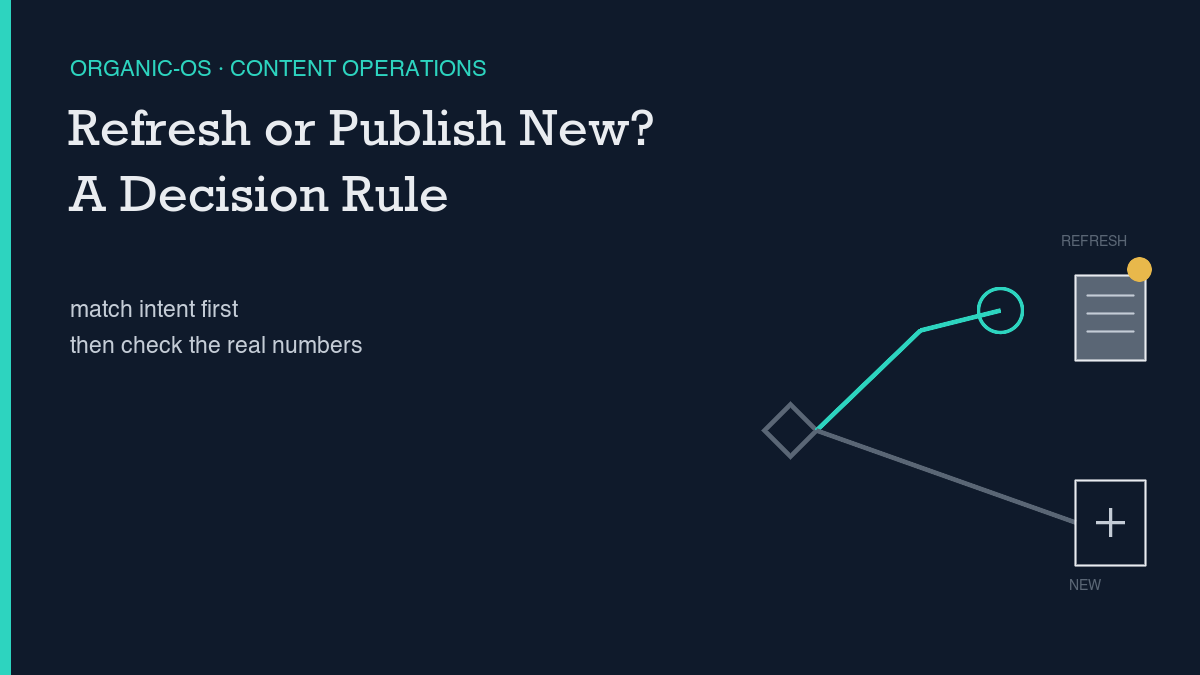
Refresh an existing page when the search intent it targets has not changed and the page already has some ranking history worth keeping – stale stats, thin sections, or an outdated example are reasons to rewrite in place, not reasons to start over. Publish something new when no page on the site actually addresses the intent yet, or when the intent itself has shifted so far that the old framing cannot be patched. Everything else is a judgment call that a single ranking-position check cannot make for you, which is why this site treats it as a named decision step rather than a reflex.
“Should this become a new post or an edit to an old one” sounds like a small question. On a site that ships new content daily, it is a recurring one, and answering it wrong in either direction has a cost: refreshing a page that should have been retired wastes a pass on something with no real intent match, and publishing a new page next to one that already half-covers the topic creates two pages competing for the same query instead of one page that actually wins it. Below is the rule this pipeline actually uses, what part of it runs as a check versus what still needs a person, and two real examples from this site’s own history – one refresh that worked as a correctness fix and one that was tried, measured, and did not move the number it was supposed to move.
The decision rule, named stage by stage
The rule runs in a fixed order, and the order matters more than any single check inside it. First: does a live page on this site already target the same search intent as the topic under consideration? If yes, the default is refresh, not create – a second page competing with the first for the same intent is a problem to avoid, not a volume strategy. Second, if a page exists, has the intent behind the target query actually shifted, or is the page just stale – old numbers, a missing subtopic, an example that no longer applies? Intent-shift calls for a more substantial rewrite of the existing URL; staleness calls for a lighter update of specific sections. Third, if no page exists at all, or the existing page’s whole framing no longer matches what the query now expects, that is the case for something new. None of this is a vibe check. It is answered by pulling the page’s actual Search Console history for the target query – position, impressions, and whether it still gets any impressions at all – before deciding anything.
Google’s own documentation gives the reason freshness is not a blanket argument for refreshing everything, everywhere, on a schedule. Its search ranking systems guide states plainly that it runs “various ‘query deserves freshness’ systems designed to show fresher content for queries where it would be expected” – news, new releases, fast-moving topics. A query that does not expect fresh information does not get a freshness boost just because a page was edited yesterday. That is the real argument against treating “refresh everything every quarter” as a rule: freshness only pays off where the query itself calls for it, which means the first question in the decision above is always intent-match, not last-edit date.
What a check can decide and what still needs a person
Some of this rule is genuinely mechanical. Whether a live URL already exists for a given slug or topic is a single REST lookup, not a guess – this pipeline runs that duplicate check before every single piece, refresh or new, specifically so a produce run never accidentally creates a second page next to one that already exists. Whether a page’s impressions for its target query have gone flat, fallen, or disappeared entirely is a Search Console pull, not an impression. Those two checks alone resolve a large share of the easy cases: page exists, still gets impressions, same intent – refresh it; no page exists at all – write something new.
What a check cannot decide is whether the existing page’s framing is actually wrong for the query now, as opposed to merely old. A page can be three years old and still exactly match what a reader wants; a page published last month can already be the wrong angle if the query’s intent moved faster than the content did. That judgment – does this page still answer the question the query is actually asking, not just the question it was asking when the page was written – is exactly the kind of call human-in-the-loop content workflows argues should stay with a person rather than get automated away, because getting it wrong is expensive and the automation would have to re-derive intent correctly every time to be trusted. The same split shows up in how this pipeline’s own editorial pass works: its gates separate mechanical checks from judgment calls on purpose, rather than folding both into one review step.
Two real refreshes from this site, with the actual numbers
On 2026-08-22, this pipeline refreshed the title and meta description on its own flagship explainer page to target a higher-impression query variant it was not yet winning – swapping “What Is an AI SEO Agent?” for “What Are AI SEO Agents?” to match the plural phrasing a real query was using, at a starting position of 20.5 with 2 impressions. The record attached a stated falsifiability condition up front: wrong if position had not improved and impressions had not risen above the trailing median by day 28. Day 7 showed no movement. Day 28 showed the same position, 20.5, and the same 2 impressions – flat, not improved. The outcome log closes this one with an explicit verdict: falsified. The refresh was real, it was measured on its own terms, and it did not work. That result is published here rather than quietly dropped, because a decision rule that only reports its wins is not a decision rule, it is a highlight reel.
A second refresh from the same week shows the other, more common shape: not every edit is a bet on moving a ranking, some are just fixing something broken. Two meta descriptions had quietly grown past Rank Math’s display limit and were getting truncated in search results. The fix was a straight trim back under the character limit on both pages – no new angle, no intent change, nothing to measure at day 28 because there was no ranking claim attached to it in the first place. A third attempt, rewriting homepage copy to add a missing keyword, landed two of its three intended changes cleanly through the available WordPress REST surface and hit a real platform wall on the third – a duplicate-heading issue baked into the site’s block-theme template, which no content-level edit can reach. That one is still logged as partially applied, with the specific remaining fix named for a human to do through the Site Editor rather than quietly marked done.
Telling whether the rule itself is working
The honest test of a decision rule like this is not whether it feels reasonable on paper. It is whether every refresh attached to it leaves a checkable before-and-after number, the same way the KPIs this site actually tracks are chosen because they can be checked, not because they sound impressive. A refresh with no stated falsifiability condition is just an edit with no accountability attached – which is exactly the gap the pillar-page example above was built to avoid, and exactly why it is reported as a failure here instead of being left out. The same discipline applies on the “new” side of the rule: watching for content decay across the whole site is what eventually tells this pipeline a given refresh-versus-new call was premature – a page that keeps losing impressions after a refresh was not a refresh problem to begin with, it may have been a new-content gap the refresh could never close.
None of this produces a rule that is right every time. It produces a rule that is checkable every time, which is a different and more useful property. A refresh that does not move its own stated number is logged as falsified rather than quietly forgotten, a partially-applied fix names the exact remaining gap instead of rounding up to “done,” and the next piece this pipeline produces inherits that record rather than repeating the same untested assumption about what a title tweak can do.
Leave a Reply