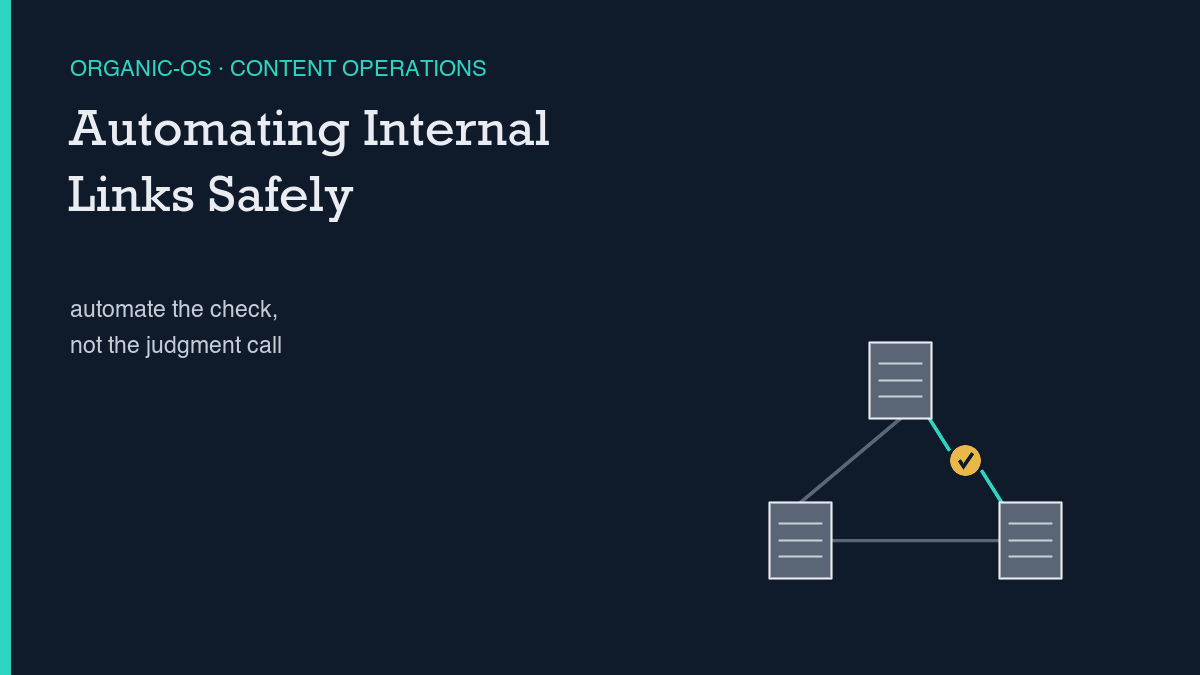
Automate the two checks that are genuinely mechanical – confirming a link target is a real, live, published page before it goes in, and confirming after publish that the link actually made it into the rendered HTML – and leave the one judgment call that is not mechanical, picking which 2-5 pages are contextually relevant enough to link from a given paragraph, to a person or an editorial pass. Skipping the second check is how this site once shipped a page with a missing internal link it believed it had already added.
Searching for “automate internal linking” mostly surfaces plugin roundups – Link Whisper, Internal Link Juicer, AIOSEO’s Link Assistant, half a dozen others, each comparing install counts and pricing tiers for a tool that scans your content and suggests a destination page for you to click “accept” on. That is a different problem from the one a daily-publishing pipeline actually has, which is not “where should a link go” but “how do we make sure every link we already decided on actually exists, actually renders, and does not quietly disappear between the draft and the live page.” This is how this site’s own pipeline automates that second problem, what it still refuses to automate, and the one time skipping a check let a page ship with a link missing.
The two checks that are actually mechanical
The first automated check runs before a single link goes into a draft: a live REST pull against the site’s own WordPress install, confirming that every candidate destination is an actual published post right now, not a slug remembered from a prior run or a sibling piece that is still sitting in draft. That distinction matters more than it sounds – this pipeline has shipped a piece before where one of its intended internal links pointed at a sibling post from the same batch that had not been published yet, and the link 404’d until the second post went live. The fix was not “remember better,” it was “never trust memory for this – pull the live, published post list every time, right before writing the link in.”
The second automated check runs after publish, against the live rendered page rather than the draft file: a scan of the actual HTML a browser or a crawler would receive, confirming each intended link’s href is present in the article body, confirming there is no leftover Gutenberg block-comment syntax leaking into visible text, and confirming the page returns HTTP 200. Google’s own link documentation frames why this is worth checking mechanically rather than assuming it from the draft: its SEO link best-practices page states that “every page you care about should have a link from at least one other page on your site,” which only holds if the link that was supposed to exist actually survived the trip from draft to published HTML – a draft that says a link is there is not the same fact as a live page that renders it.
What stays a human call
Neither check decides which pages should link to which. That is still judgment, and this pipeline treats it that way on purpose, the same split human-in-the-loop content workflows argues for more generally: automate the parts where a wrong answer is cheap to catch and expensive to repeat, leave the parts where a wrong answer is expensive to catch to a person or an editorial pass. Picking 2 to 5 relevant destinations for a given piece is squarely in the second category – a mechanical keyword-match linker (the kind the plugin roundups above are built around) will happily link the word “automation” to an unrelated page every time it appears, which is exactly the chained, context-free linking Google’s own guidance warns against: “don’t chain up links next to each other; it’s harder for your readers to distinguish between links, and you lose surrounding text for each link.” Choosing relevance, not just keyword overlap, is still a per-piece editorial decision here, done during the draft and the editor pass, not handed to a matching rule.
Anchor-text wording is the other half of that same judgment call. The same Google guidance is specific about what good anchor text looks like – “descriptive, reasonably concise, and relevant to the page that it’s on and to the page it links to” – which rules out both generic anchors like “click here” and over-stuffed exact-match keyword phrases dropped in solely to carry ranking signal. This pipeline’s own stage-by-stage process treats writing the anchor text as part of drafting, inside the sentence it naturally belongs in, rather than as a separate linking pass bolted on afterward – “the words before and after links matter,” as the same guidance puts it, and that only holds if the link was written into the sentence, not inserted around it.
The time skipping the second check cost a link
On 2026-07-31, this pipeline published a piece intending four internal links, including one to its own homepage. The editor notes for that run claimed all four links were present. The post-publish render-verification check – at that point a newer, less-trusted step – ran anyway, scanning the actual live HTML rather than trusting the notes, and found only three of the four links in the rendered page. The homepage link was missing; it had been written into an earlier version of the paragraph and dropped during a later edit, and nothing before the render check would have caught that, because the draft file itself looked fine on a read-through. The fix was mechanical once the gap was visible: add the link back into the paragraph, push the corrected content to the live post, and re-run the exact same render-verification scan to confirm all four links were now actually there before marking the run done.
That single incident is the direct reason the render-verification check is no longer optional or skippable on a “the editor notes already said it’s fine” basis. It runs on every publish now, checking the live page rather than any file that claims to describe it, specifically because a file that claims a link exists and a page that actually renders it turned out to be two different facts on at least one real occasion. This site’s editorial gates exist because something broke before, not as a precaution taken in the abstract, and the post-publish link check is one of them.
Telling whether this is actually helping
The honest way to check whether automating these two steps is worth the overhead is to watch whether the failure mode they are built to catch – a link that the draft says exists but the live page does not render – still happens after the check is in place. Since the 2026-07-31 incident, every subsequent publish run in this pipeline has included the same render-verification pass as a required step before the run is recorded as done, and the decision log for each one states explicitly whether every intended link was found present on the first scan or required a repair-and-rescan cycle. The broader pattern this site follows for WordPress automation generally is the same one: plugins and scripts can surface a change or a suggestion, but something still has to verify, against the live site, that what was supposed to happen actually did – and for internal links specifically, “actually did” means fetching the published page and finding the link in it, not re-reading the file that was supposed to produce it.
Leave a Reply