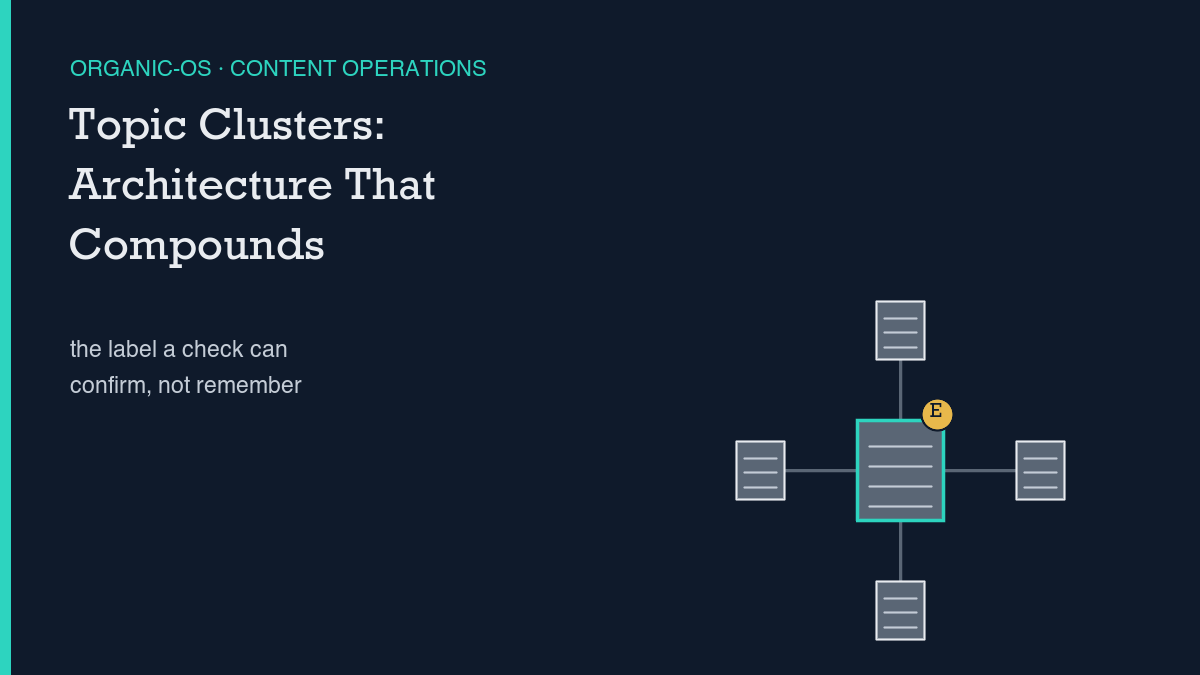
A topic cluster is a group of related pages that link to each other and to one shared pillar page, so search engines read the whole group as coverage of one subject rather than as scattered, unrelated posts. Architecture that compounds means the cluster label is a structured field checked by a script, not a sentence a person has to remember – this site switched from the second to the first on 2026-09-02, and the difference is the subject of this piece.
HubSpot’s own description of the model is specific: “topic clusters organize a group of related content pieces (cluster pages) around one central pillar page,” with the pillar covering a subject broadly and each cluster page addressing one subtopic underneath it. Google’s search-starter guidance backs the same instinct from the crawling side – “when you’re setting up or redoing your site, it can be good to organize it in a logical way because it can help search engines and users understand how your pages relate to the rest of your site.” Neither claim is about writing better sentences. Both are about structure: whether a reader or a crawler can tell that twelve pages belong together without being told so in prose.
The process, named stage by stage
This site’s current batch of 80 content briefs, approved as a standing batch on 2026-09-02, groups every brief into one of seven lettered clusters, A through G. Each brief’s own “Expected effect” field states its cluster directly – “Extends cluster E,” for example – which is what lets a later check grep every brief file for that label and get a clean answer about which slugs are supposed to interlink, instead of a person having to remember a loose topical grouping from memory. This piece is itself cluster E’s seventh of twelve briefs, following six already-published cluster-E posts: automate-content-calendar, publishing-daily-experiment, a content brief template, editorial-gates-ai-content, content-refresh-vs-new-posts, and automating internal links safely.
Writing the cluster label into the brief is the pillar-and-cluster model in its most mechanical form. HubSpot’s own page frames the payoff as structural rather than stylistic: “internal links pass authority between the pillar and cluster pages, anchor text tells crawlers how each page relates to the others, and the overall structure consolidates a previously scattered set of posts into a single topical unit.” That only works if the links actually get written – a labeled cluster field tells a drafting pass which existing published posts are candidates to link to, but it does not write the link itself. Picking two to five of those candidates that are genuinely relevant to a given paragraph, and writing anchor text that is not just a keyword dropped in for ranking signal, is still an editorial step done per piece, not a side effect of the label existing.
What is automated, and what a person still judges
Two parts of this are mechanical checks, not editorial judgment, and this site’s own prior piece on automating internal links covers both in detail. The first runs before a single link goes into a draft: a live REST pull against the site’s own WordPress install confirming that every candidate destination is an actual published post right now, not a slug remembered from a prior run or a sibling piece still sitting in draft. The second runs after publish, against the rendered page rather than the file that produced it: a scan of the live HTML confirming each intended link’s href actually made it into the article body, because a draft that says a link exists and a page that renders it have turned out, on at least one real occasion on this site, to be two different facts.
What neither check does is decide which pages should be in the same cluster, or which of a cluster’s pages are relevant enough to link from a specific sentence. That assignment happens once, at brief-writing time, as a human or editorial call about which 80 topics belong in which of the seven lettered groups – a judgment about subject-matter adjacency, not something a script can infer from a slug. It is worth separating this from WordPress’s own category taxonomy, which looks similar but solves a different problem: category pages are a built-in archive view generated from a single taxonomy field, while a topic cluster is an editorial grouping that can, and often does, span multiple categories and gets expressed through in-content links rather than a taxonomy term alone.
Before and after, on this site specifically
Before 2026-09-02, this site’s briefs referenced cluster membership only in loose prose. An August 2026 brief on GEO versus SEO versus AEO, for one example, states its expected effect as “extends the AI-SEO topic cluster” – true, but not a field a script can check across every brief at once, and not something that tells a drafting pass exactly which other slugs are in that cluster without a person re-reading several files. After 2026-09-02, every one of the 80 Wave-5 briefs carries a one-line, lettered “Extends cluster X” statement, confirmed this session by grepping all 80 brief files directly: every single one returns a clean A through G label, with no exceptions and nothing left to infer.
That is a small change in a frontmatter field, and it is also the entire difference between a topic cluster that exists because someone remembers it and one that exists because a check can confirm it. It does not, by itself, write a single internal link – the six cluster-E posts published so far still needed a person to pick which two to five of the other eleven cluster-E briefs were relevant enough to cite in a given paragraph, and the mechanical link-verification pass described above still needed to run on each one after publish. The label makes the grouping checkable. It does not make the linking automatic.
Telling whether the architecture is actually helping
The honest test of a cluster architecture is not whether the label exists, it is whether a reader or a crawler landing on any one cluster page can find the others without searching for them, and whether those pages start showing up in Search Console for queries that touch more than one of them. This piece’s own brief sets that exact bar: it is wrong if, 60 days after publish, this URL has zero GSC impressions for any query containing the primary keyword’s terms despite being indexed – the same falsifiable, dated condition this site attaches to every brief rather than a vague “we expect this to help.” Entity and topical-authority signals point the same direction from a different angle: a cluster of pages that consistently link to and reference the same subject gives search engines more to work with than one isolated page claiming expertise, which is the same logic covered in this site’s piece on entity SEO for small sites. None of that is a guarantee that a specific page ranks. It is a structural condition – links that actually resolve, labels that are mechanically checkable, a kill date on the claim – that makes a cluster’s performance something this site can measure rather than something it has to assume.
Leave a Reply