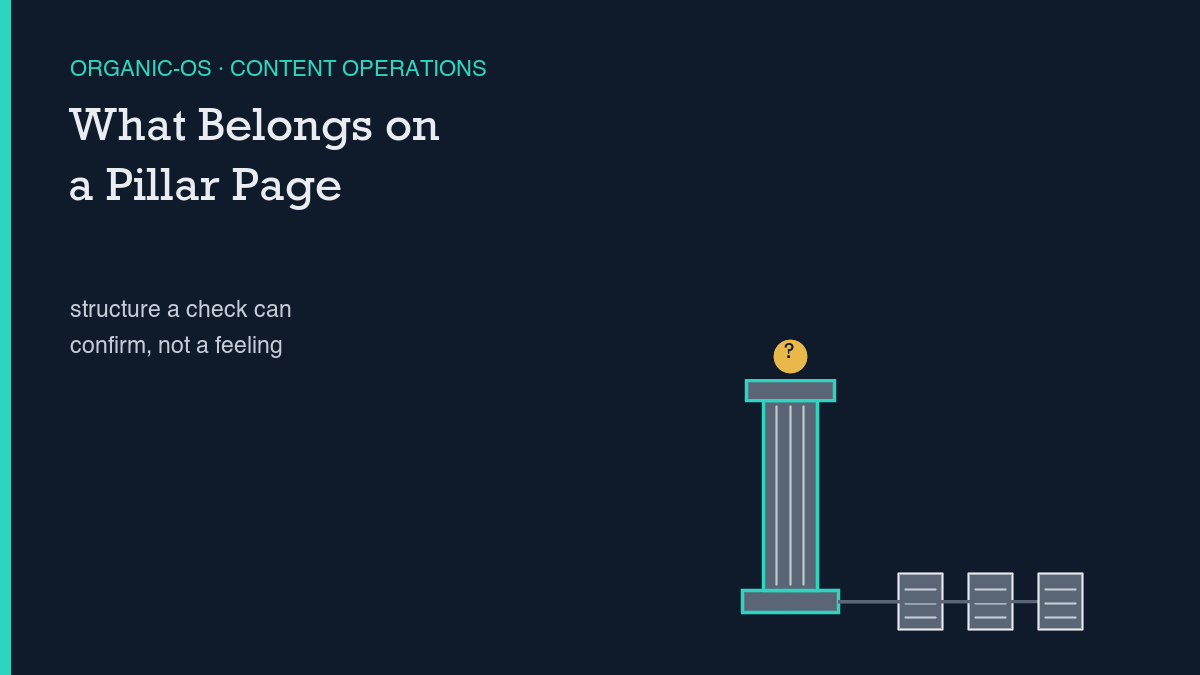
A pillar page belongs to broad, complete coverage of one topic, plus working links out to the narrower cluster posts that go deeper on each piece of it – it should not try to be the deep piece itself. HubSpot’s own definition puts it plainly: a pillar page “covers all aspects of the topic on a single page, with room for more in-depth reporting in more detailed cluster blog posts that hyperlink back to the pillar page.” This site has one real pillar page built against that definition, and checking it directly – headings, links, and one leftover label this piece caught while writing it – is the worked example below.
“Broad and complete” is not a feeling; it is checkable against specific pieces. HubSpot’s pillar-page guidance adds that pillar pages “broadly cover a particular topic” while cluster content addresses “a specific keyword related to that topic in-depth,” and that a pillar page runs longer than a typical post precisely because it has to cover every angle without going deep on any single one. Google’s own helpful-content guidance asks a version of the same question from the ranking side: “does the content provide a substantial, complete, or comprehensive description of the topic?” Neither source hands over a checklist. Both point at the same gap a pillar page has to close – a reader should be able to get the whole shape of a subject on one page, then follow a link to go deeper on any one part of it.
What a pillar page has to cover, piece by piece
In practice that breaks into four pieces that recur across the pillar pages worth studying: a direct definition near the top, a named process or structure underneath it (the actual mechanics of the topic, not just an overview paragraph), an evaluation or decision section that helps a reader judge their own situation against it, and a set of outbound links to the cluster posts that each take one piece further than the pillar page goes. Leave any one of those four out and the page either reads as too thin to be a pillar (no definition, no structure) or tries to do a cluster post’s job on top of its own (going deep on one sub-topic instead of linking to a page that already does), which is the exact overlap HubSpot’s definition is written to prevent.
This site’s own topic-cluster structure, covered in more detail in the piece on topic cluster architecture, is what the fourth piece depends on: a pillar page cannot link out to cluster posts that do not exist yet or are not live, so the same lettered cluster field that tells a drafting pass which posts belong together is also what tells a pillar page which links it is allowed to make at any given time.
What a check can confirm, and what still needs a person’s eye
Two of those four pieces are mechanically checkable and two are not. Whether an outbound link actually resolves to a live, published post – rather than a slug that is still a draft or was renamed since the pillar page was last touched – is a fact a script can confirm with one REST call, the same pre-publish link-target check and post-publish render check this site runs on every piece it ships. Whether a structured field like a cluster label exists on the underlying brief is equally binary – the field is either present or it is not, the same way this site’s own brief template makes a cluster assignment a line a script can grep for instead of a fact an editor has to remember.
What no check can confirm is whether the definition at the top is actually complete, or whether the evaluation section actually helps a reader who does not already know the answer – both of those are judgment calls about the content itself, not about whether a field exists or a link resolves. A page can pass every mechanical check (links live, cluster field set, FAQ schema present) and still fail at being a pillar page, if the definition is vague or the evaluation section just restates the definition in different words instead of giving the reader something to decide with.
This site’s own pillar page, as the worked example
This site has one page built as a pillar in that sense: What Is an AI SEO Agent?, which carries a definition section, a step-by-step section on the observe-propose-approve loop, an evaluation section for judging a tool against it, and a frequently-asked-questions section with its own schema – plus four outbound links into the cluster posts that each take one of those pieces deeper. Checked directly against the live page this session, every one of those four links resolves to a currently published post, and the FAQ section is marked up with FAQPage schema that is actually present in the rendered HTML, not just claimed.
The same direct check also found a leftover: the page still opens with a bolded “In short:” label ahead of its answer, the exact pattern this site’s own formatting rule – written after label text leaked into auto-generated excerpts on seven posts in July 2026 – now forbids on every piece published since. The pillar page itself predates that rule and has not been touched since, so it is the one page on this site where the before-state of that rule is still live and checkable rather than something this piece has to take on faith. That is the actual before/after a pillar page produces when the rule changes but the page does not: the structure (definition, process, evaluation, links) still holds up, but one surface detail falls out of date until someone goes back and fixes it – a gap this review surfaced rather than one left to assumption.
The same pillar page is also where this site logged a real, negative result from trying to improve it: on 2026-08-22 its title and meta description were rewritten to target a specific plural-phrasing query, measured against its own stated falsifiability bar at day 7 and again at day 28. Both checkpoints came back identical to the pre-change baseline – position flat at 20.5, impressions flat at 2 – and the record was closed with an explicit FALSIFIED verdict rather than rounded up to a win. Getting the pillar structure right does not, by itself, guarantee that a specific wording change on top of it moves a specific query; this site’s own outcome log says so about its own pillar page, not as a hypothetical.
Telling whether the structure is actually helping
The honest test of a pillar page is not whether it has the four pieces, it is whether a reader landing on it can get the shape of the whole topic and then find the right cluster post for the part they actually care about, and whether that pattern shows up as GSC impressions across a spread of related queries rather than a single phrase. This piece’s own brief sets a dated version of that bar for itself: wrong if, 60 days after publish, this URL has zero GSC impressions for any query containing the primary keyword’s terms despite being indexed – the same falsifiable, kill-datable condition this site attaches to every brief, including the one that produced the FALSIFIED result above. Comprehensiveness and linking structure are the same signal Google’s helpful-content guidance and the entity and topical-authority work covered in entity SEO for small sites both point at – a page that is legibly complete and well-linked gives a reader and a crawler more to work with than one that is not. None of that is a guarantee that any specific page or query moves. It is a structural condition that makes a pillar page’s performance something this site can measure and log honestly, including when the answer is no.
Leave a Reply