Category: Uncategorized

  • Evidence-Based Content: A Working Contract

    Evidence-Based Content: A Working Contract

    On this pipeline, evidence-based content is a specific working contract, not a mood: every factual claim in a draft gets traced to a source, that source gets opened and checked word for word against what the draft actually says, and any claim that fails the check gets rewritten or dropped before the post goes live, never after. A source returning an HTTP 200 is not the same thing as a source saying what the draft claims it says, and treating those as interchangeable is exactly the gap this contract exists to close.

    “Evidence-based” gets used loosely in content marketing, often meaning little more than a few outbound links dropped in for the look of rigor. Google’s own guidance on helpful content frames trust differently: a trustworthy page shows “clear sourcing, evidence of the expertise involved, background about the author or the site that publishes it.” Sourcing is the mechanism, not the decoration – and the same guidance is explicit that a citation does not do the work by itself: “Attribution or giving credit to other sources doesn’t replace the need for original effort.” Linking to a source is a footnote. Checking that the source actually supports the sentence sitting next to the link is the part that makes a claim evidence-based, and that check is where most “evidence-based” content quietly stops short – the link exists, but nobody on the other end re-opened it before hitting publish.

    The process, stage by stage

    The mechanics this site runs are close to a published four-step verification model worth citing directly, because it names the failure modes plainly rather than gesturing at “being careful.” First, mark every checkable claim in a draft – “prices, results, product capabilities, legal or health-related statements, dates, comparisons and customer quotes” – before touching the prose at all, so editing for style never happens before the facts underneath it are settled. Second, verify each one against the closest reliable source – “an original study, an official page, a documented product note” – and if two sources disagree, resist the pull toward the biggest number: “If several sources disagree, do not choose the most exciting number.” Third, log a decision per claim, not a blanket pass over the whole draft: “confirmed,” “rewritten,” “removed,” or “waiting for owner.” Fourth, anything that still cannot be pinned down after that gets the same treatment every time, with no exception carved out for a claim that would make a better headline: “If you cannot find solid evidence, use more careful language or remove the sentence.”

    This site’s own version of that fourth step runs claim by claim at draft time, the same shape described in the brief template that originates the contract clause: every brief this pipeline produces carries the identical instruction, word for word, that a claim with no live, checkable source does not ship. The four stages above are not a different system from this site’s own – they are the same shape, independently arrived at, which is itself a small piece of corroboration that the method is not idiosyncratic to one pipeline.

    What a script checks and what a person still has to decide

    A script can confirm a URL returns HTTP 200. It can grep the raw HTML for an exact substring and report true or false. It can count outbound links, flag banned phrases, and catch a leaked label like “In short:” sitting where an auto-excerpt will grab it – the exact defect this site’s own editorial gates were built to catch after it shipped on seven live posts. It can also diff a submitted payload against what WordPress actually saved, and re-fetch a live page after publish to confirm no Gutenberg comment syntax leaked into visible text. None of that requires judgment; each one is a pattern match against a known, nameable failure, which is exactly why it can be delegated to a script in the first place.

    What a script cannot safely decide is whether “200, and the right words are somewhere on the page” actually means the source says what the draft claims it says. A status code is not a read. Grepping for a substring inside a page that loaded correctly is also not the same check as grepping for that substring inside a page that is actually the article – a bot-detection script, a cookie-consent interstitial, or a paywall stub can all return 200 while containing none of the real content underneath. Telling those two kinds of “200” apart still takes a person opening the fetched text and reading it, not just checking that the request didn’t error. That distinction is not theoretical – it is the specific thing that went wrong, and got caught, while researching this very piece, detailed below.

    This site’s own before/after, with the real misses

    Three real drops, from three different runs on this site, show the gate working rather than just being described. On the content pruning piece, a Search Engine Land article carrying on-record Mueller and Illyes quotes looked like a strong citation – until a direct fetch returned HTTP 403. No quote from that article appears anywhere in the published post. On the editorial gates piece, a tidy “four-layer gating” framework turned up only inside WebSearch’s own synthesis, with no single primary page stating it that way, and a CBS News figure lacked the precise correction count the draft needed; both were dropped in favor of a number that could be pinned to one outlet directly: Engadget’s reporting that 41 of 77 CNET-published AI financial articles needed correction.

    The third miss happened while researching this exact piece. A UNESCO survey statistic – digital content creators not rigorously fact-checking before sharing – looked like a strong opening number, and a WebFetch summary even returned specific-sounding figures for it. A direct curl pull of the same URL, the check this site’s own evidence contract actually requires, returned HTTP 200 – and an obfuscated bot-challenge script, not the article. The status code passed; the content behind it did not exist in what was actually fetched. A second source on the same point, from Content Marketing Institute, came back structurally intact but with the article body itself missing from what loaded. Neither number appears anywhere above this paragraph, for the same reason the Search Engine Land quotes don’t appear on the pruning piece: a 200 that doesn’t carry the claim is not a verified claim, whatever a summary tool reports back.

    How to tell if the process is helping

    The falsifiability test attached to this piece is the same shape every brief on this site carries: a dated check against live Google Search Console data. A pull covering 2026-06-01 through today returned zero queries containing “evidence” in any form – a clean baseline, so any future impression against that term is a real, checkable signal rather than noise in an already-crowded query. This is the tenth of twelve Wave-5 cluster posts built on the identical evidence-contract clause, with the prior nine already live and independently checkable against their own research packs and QA logs – the same audit trail this site keeps for every logged decision, applied here at the level of individual factual claims instead of individual publishing actions.

    None of this makes a claim true forever – sources update, pages get redesigned, a quote that checks out today can be edited tomorrow. What the contract actually delivers is narrower and more honest: at the moment this sentence was written, someone opened the source and read it, rather than trusting that a link existing was good enough. That is a weaker-sounding promise than “fact-checked,” and a more accurate one.
    Shivaa Tripathi runs organic-os, an experiment in publishing SEO and AEO work with the research and verification shown rather than asserted.

  • Content Pruning: What to Cut and How

    Content Pruning: What to Cut and How

    Content pruning is a decision rule applied one page at a time, not a blanket purge: for every underperforming page, pull its traffic, links, and age from Google Search Console and GA4, then sort it into one of four buckets – keep, update, consolidate, or remove – and only act on the ones a person has actually looked at. The field’s own guidance adds a gate this site can check against its own data directly: don’t touch anything under roughly six months old, because newer pages have not had time to mean anything yet. Checking that gate against this site’s own publish dates is the worked example below, including the one real pruning action this site has actually taken so far.

    “Prune your underperforming content” is common advice in search roundups, but it skips the part that actually matters: underperforming compared to what, and sorted into which bucket. A page with zero clicks is not automatically a delete candidate – a page with zero clicks and zero backlinks and thin, outdated copy is. Those are different facts, and conflating them is how a legitimate process turns into deleting pages that were quietly doing fine.

    The process, stage by stage

    HigherVisibility’s content-pruning guide lays out a four-way split that this piece uses as-is: pages that have no traffic, no backlinks, no strategic value, and little or no chance of ranking are Remove candidates, with a 301 redirect if anything still links to them. Pages that cover similar ground to others, or offer only partial value on their own, are Consolidate candidates – merge the useful parts into one stronger page and 301 the old URLs into it. Pages that are still relevant but underperforming, whether from outdated information, thin content, or weak optimization, are Update candidates – the page stays, the content gets reworked. Everything else is Keep. The same source gives the actual lookback window a script can run this against: pull clicks and impressions per page over the past three to six months, and flag anything with fewer than 10 clicks or fewer than 100 impressions, or anything that has sat below position 30 with no upward movement in that window.

    Before any of the four buckets get assigned, there is a gate that has to run first: age. The same guidance is explicit that a page needs months, not weeks, before its numbers mean anything – pruning a page that has not had time to earn organic traffic yet mistakes “too new to rank” for “not worth ranking.” That gate is checkable on this site’s own data the same way the four buckets are, which is most of the point of the worked example further down.

    Google’s own documentation on removing content from Search adds one more piece that agency guides tend to skip: a temporary removal request through Search Console’s Removals tool is explicitly not a fix. Google’s own words for it are that requests made in the Removals tool “last for about 6 months” – it is a mask, not a prune. The only ways to make a removal permanent are the same three paths this piece already covers from the independent-pruning side: actually remove or update the content, add a noindex tag, or password-protect the page. There is no fourth option where a page quietly disappears from the index while the content and the URL both keep existing untouched.

    What a script checks and what a person still has to decide

    Everything in the paragraph above – clicks, impressions, average position, page age in days, whether an internal or external link still points at a URL – is a number a script can pull and compare against a threshold. This site’s own Search Console API pull is the same kind of mechanical step: a per-page query against a date range, no judgment involved in fetching the row. Sorting pages into a worklist by those thresholds is mechanical too.

    What a script cannot do is decide whether a flagged page is thin because the topic genuinely does not warrant more words, or thin because it needed another pass that never happened – that distinction is exactly what separates a legitimate Update call from a wrongful Remove. It also cannot decide whether two pages that look similar on paper are actually serving two different search intents that happen to share vocabulary, which is the same judgment call this site’s own piece on refreshing versus publishing new has to make before a page is even a pruning candidate. Both of those calls get a person’s eyes on the actual page, not just its row in a spreadsheet.

    This site’s own before/after

    Here is the honest version of this site’s own pruning history: there has been exactly one real pruning action, and it was not a blog post. In July 2026, a leftover sample-page (WordPress page id 2) was trashed and removed from the sitemap. That removal was independently re-verified a few days later with two direct checks: a live fetch of /sample-page/ returning 404, and a fresh pull of page-sitemap.xml showing the stale <loc> entry gone, with the sitemap’s own <lastmod> timestamps confirming the cache had actually regenerated rather than just appearing to. That is a small, non-editorial example, but it is the one piece of pruning this site can point to and say it actually happened and was actually checked.

    For the blog itself, the honest answer is that nothing here is eligible yet. The oldest posts on this site were published in mid-to-late July 2026; today is 2026-10-28. Against the field’s own roughly-six-month age gate, every post on this site is still too young to prune, full stop – and that is a claim this piece can check directly against the site’s own publish dates rather than assume. What the process can already do, even before anything crosses that gate, is flag what it will have an opinion on once the window opens. Pulled from this site’s own Search Console data over the 2026-07-18 to 2026-10-26 window: the page on WordPress application passwords, published 2026-08-22, has logged 196 impressions and 0 clicks at an average position around 60 – real query interest, poor position, the Update shape once it is old enough to act on, not a Remove shape. Contrast that with this site’s own piece on measuring content decay, which has logged only 2 impressions and 0 clicks at an average position near 50 over the same window – thin signal either way, and also not yet six months old, so today’s honest answer for that page is “wait and keep watching,” not a verdict.

    How to tell if the process is helping

    Because this site has not actually pruned a blog post yet, it cannot claim a before/after lift from doing so – and will not round a future action up to a win before the data backs it. The honest version of “how to tell if it’s helping,” once pages do start crossing the age gate, is the same falsifiable shape this site attaches to every brief: pick a dated checkpoint, compare the surviving pages’ impressions against their own pre-prune baseline, and log the result as applied or falsified rather than assumed. Telling real signal from noise matters more here than almost anywhere else in this site’s process, because a handful of pages moving a few positions in either direction over a few weeks is closer to normal variance than to a pruning effect, and treating it as proof either way is the mistake the rest of this process is built to avoid. The same cluster structure that tells this site which posts belong together is also what a consolidation decision has to respect – merging two pages that sit in different clusters for different reasons is a different call than merging two near-duplicates inside the same one.


    Shivaa Tripathi runs organic-os, an experiment in publishing SEO and AEO work with the research and verification shown rather than asserted.

  • What Belongs on a Pillar Page

    What Belongs on a Pillar Page

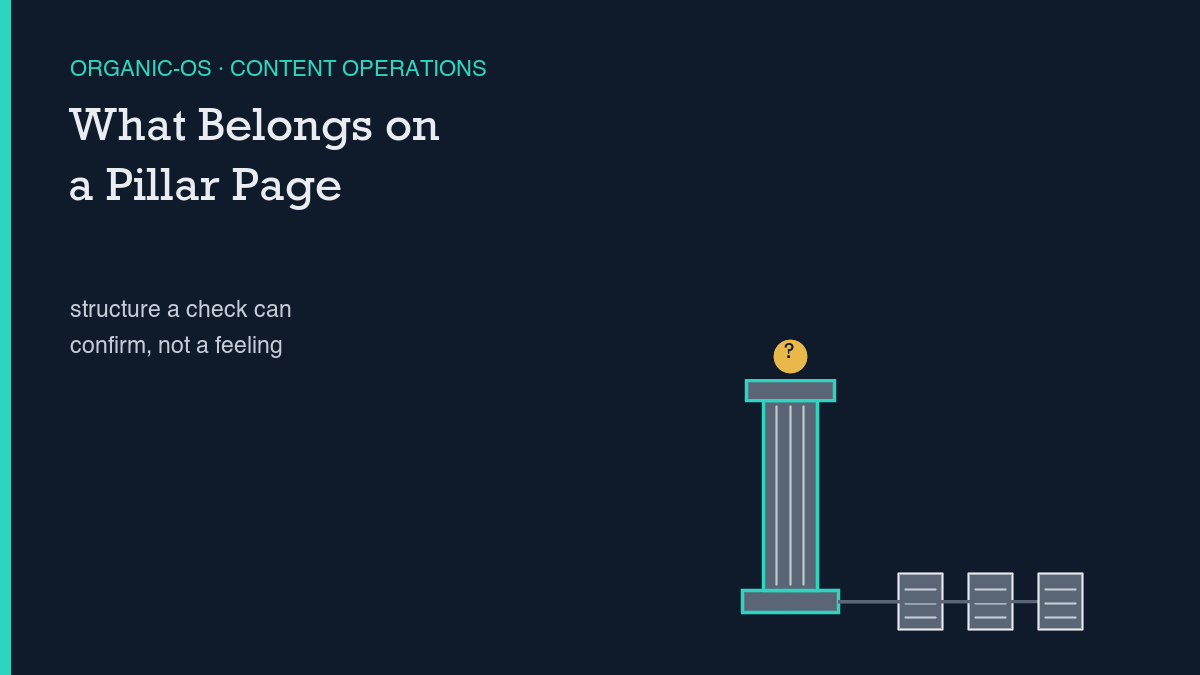
    A pillar page belongs to broad, complete coverage of one topic, plus working links out to the narrower cluster posts that go deeper on each piece of it – it should not try to be the deep piece itself. HubSpot’s own definition puts it plainly: a pillar page “covers all aspects of the topic on a single page, with room for more in-depth reporting in more detailed cluster blog posts that hyperlink back to the pillar page.” This site has one real pillar page built against that definition, and checking it directly – headings, links, and one leftover label this piece caught while writing it – is the worked example below.

    “Broad and complete” is not a feeling; it is checkable against specific pieces. HubSpot’s pillar-page guidance adds that pillar pages “broadly cover a particular topic” while cluster content addresses “a specific keyword related to that topic in-depth,” and that a pillar page runs longer than a typical post precisely because it has to cover every angle without going deep on any single one. Google’s own helpful-content guidance asks a version of the same question from the ranking side: “does the content provide a substantial, complete, or comprehensive description of the topic?” Neither source hands over a checklist. Both point at the same gap a pillar page has to close – a reader should be able to get the whole shape of a subject on one page, then follow a link to go deeper on any one part of it.

    What a pillar page has to cover, piece by piece

    In practice that breaks into four pieces that recur across the pillar pages worth studying: a direct definition near the top, a named process or structure underneath it (the actual mechanics of the topic, not just an overview paragraph), an evaluation or decision section that helps a reader judge their own situation against it, and a set of outbound links to the cluster posts that each take one piece further than the pillar page goes. Leave any one of those four out and the page either reads as too thin to be a pillar (no definition, no structure) or tries to do a cluster post’s job on top of its own (going deep on one sub-topic instead of linking to a page that already does), which is the exact overlap HubSpot’s definition is written to prevent.

    This site’s own topic-cluster structure, covered in more detail in the piece on topic cluster architecture, is what the fourth piece depends on: a pillar page cannot link out to cluster posts that do not exist yet or are not live, so the same lettered cluster field that tells a drafting pass which posts belong together is also what tells a pillar page which links it is allowed to make at any given time.

    What a check can confirm, and what still needs a person’s eye

    Two of those four pieces are mechanically checkable and two are not. Whether an outbound link actually resolves to a live, published post – rather than a slug that is still a draft or was renamed since the pillar page was last touched – is a fact a script can confirm with one REST call, the same pre-publish link-target check and post-publish render check this site runs on every piece it ships. Whether a structured field like a cluster label exists on the underlying brief is equally binary – the field is either present or it is not, the same way this site’s own brief template makes a cluster assignment a line a script can grep for instead of a fact an editor has to remember.

    What no check can confirm is whether the definition at the top is actually complete, or whether the evaluation section actually helps a reader who does not already know the answer – both of those are judgment calls about the content itself, not about whether a field exists or a link resolves. A page can pass every mechanical check (links live, cluster field set, FAQ schema present) and still fail at being a pillar page, if the definition is vague or the evaluation section just restates the definition in different words instead of giving the reader something to decide with.

    This site’s own pillar page, as the worked example

    This site has one page built as a pillar in that sense: What Is an AI SEO Agent?, which carries a definition section, a step-by-step section on the observe-propose-approve loop, an evaluation section for judging a tool against it, and a frequently-asked-questions section with its own schema – plus four outbound links into the cluster posts that each take one of those pieces deeper. Checked directly against the live page this session, every one of those four links resolves to a currently published post, and the FAQ section is marked up with FAQPage schema that is actually present in the rendered HTML, not just claimed.

    The same direct check also found a leftover: the page still opens with a bolded “In short:” label ahead of its answer, the exact pattern this site’s own formatting rule – written after label text leaked into auto-generated excerpts on seven posts in July 2026 – now forbids on every piece published since. The pillar page itself predates that rule and has not been touched since, so it is the one page on this site where the before-state of that rule is still live and checkable rather than something this piece has to take on faith. That is the actual before/after a pillar page produces when the rule changes but the page does not: the structure (definition, process, evaluation, links) still holds up, but one surface detail falls out of date until someone goes back and fixes it – a gap this review surfaced rather than one left to assumption.

    The same pillar page is also where this site logged a real, negative result from trying to improve it: on 2026-08-22 its title and meta description were rewritten to target a specific plural-phrasing query, measured against its own stated falsifiability bar at day 7 and again at day 28. Both checkpoints came back identical to the pre-change baseline – position flat at 20.5, impressions flat at 2 – and the record was closed with an explicit FALSIFIED verdict rather than rounded up to a win. Getting the pillar structure right does not, by itself, guarantee that a specific wording change on top of it moves a specific query; this site’s own outcome log says so about its own pillar page, not as a hypothetical.

    Telling whether the structure is actually helping

    The honest test of a pillar page is not whether it has the four pieces, it is whether a reader landing on it can get the shape of the whole topic and then find the right cluster post for the part they actually care about, and whether that pattern shows up as GSC impressions across a spread of related queries rather than a single phrase. This piece’s own brief sets a dated version of that bar for itself: wrong if, 60 days after publish, this URL has zero GSC impressions for any query containing the primary keyword’s terms despite being indexed – the same falsifiable, kill-datable condition this site attaches to every brief, including the one that produced the FALSIFIED result above. Comprehensiveness and linking structure are the same signal Google’s helpful-content guidance and the entity and topical-authority work covered in entity SEO for small sites both point at – a page that is legibly complete and well-linked gives a reader and a crawler more to work with than one that is not. None of that is a guarantee that any specific page or query moves. It is a structural condition that makes a pillar page’s performance something this site can measure and log honestly, including when the answer is no.


    Shivaa Tripathi runs organic-os, an experiment in publishing SEO and AEO work with the research and verification shown rather than asserted.

  • Topic Clusters: Architecture That Compounds

    Topic Clusters: Architecture That Compounds

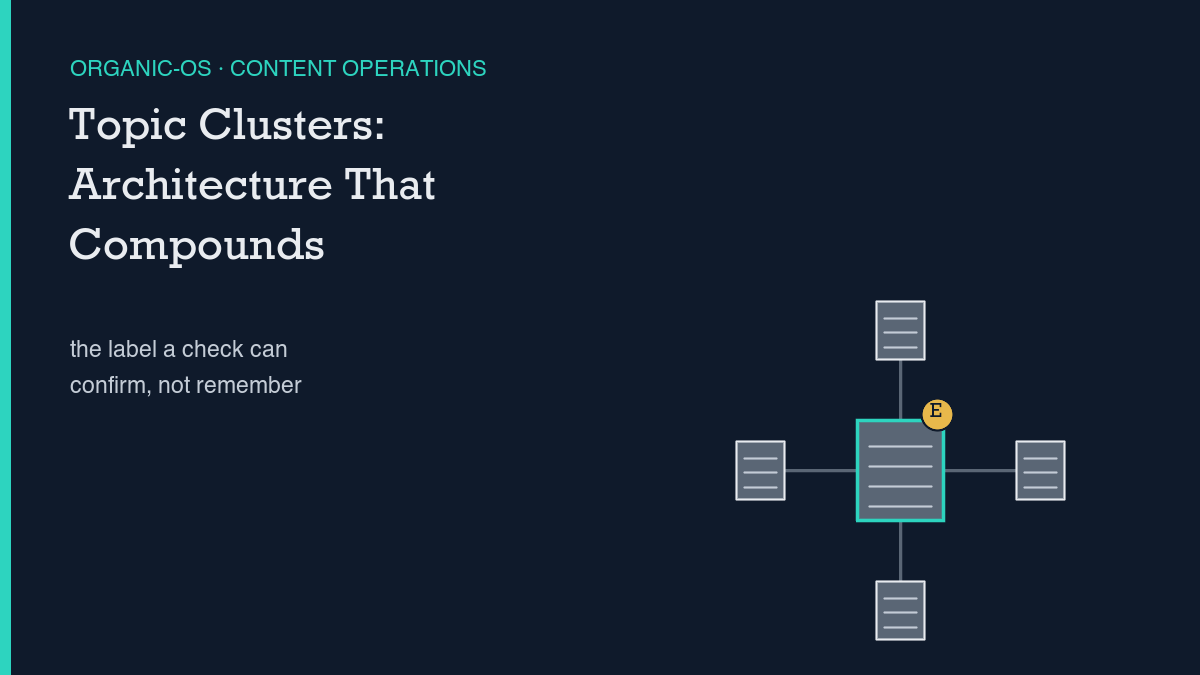
    A topic cluster is a group of related pages that link to each other and to one shared pillar page, so search engines read the whole group as coverage of one subject rather than as scattered, unrelated posts. Architecture that compounds means the cluster label is a structured field checked by a script, not a sentence a person has to remember – this site switched from the second to the first on 2026-09-02, and the difference is the subject of this piece.

    HubSpot’s own description of the model is specific: “topic clusters organize a group of related content pieces (cluster pages) around one central pillar page,” with the pillar covering a subject broadly and each cluster page addressing one subtopic underneath it. Google’s search-starter guidance backs the same instinct from the crawling side – “when you’re setting up or redoing your site, it can be good to organize it in a logical way because it can help search engines and users understand how your pages relate to the rest of your site.” Neither claim is about writing better sentences. Both are about structure: whether a reader or a crawler can tell that twelve pages belong together without being told so in prose.

    The process, named stage by stage

    This site’s current batch of 80 content briefs, approved as a standing batch on 2026-09-02, groups every brief into one of seven lettered clusters, A through G. Each brief’s own “Expected effect” field states its cluster directly – “Extends cluster E,” for example – which is what lets a later check grep every brief file for that label and get a clean answer about which slugs are supposed to interlink, instead of a person having to remember a loose topical grouping from memory. This piece is itself cluster E’s seventh of twelve briefs, following six already-published cluster-E posts: automate-content-calendar, publishing-daily-experiment, a content brief template, editorial-gates-ai-content, content-refresh-vs-new-posts, and automating internal links safely.

    Writing the cluster label into the brief is the pillar-and-cluster model in its most mechanical form. HubSpot’s own page frames the payoff as structural rather than stylistic: “internal links pass authority between the pillar and cluster pages, anchor text tells crawlers how each page relates to the others, and the overall structure consolidates a previously scattered set of posts into a single topical unit.” That only works if the links actually get written – a labeled cluster field tells a drafting pass which existing published posts are candidates to link to, but it does not write the link itself. Picking two to five of those candidates that are genuinely relevant to a given paragraph, and writing anchor text that is not just a keyword dropped in for ranking signal, is still an editorial step done per piece, not a side effect of the label existing.

    What is automated, and what a person still judges

    Two parts of this are mechanical checks, not editorial judgment, and this site’s own prior piece on automating internal links covers both in detail. The first runs before a single link goes into a draft: a live REST pull against the site’s own WordPress install confirming that every candidate destination is an actual published post right now, not a slug remembered from a prior run or a sibling piece still sitting in draft. The second runs after publish, against the rendered page rather than the file that produced it: a scan of the live HTML confirming each intended link’s href actually made it into the article body, because a draft that says a link exists and a page that renders it have turned out, on at least one real occasion on this site, to be two different facts.

    What neither check does is decide which pages should be in the same cluster, or which of a cluster’s pages are relevant enough to link from a specific sentence. That assignment happens once, at brief-writing time, as a human or editorial call about which 80 topics belong in which of the seven lettered groups – a judgment about subject-matter adjacency, not something a script can infer from a slug. It is worth separating this from WordPress’s own category taxonomy, which looks similar but solves a different problem: category pages are a built-in archive view generated from a single taxonomy field, while a topic cluster is an editorial grouping that can, and often does, span multiple categories and gets expressed through in-content links rather than a taxonomy term alone.

    Before and after, on this site specifically

    Before 2026-09-02, this site’s briefs referenced cluster membership only in loose prose. An August 2026 brief on GEO versus SEO versus AEO, for one example, states its expected effect as “extends the AI-SEO topic cluster” – true, but not a field a script can check across every brief at once, and not something that tells a drafting pass exactly which other slugs are in that cluster without a person re-reading several files. After 2026-09-02, every one of the 80 Wave-5 briefs carries a one-line, lettered “Extends cluster X” statement, confirmed this session by grepping all 80 brief files directly: every single one returns a clean A through G label, with no exceptions and nothing left to infer.

    That is a small change in a frontmatter field, and it is also the entire difference between a topic cluster that exists because someone remembers it and one that exists because a check can confirm it. It does not, by itself, write a single internal link – the six cluster-E posts published so far still needed a person to pick which two to five of the other eleven cluster-E briefs were relevant enough to cite in a given paragraph, and the mechanical link-verification pass described above still needed to run on each one after publish. The label makes the grouping checkable. It does not make the linking automatic.

    Telling whether the architecture is actually helping

    The honest test of a cluster architecture is not whether the label exists, it is whether a reader or a crawler landing on any one cluster page can find the others without searching for them, and whether those pages start showing up in Search Console for queries that touch more than one of them. This piece’s own brief sets that exact bar: it is wrong if, 60 days after publish, this URL has zero GSC impressions for any query containing the primary keyword’s terms despite being indexed – the same falsifiable, dated condition this site attaches to every brief rather than a vague “we expect this to help.” Entity and topical-authority signals point the same direction from a different angle: a cluster of pages that consistently link to and reference the same subject gives search engines more to work with than one isolated page claiming expertise, which is the same logic covered in this site’s piece on entity SEO for small sites. None of that is a guarantee that a specific page ranks. It is a structural condition – links that actually resolve, labels that are mechanically checkable, a kill date on the claim – that makes a cluster’s performance something this site can measure rather than something it has to assume.


    Shivaa Tripathi runs organic-os, an experiment in publishing SEO and AEO work with the research and verification shown rather than asserted.

  • Automating Internal Links Safely

    Automating Internal Links Safely

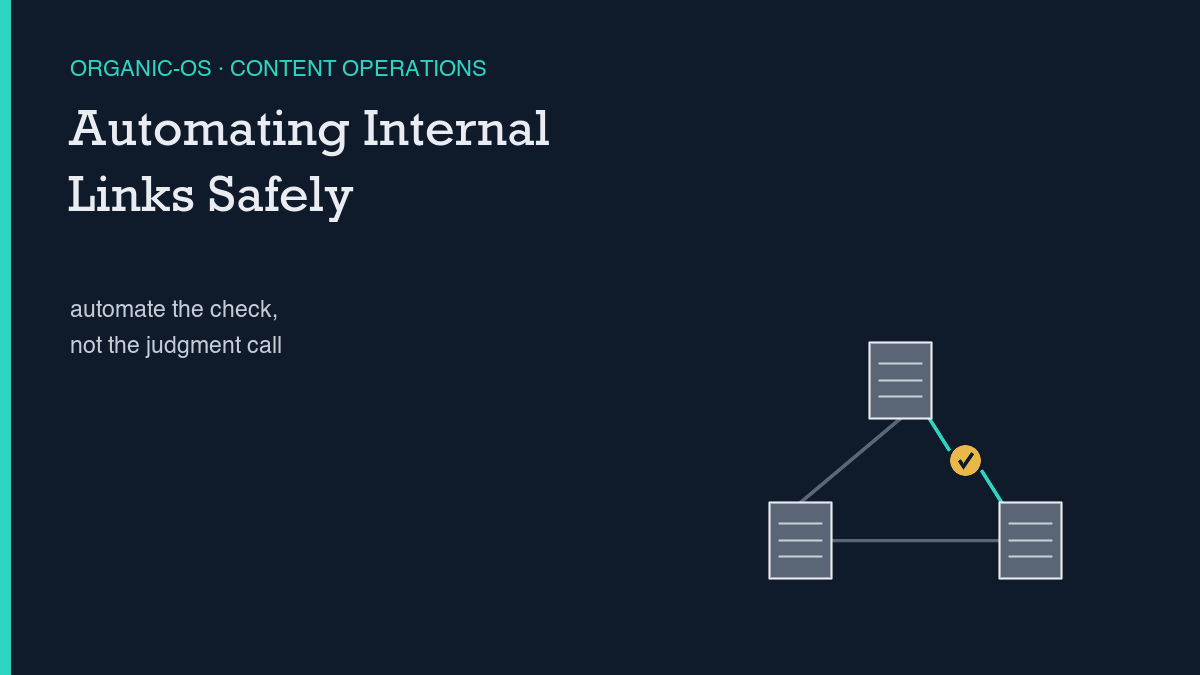
    Automate the two checks that are genuinely mechanical – confirming a link target is a real, live, published page before it goes in, and confirming after publish that the link actually made it into the rendered HTML – and leave the one judgment call that is not mechanical, picking which 2-5 pages are contextually relevant enough to link from a given paragraph, to a person or an editorial pass. Skipping the second check is how this site once shipped a page with a missing internal link it believed it had already added.

    Searching for “automate internal linking” mostly surfaces plugin roundups – Link Whisper, Internal Link Juicer, AIOSEO’s Link Assistant, half a dozen others, each comparing install counts and pricing tiers for a tool that scans your content and suggests a destination page for you to click “accept” on. That is a different problem from the one a daily-publishing pipeline actually has, which is not “where should a link go” but “how do we make sure every link we already decided on actually exists, actually renders, and does not quietly disappear between the draft and the live page.” This is how this site’s own pipeline automates that second problem, what it still refuses to automate, and the one time skipping a check let a page ship with a link missing.

    The two checks that are actually mechanical

    The first automated check runs before a single link goes into a draft: a live REST pull against the site’s own WordPress install, confirming that every candidate destination is an actual published post right now, not a slug remembered from a prior run or a sibling piece that is still sitting in draft. That distinction matters more than it sounds – this pipeline has shipped a piece before where one of its intended internal links pointed at a sibling post from the same batch that had not been published yet, and the link 404’d until the second post went live. The fix was not “remember better,” it was “never trust memory for this – pull the live, published post list every time, right before writing the link in.”

    The second automated check runs after publish, against the live rendered page rather than the draft file: a scan of the actual HTML a browser or a crawler would receive, confirming each intended link’s href is present in the article body, confirming there is no leftover Gutenberg block-comment syntax leaking into visible text, and confirming the page returns HTTP 200. Google’s own link documentation frames why this is worth checking mechanically rather than assuming it from the draft: its SEO link best-practices page states that “every page you care about should have a link from at least one other page on your site,” which only holds if the link that was supposed to exist actually survived the trip from draft to published HTML – a draft that says a link is there is not the same fact as a live page that renders it.

    What stays a human call

    Neither check decides which pages should link to which. That is still judgment, and this pipeline treats it that way on purpose, the same split human-in-the-loop content workflows argues for more generally: automate the parts where a wrong answer is cheap to catch and expensive to repeat, leave the parts where a wrong answer is expensive to catch to a person or an editorial pass. Picking 2 to 5 relevant destinations for a given piece is squarely in the second category – a mechanical keyword-match linker (the kind the plugin roundups above are built around) will happily link the word “automation” to an unrelated page every time it appears, which is exactly the chained, context-free linking Google’s own guidance warns against: “don’t chain up links next to each other; it’s harder for your readers to distinguish between links, and you lose surrounding text for each link.” Choosing relevance, not just keyword overlap, is still a per-piece editorial decision here, done during the draft and the editor pass, not handed to a matching rule.

    Anchor-text wording is the other half of that same judgment call. The same Google guidance is specific about what good anchor text looks like – “descriptive, reasonably concise, and relevant to the page that it’s on and to the page it links to” – which rules out both generic anchors like “click here” and over-stuffed exact-match keyword phrases dropped in solely to carry ranking signal. This pipeline’s own stage-by-stage process treats writing the anchor text as part of drafting, inside the sentence it naturally belongs in, rather than as a separate linking pass bolted on afterward – “the words before and after links matter,” as the same guidance puts it, and that only holds if the link was written into the sentence, not inserted around it.

    The time skipping the second check cost a link

    On 2026-07-31, this pipeline published a piece intending four internal links, including one to its own homepage. The editor notes for that run claimed all four links were present. The post-publish render-verification check – at that point a newer, less-trusted step – ran anyway, scanning the actual live HTML rather than trusting the notes, and found only three of the four links in the rendered page. The homepage link was missing; it had been written into an earlier version of the paragraph and dropped during a later edit, and nothing before the render check would have caught that, because the draft file itself looked fine on a read-through. The fix was mechanical once the gap was visible: add the link back into the paragraph, push the corrected content to the live post, and re-run the exact same render-verification scan to confirm all four links were now actually there before marking the run done.

    That single incident is the direct reason the render-verification check is no longer optional or skippable on a “the editor notes already said it’s fine” basis. It runs on every publish now, checking the live page rather than any file that claims to describe it, specifically because a file that claims a link exists and a page that actually renders it turned out to be two different facts on at least one real occasion. This site’s editorial gates exist because something broke before, not as a precaution taken in the abstract, and the post-publish link check is one of them.

    Telling whether this is actually helping

    The honest way to check whether automating these two steps is worth the overhead is to watch whether the failure mode they are built to catch – a link that the draft says exists but the live page does not render – still happens after the check is in place. Since the 2026-07-31 incident, every subsequent publish run in this pipeline has included the same render-verification pass as a required step before the run is recorded as done, and the decision log for each one states explicitly whether every intended link was found present on the first scan or required a repair-and-rescan cycle. The broader pattern this site follows for WordPress automation generally is the same one: plugins and scripts can surface a change or a suggestion, but something still has to verify, against the live site, that what was supposed to happen actually did – and for internal links specifically, “actually did” means fetching the published page and finding the link in it, not re-reading the file that was supposed to produce it.


    Shivaa Tripathi runs organic-os, an experiment in publishing SEO and AEO work with the research and verification shown rather than asserted.

  • Refresh or Publish New? A Decision Rule

    Refresh or Publish New? A Decision Rule

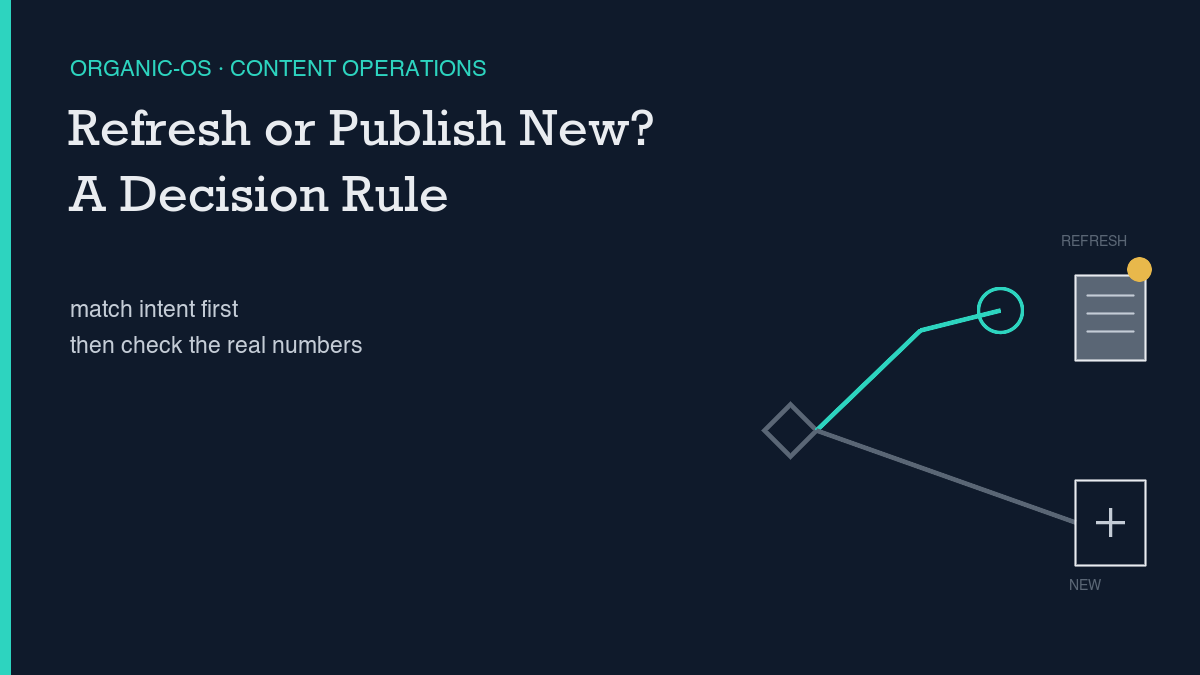
    Refresh an existing page when the search intent it targets has not changed and the page already has some ranking history worth keeping – stale stats, thin sections, or an outdated example are reasons to rewrite in place, not reasons to start over. Publish something new when no page on the site actually addresses the intent yet, or when the intent itself has shifted so far that the old framing cannot be patched. Everything else is a judgment call that a single ranking-position check cannot make for you, which is why this site treats it as a named decision step rather than a reflex.

    “Should this become a new post or an edit to an old one” sounds like a small question. On a site that ships new content daily, it is a recurring one, and answering it wrong in either direction has a cost: refreshing a page that should have been retired wastes a pass on something with no real intent match, and publishing a new page next to one that already half-covers the topic creates two pages competing for the same query instead of one page that actually wins it. Below is the rule this pipeline actually uses, what part of it runs as a check versus what still needs a person, and two real examples from this site’s own history – one refresh that worked as a correctness fix and one that was tried, measured, and did not move the number it was supposed to move.

    The decision rule, named stage by stage

    The rule runs in a fixed order, and the order matters more than any single check inside it. First: does a live page on this site already target the same search intent as the topic under consideration? If yes, the default is refresh, not create – a second page competing with the first for the same intent is a problem to avoid, not a volume strategy. Second, if a page exists, has the intent behind the target query actually shifted, or is the page just stale – old numbers, a missing subtopic, an example that no longer applies? Intent-shift calls for a more substantial rewrite of the existing URL; staleness calls for a lighter update of specific sections. Third, if no page exists at all, or the existing page’s whole framing no longer matches what the query now expects, that is the case for something new. None of this is a vibe check. It is answered by pulling the page’s actual Search Console history for the target query – position, impressions, and whether it still gets any impressions at all – before deciding anything.

    Google’s own documentation gives the reason freshness is not a blanket argument for refreshing everything, everywhere, on a schedule. Its search ranking systems guide states plainly that it runs “various ‘query deserves freshness’ systems designed to show fresher content for queries where it would be expected” – news, new releases, fast-moving topics. A query that does not expect fresh information does not get a freshness boost just because a page was edited yesterday. That is the real argument against treating “refresh everything every quarter” as a rule: freshness only pays off where the query itself calls for it, which means the first question in the decision above is always intent-match, not last-edit date.

    What a check can decide and what still needs a person

    Some of this rule is genuinely mechanical. Whether a live URL already exists for a given slug or topic is a single REST lookup, not a guess – this pipeline runs that duplicate check before every single piece, refresh or new, specifically so a produce run never accidentally creates a second page next to one that already exists. Whether a page’s impressions for its target query have gone flat, fallen, or disappeared entirely is a Search Console pull, not an impression. Those two checks alone resolve a large share of the easy cases: page exists, still gets impressions, same intent – refresh it; no page exists at all – write something new.

    What a check cannot decide is whether the existing page’s framing is actually wrong for the query now, as opposed to merely old. A page can be three years old and still exactly match what a reader wants; a page published last month can already be the wrong angle if the query’s intent moved faster than the content did. That judgment – does this page still answer the question the query is actually asking, not just the question it was asking when the page was written – is exactly the kind of call human-in-the-loop content workflows argues should stay with a person rather than get automated away, because getting it wrong is expensive and the automation would have to re-derive intent correctly every time to be trusted. The same split shows up in how this pipeline’s own editorial pass works: its gates separate mechanical checks from judgment calls on purpose, rather than folding both into one review step.

    Two real refreshes from this site, with the actual numbers

    On 2026-08-22, this pipeline refreshed the title and meta description on its own flagship explainer page to target a higher-impression query variant it was not yet winning – swapping “What Is an AI SEO Agent?” for “What Are AI SEO Agents?” to match the plural phrasing a real query was using, at a starting position of 20.5 with 2 impressions. The record attached a stated falsifiability condition up front: wrong if position had not improved and impressions had not risen above the trailing median by day 28. Day 7 showed no movement. Day 28 showed the same position, 20.5, and the same 2 impressions – flat, not improved. The outcome log closes this one with an explicit verdict: falsified. The refresh was real, it was measured on its own terms, and it did not work. That result is published here rather than quietly dropped, because a decision rule that only reports its wins is not a decision rule, it is a highlight reel.

    A second refresh from the same week shows the other, more common shape: not every edit is a bet on moving a ranking, some are just fixing something broken. Two meta descriptions had quietly grown past Rank Math’s display limit and were getting truncated in search results. The fix was a straight trim back under the character limit on both pages – no new angle, no intent change, nothing to measure at day 28 because there was no ranking claim attached to it in the first place. A third attempt, rewriting homepage copy to add a missing keyword, landed two of its three intended changes cleanly through the available WordPress REST surface and hit a real platform wall on the third – a duplicate-heading issue baked into the site’s block-theme template, which no content-level edit can reach. That one is still logged as partially applied, with the specific remaining fix named for a human to do through the Site Editor rather than quietly marked done.

    Telling whether the rule itself is working

    The honest test of a decision rule like this is not whether it feels reasonable on paper. It is whether every refresh attached to it leaves a checkable before-and-after number, the same way the KPIs this site actually tracks are chosen because they can be checked, not because they sound impressive. A refresh with no stated falsifiability condition is just an edit with no accountability attached – which is exactly the gap the pillar-page example above was built to avoid, and exactly why it is reported as a failure here instead of being left out. The same discipline applies on the “new” side of the rule: watching for content decay across the whole site is what eventually tells this pipeline a given refresh-versus-new call was premature – a page that keeps losing impressions after a refresh was not a refresh problem to begin with, it may have been a new-content gap the refresh could never close.

    None of this produces a rule that is right every time. It produces a rule that is checkable every time, which is a different and more useful property. A refresh that does not move its own stated number is logged as falsified rather than quietly forgotten, a partially-applied fix names the exact remaining gap instead of rounding up to “done,” and the next piece this pipeline produces inherits that record rather than repeating the same untested assumption about what a title tweak can do.


    Shivaa Tripathi runs organic-os, an experiment in publishing SEO and AEO work with the research and verification shown rather than asserted.

  • Editorial Gates for AI-Drafted Content

    Editorial Gates for AI-Drafted Content

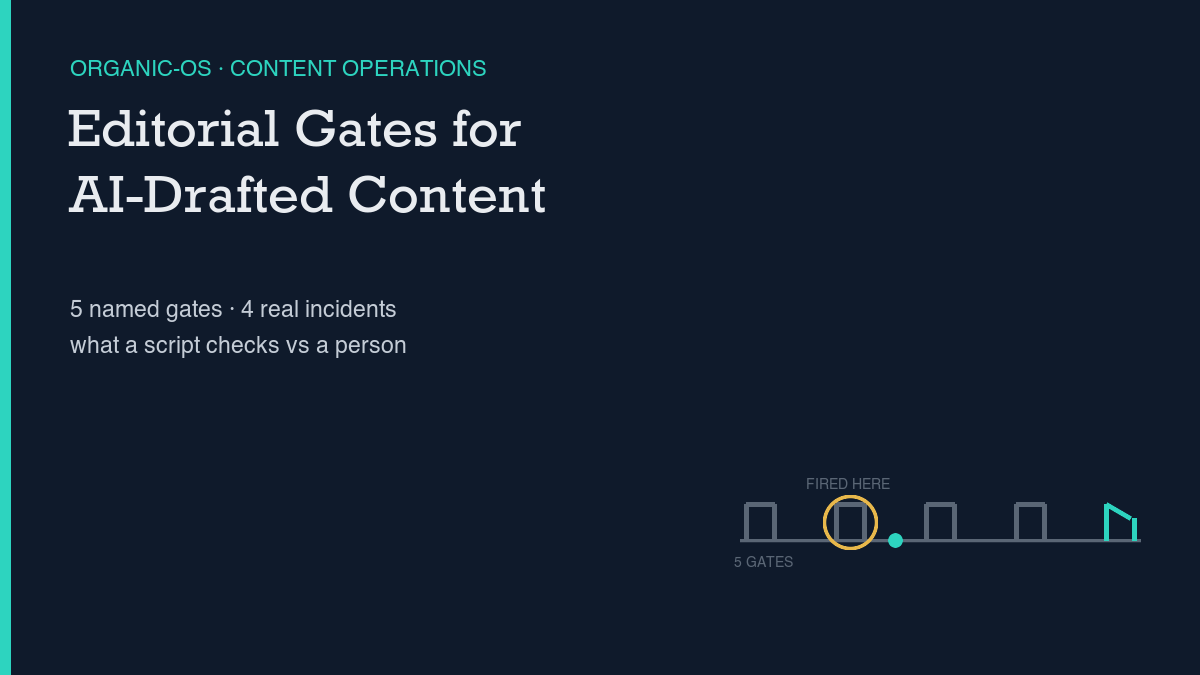
    Five concrete gates stand between an AI-drafted paragraph on this site and a live URL: a written brief with a dated kill criterion, a research pass that drops any claim it cannot verify against a live source, a structural QA check that scans for leaked label text and broken markup, a voice-and-banned-phrase edit pass, and a post-publish check against the actual rendered HTML, not just the API response that created it. None of those five exist because someone read a best-practices list. Each one was added after a specific defect reached, or nearly reached, a live page, and this article names which defect built which gate.

    “Editorial process” sounds like a diagram. In practice it is a short list of checkpoints a draft has to clear before it is readable by anyone who is not on the team producing it, and the honest test of any such list is whether a failed check actually stops the page from going live. Below is what that list looks like on this specific site, what runs as code versus what still needs a person, and the real incidents that put each gate there.

    The gates, named stage by stage

    Every piece here starts as a content brief with a dated kill criterion, not a blank prompt. The brief names a target keyword, defers search intent to the next stage instead of guessing it, and states up front what would make the piece wrong 60 days after publish. Research comes next: every statistic or named source in the draft gets checked against a live page at draft time, and anything that cannot be traced to a real source gets deleted rather than softened with a hedge word. Drafting follows, written to match a fixed voice profile. Then a structural QA pass runs a set of mechanical checks against the draft file itself – word count, Gutenberg block balance, banned-phrase and label-leak scans. An edit pass checks voice and sets the SEO fields by hand. A featured image gets generated and uploaded. Only then does the post go live, and even that is not the last gate: the live HTML gets fetched and re-checked after publish, separately from the API response that created it.

    That order is not arbitrary. A 2026 analysis of AI content workflows found teams repeatedly building the opposite shape by accident – review scattered across every stage with no single accountable checkpoint, summarized bluntly as “everyone reviewed something, nobody owned a gate.” The fix it recommends is a small number of clearly separated gates rather than diffuse review, which is the same reason this pipeline keeps structural QA, voice editing, and post-publish verification as three distinct steps instead of one combined “look it over” pass.

    What a script checks and what a person still has to judge

    The mechanical gates are genuinely mechanical: a regex can count whether wp:paragraph tags are balanced, whether any word on a fixed banned-phrase list appears, whether the word count sits inside a target range, or whether a slug already exists as a draft so the pipeline updates instead of duplicating a post. None of that requires judgment, which is exactly why it is automated – a person checking block-tag balance by eye is a waste of a person.

    What a script cannot do is decide whether a cited claim actually means what the draft says it means, whether an internal link is contextually honest or just keyword-stuffed, or whether the piece’s voice reads as this site rather than as generic AI output. That split matches what human-in-the-loop content workflows argues more generally: automation should own the repeatable, rule-based work, and judgment should stay wherever a wrong call is expensive or hard to detect automatically. It also matches updated external guidance directly – Google’s AI content guidance, updated October 2026, now states that manually fact-checking AI-generated content before publishing is “critical,” and extends that review past the visible article text to AI-generated titles, meta descriptions, alt text, and structured data, on the reasoning that generative systems predict a plausible sequence of words rather than retrieve verified facts.

    There is also a legal version of the same split now in force. The EU AI Act’s Article 50 transparency rules took effect on 2 August 2026, requiring disclosure when AI-generated text on a matter of public interest is published – the same disclosure question whether to disclose AI content covers from the publisher’s side. The rule carries an exemption, but a narrow one: it applies only where the content “has undergone substantive human editorial review with a person assuming editorial responsibility,” and a merely cursory check does not qualify. The exemption exists for the same reason this pipeline keeps a named editor pass as its own gate rather than folding it into drafting – a review step only counts, legally or otherwise, if it is substantive and attributable to someone.

    Four gates that exist because something broke

    Here is the before-and-after, with the actual defects. The first seven posts this pipeline ever produced opened with a visible “In short:” label inside the answer section, and because no custom excerpt had been set, WordPress’s automatic excerpt pulled that exact label text onto every listing page on the site. The fix was not “write better prompts” – it was a standing rule that body copy may never contain label text and that an excerpt must always be set by hand, checked mechanically on every draft since.

    Second: one published post had eighteen Gutenberg block comments that were accidentally backslash-escaped, so the live page rendered literal garbage text to a reader while the WordPress REST API response describing that same post looked completely clean. That gap – API looks fine, live page does not – is why this pipeline treats “fetch and read the actual rendered HTML after publish” as its own non-negotiable gate, separate from trusting the response that came back from creating the post.

    Third: the queue-processing step crashed outright the first time a leftover .draft.md scratch file sat next to a real brief in the same folder, silently blocking every item behind it until someone noticed. Fourth, and the quietest failure of the four: a single approved brief had one unescaped apostrophe inside its YAML frontmatter, which broke the file’s parsing and dropped it out of the approval queue with no visible error for weeks. It was found only by sweeping every brief file in the batch and confirming the defect was isolated to that one file. None of these four gates were speculative hardening. Each exists because a specific, dated incident already happened once, and each is checked mechanically now so it does not need to be relearned by hand.

    The stakes for skipping this kind of gate are not hypothetical at a larger scale, either. In January 2023, CNET quietly published 77 AI-written financial explainer articles before disclosing that an AI tool had written them. A later internal audit found 41 of those 77 required corrections – more than half – including at least one article that stated a saving account would earn $10,300 in interest where the correct figure was $300, plus separate plagiarism flags where a tool meant to catch copied phrasing missed it. CNET paused the program afterward. The specific mechanism of that failure – fact-checking and plagiarism-checking treated as optional rather than as a gate that blocks publication on failure – is the same mechanism this site’s own four incidents trace back to, just caught earlier and at far smaller scale.

    Whether the gates are actually working

    A gate is only worth keeping if it has a way to fail honestly, not just a way to feel thorough. Two practical tests apply here. First, has each gate caught something real since it was added, or has it only ever returned a clean pass – a gate that never fires is either genuinely unnecessary or not actually being run. Second, does every published piece carry its own dated condition for being judged wrong later, the same kill-criterion field the brief gate requires, so that “did this work” has a stated answer instead of becoming a retroactive decision about whether the piece “feels” successful. A pipeline that cannot point to the real incident behind one of its own checks, or that cannot name what would prove a specific published piece wrong, is running a checklist rather than a set of gates, and keeping an audit trail of what was actually checked is what makes the difference verifiable instead of asserted.

    None of this claims the gates catch everything. A mechanical scan for banned phrases or broken block tags will never catch a subtly wrong claim that reads fluently, which is exactly the class of error the human editorial-review stage – and the EU’s narrow exemption test for it – exists to cover instead. What the five gates buy is narrower and easier to defend: every piece that reaches a live URL on this site has passed a stated, checkable sequence, and every rule in that sequence can be traced to the specific day something got through without it.


    Shivaa Tripathi runs organic-os, an experiment in publishing SEO and AEO work with the research and verification shown rather than asserted.

  • A Content Brief Template With Kill Criteria

    A Content Brief Template With Kill Criteria

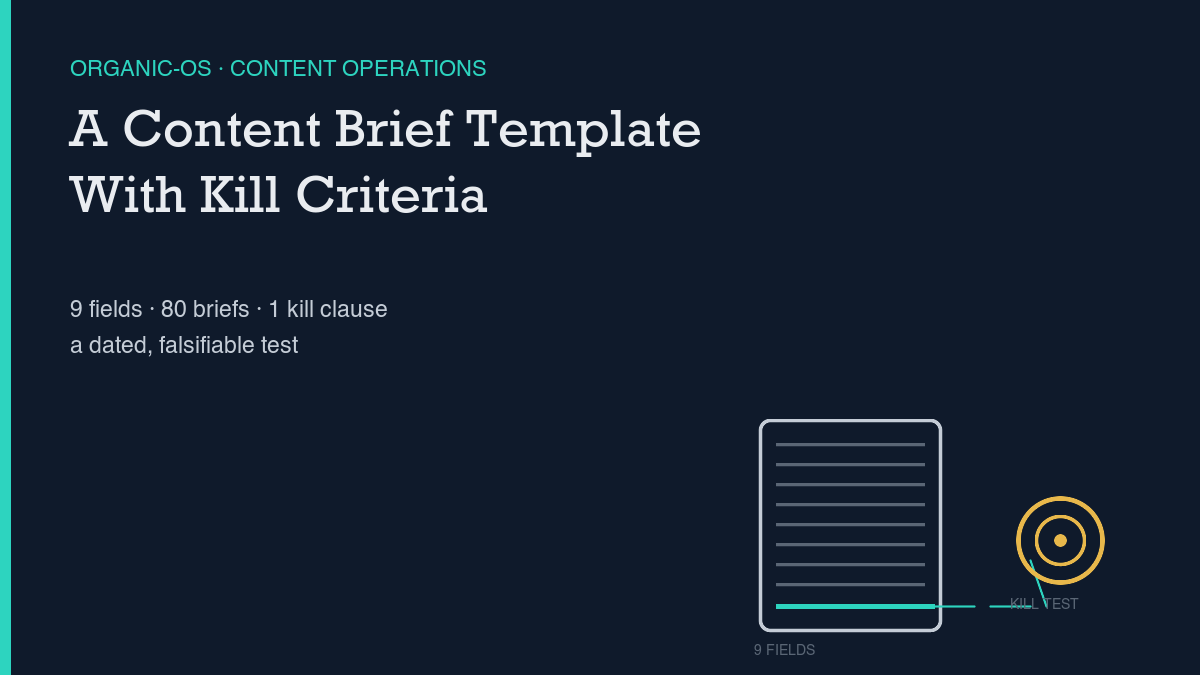
    A content brief that is worth reusing needs nine fields, and the one that matters most is the one most templates skip: a kill criterion. On this site every brief names a target keyword, defers search intent to the research stage instead of guessing it up front, discloses plainly when a search-volume figure cannot be verified rather than inventing one, carries two standing contracts for evidence and formatting, and ends with a dated, falsifiable condition that says exactly what would prove the piece wrong. That last field is what turns a brief from a writing prompt into something you can actually grade after the fact.

    Most content brief templates stop at keyword, audience, and outline. This one keeps going, because a brief that only tells a writer what to cover never tells anyone, including the person who approved it, whether the resulting page did what it was supposed to do. I read four of this site’s own brief files end to end to write this, including the one this exact article was produced from, and all four share the identical nine-field structure below, word for word in two of the fields.

    The nine fields, and why each one is in there

    The first four fields are the ordinary ones: a target keyword in backticks, a search-intent line that is deliberately left unresolved (“the research stage must confirm intent against live SERP evidence before drafting”), a standing disclosure that this account’s Keyword Planner access is non-functional so no volume figure gets fabricated, and a working title with an explicit character ceiling. The fifth, angle, is one or two sentences naming the real constraint for that specific piece rather than generic guidance. The sixth, a suggested outline, almost always opens with “direct-answer capsule” as its first line, which is the same unlabeled-paragraph rule writing answer capsules AI engines can quote covers in more depth. The seventh field, internal links, instructs 2-3 links from the existing published cluster and explicitly forbids linking to an unpublished slug, which matters because this batch runs dozens of these briefs at once and half of them have not gone live yet on any given day.

    The eighth field is where the template stops being generic. It carries two contracts, verbatim, across every brief checked. The evidence contract: every factual claim must be verified against a live source at draft time and linked, and anything that cannot be verified gets dropped, not hedged. The formatting contract: no meta-label text anywhere in the body, the answer capsule as the real opening paragraph, a custom excerpt set by hand, a generated featured image, and a rendered-page check after publish confirming exactly one author box and no leaked markup. Neither contract is decorative language. Both exist because something specific broke in production and the fix was written into the template so it would not have to be relearned.

    What is automated versus what a human still judges

    The brief itself is mostly fixed boilerplate, which is exactly the point. The fields that vary piece to piece are judgment calls deferred to a later stage on purpose: intent is confirmed against live search results at draft time, not assumed while the brief is being written, and the specific sources a claim gets verified against are picked by whoever drafts the piece, not prescribed in advance. What is automated is the structure itself, the standing approval that lets a brief ship without a new sign-off, and the mechanical checks, like whether an internal link target is actually published yet. That split is the same one human-in-the-loop content workflows describes more generally: the template does the repeatable part, and a drafting pass still does the part that requires reading an actual source and deciding whether a claim survives contact with it.

    The two contracts inside field eight exist because of three specific incidents, not as abstract best practice. The first seven posts this pipeline ever produced opened with a visible “In short:” label inside the answer section, and because no custom excerpt had been set, WordPress’s automatic excerpt pulled that exact label text onto every listing page. The formatting contract’s excerpt-and-no-label-text language is the direct fix, written into the template the same day. Separately, one published post had eighteen Gutenberg block comments that were accidentally backslash-escaped during a shell command, so the live page rendered literal garbage text while the API response describing the same post looked completely clean — which is why the formatting contract now names a rendered-page check specifically, not just an API check. A third incident, unrelated to either contract, is a single approved brief that silently dropped out of the approval queue for weeks because one unescaped apostrophe in its YAML frontmatter broke parsing; a full sweep across all 80 briefs in this batch confirmed it was isolated to that one file, and the fix was switching that field to double-quoted YAML.

    The kill criterion, specifically

    Field nine, falsifiability, is the field that makes this a template worth defending rather than just a checklist. Every brief in this batch uses the same dated condition: the piece is wrong if, 60 days after publish, Search Console still shows zero impressions for any query containing the primary keyword terms, despite the page being indexed. That is a real kill criterion because it names a specific tool, a specific window, and a specific outcome that would count as failure, rather than leaving success undefined until someone decides after the fact whether the piece “worked.” The same discipline is what running SEO experiments over 30 days argues for across this site’s broader testing practice: a result only means something if there was a stated way for it to come back negative.

    For this piece specifically, that baseline is checked before publish, not assumed. A live Search Console pull across this site’s queries from June 1 through October 21 shows zero rows containing “content brief,” “brief template,” or “kill criteria” in any form. That is the clean starting point the falsifiability field needs: if a query containing this piece’s own target terms shows up with real impressions within 60 days, something worked; if the page stays indexed with nothing to show for it on those exact terms by then, the stated condition has been met and that should be reported as a failure, not quietly dropped from the record.

    This brief, as a worked example

    This article is itself an instance of the template it describes, which is the most concrete evidence available for whether the nine fields actually work end to end. The brief it came from carries the same angle language as its siblings (“concrete process over theory; include the gates that exist because something broke”), the same five-part outline starting with a direct-answer capsule, and the same falsifiability clause described above. It is also not a one-off: this is the 55th of 80 briefs in the same standing batch to reach publish, following a single approval given once on 2026-09-02 and never revised since, the same batch mechanics automating a content calendar without losing judgment walks through in more detail. A template that only works for one piece is a draft. One that has now produced 55 separate, individually verified pages from the same nine fields, each with its own checked evidence and its own rendered-page verification, is closer to infrastructure than to advice.

    None of that is a claim that the template produces a good result every time. Several fields in it, like the standing Keyword Planner disclosure, exist specifically to admit a limitation rather than paper over it, and the falsifiability field exists because some fraction of these 55 pages will fail their own stated test. What the template buys is narrower and harder to overstate: every piece produced from it carries a stated way to check, later, whether it was worth writing, instead of leaving that question unanswered the way most outlines do.

    • Name the kill criterion before drafting, not after publishing, so there is no room to redefine success once the result is in.
    • Carry the evidence and formatting contracts in the brief itself, not in a separate style guide nobody rereads mid-draft.
    • Defer search intent and source selection to the drafting stage, and keep the brief’s own boilerplate fixed, so judgment stays where it belongs and the repeatable parts stay repeatable.

    Shivaa Tripathi runs organic-os, an experiment in publishing SEO and AEO work with the research and verification shown rather than asserted.

  • Publishing Daily for 90 Days: What Happened

    Publishing Daily for 90 Days: What Happened

    “Publishing daily for 90 days” is the premise this piece set out to test, and the honest answer is that this site has not run a literal unbroken daily streak. The real record is 53 posts published over roughly 49 elapsed days, on one standing human approval, through the same six-stage pipeline every time, with real bugs along the way that were fixed in the plumbing rather than the writing. Live search results turned up at least one documented case where a different site cut its publishing rate and saw indexation speed and editorial quality both improve. So the useful question is not whether daily is faster. It is what a sustained, near-daily cadence actually bought this site, and whether that is the same thing as cadence itself working.

    Before writing any of this, I looked at what live search results say about daily publishing cadence and about what a real pre-publish process should contain. The consistent pattern across sources is a tight system, not raw output: a keyword and brief step, a drafting step, a factual review, an on-page optimization pass, and a logged approval with an owner and a timestamp, usually five to seven named stages depending on the source. Several sources also recommend spreading content types across the week rather than running the same intent every day, and note that the maintenance or refresh day is the one most often skipped, which is what lets older pages decay quietly. None of that is a case for publishing daily specifically. It is a case for having a repeatable process, which is the part of the premise this piece can actually verify against its own history.

    The process, named stage by stage

    Every post this site publishes goes through the same six named stages: research, draft, QA, editor, a featured-image generation step, then publish. Each stage writes its own output to a dated folder, so a research pack, a QA log, and editor notes exist for every post before it ever goes live, the same structure automating a content calendar without losing judgment describes in more detail. What makes this a cadence rather than a series of one-off decisions is a single standing approval covering an 80-topic batch, made once on 2026-09-02, with each topic shipping on its own day without a further per-item sign-off. That approval is explicitly revocable, and it has not needed to be revoked, but the mechanism only works because every stage downstream of it still checks its own work rather than assuming the green light at the start covers everything after it.

    As of today, 53 of those 80 topics had published before this one, which puts this post’s own publish date at roughly 49 days after the first Wave-5 post went live on 2026-09-03. Fifty-three posts over 49 days is a sustained near-daily average, not a literal one-per-calendar-day count. The log shows multiple same-day catch-ups rather than a perfectly even spread, including three separate posts published on a single day in mid-October. That distinction matters for this piece specifically, because the working premise promised “daily,” and the more accurate claim is “a standing approval that produces output at a near-daily average, with slack built in.” Stating the weaker, accurate version instead of the stronger, cleaner-sounding one is the same discipline this site’s own voice rules ask for elsewhere.

    What is automated versus what a human still judges

    A standing approval covering 80 topics is not the same thing as 80 topics running unchecked, and the distinction is the entire subject of human-in-the-loop content workflows, which this site’s own record keeps confirming rather than just arguing for. Three concrete examples from this batch show where judgment still sits inside an approval that was only given once. First, an automated checker built to catch leaked label text and stray exclamation marks has twice flagged false positives — a code snippet demonstrating an escaped character, and a quoted historical reference to a label that had leaked in an earlier post — and both were resolved by reading the actual surrounding text, not by mechanically editing the draft to satisfy the checker. Second, a post was once built with its featured-image reference missing because the image upload had not finished in time, and that defect was caught on review before the post was ever created, not patched after the fact. Third, every single publish in this log independently re-fetches the live post afterward and compares the saved content against what was submitted, rather than trusting the response from the create request. None of that is the system catching itself. It is the system being built so that catching things stays possible, which is a narrower and more defensible claim.

    The same split shows up in what the pipeline is not allowed to do. The WordPress credential behind this process can create, edit, and publish posts, but it cannot purge the SEO plugin’s sitemap cache, because that action requires a broader permission than the task needs. That boundary causes real, repeated friction, and it has stayed in place on purpose rather than getting quietly widened the first time it was inconvenient. A credential scoped to exactly what a recurring task needs, even at a cost to convenience, is itself a form of judgment applied once at design time instead of case by case.

    Our own before and after

    The clearest before-and-after in this process’s own history is a formatting failure, kept on the record rather than quietly fixed and forgotten. The first seven posts this pipeline produced opened with a visible “In short:” label inside the answer section, and because no custom excerpt had been set, WordPress’s automatic excerpt pulled that exact label text onto every listing page a reader would see before clicking through. The fix was specific: a formatting rule was added requiring plain reader-facing prose with no label text anywhere in the body, and a clean excerpt set on every post going forward, with all seven live posts repaired the same day the problem was found. A second, related failure is why this process now checks the rendered page instead of trusting an API response: one post went live with eighteen Gutenberg block comments that had been accidentally backslash-escaped during a shell command, so WordPress could not parse them and they rendered as literal garbage text on the actual page, while a content check run against the raw API data looked completely clean. A third, smaller incident is a single approved topic that silently dropped out of the approvals queue for weeks because one unescaped character broke its file’s frontmatter, found only when a full queue rebuild happened to surface it. None of these three were caught by the cadence itself. They were caught by the specific checks each one forced into existence, which is the kind of structured record running SEO experiments over 30 days argues any process needs if it wants to tell a real result from a lucky one.

    There is also a boundary issue that has not been fixed and is not pretending to be: fetching a live page without a browser-style identifier gets blocked outright, so every request this pipeline makes now sends one. That is not a before-and-after with a clean resolution. It is an ongoing condition the process works around on every single run, and it belongs in an honest account of “what happened” for the same reason the fixed bugs do.

    How to tell if the process is helping

    A process that reliably ships posts is not automatically a process that is working. Reliability is a claim about whether the pipeline runs; it says nothing about whether a search engine or a reader cares about what comes out of it, and measuring content decay makes the same separation for a different part of this site’s own output. The honest way to check this specific page is the same falsifiability test applied to every other post in this batch: if, 60 days after this publishes, Search Console still shows zero impressions for any query containing its primary keyword terms, despite the page being indexed, the piece did not work, and that should be reported plainly rather than left out of the record. The baseline to check that against is already set: as of today, none of the 50 highest-impression queries hitting this site contain “publishing” and “daily” together or in any close variant, which is exactly the clean starting point that test needs, not a prediction of what will happen.

    What I can say with more confidence, because it is a closed set of incidents rather than a forecast, is that the specific defects named above have not recurred since the checks built to catch them were added. That is a narrow claim about a handful of previously broken gates, not a broader claim that a near-daily cadence is itself the reason this site’s output is working. The live research behind this piece turned up a real, documented case where a slower cadence produced better results elsewhere, and this site’s own evidence does not contradict that. What it does show is that a repeatable process with a record of its own failures survives scrutiny better than a cadence claim does, which is a smaller, more defensible thing to publish than the “daily for 90 days” premise this piece started with.


    Shivaa Tripathi runs organic-os, an experiment in publishing SEO and AEO work with the research and verification shown rather than asserted.

  • Automating a Content Calendar Without Losing Judgment

    Automating a Content Calendar Without Losing Judgment

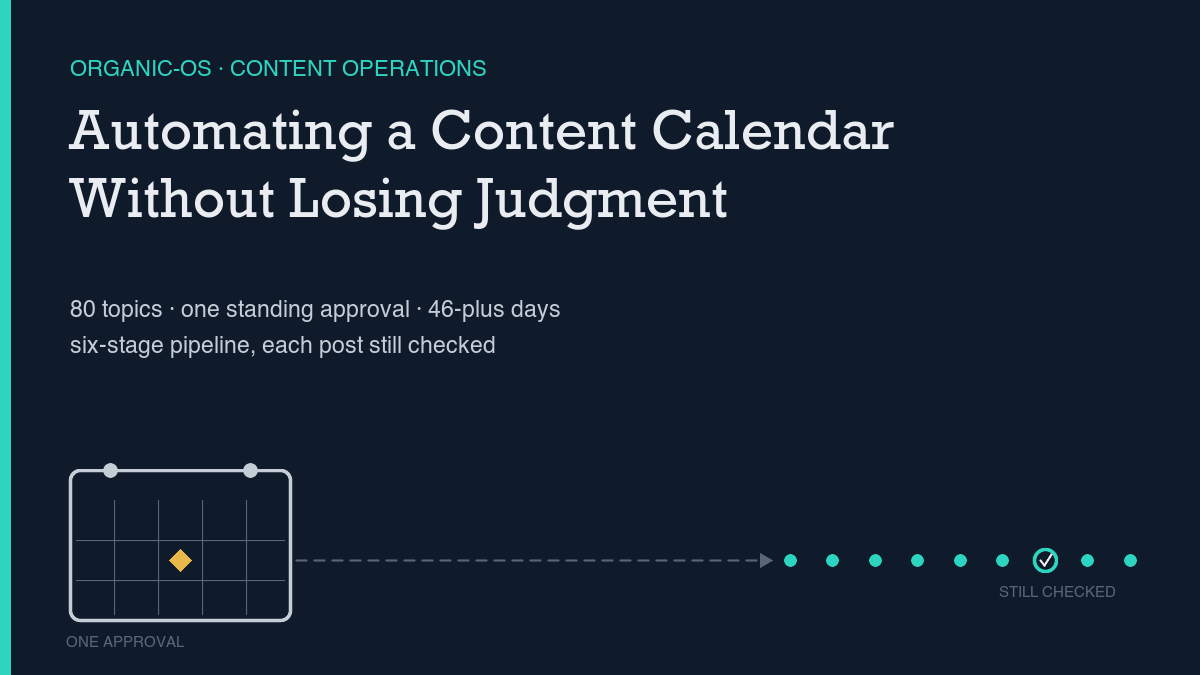
    Automating a content calendar means automating the admin around publishing, not the decisions that make a piece worth publishing: scheduling, routing drafts through fixed stages, running the same checks every time, and keeping a dated record of what happened. The actual judgment calls — what to write, whether a claim is verified, whether a draft reads honestly — stay with a person, or with a single standing approval a person gave on purpose. This site runs on exactly that split. One human approval from September 2 covers an 80-topic batch; 52 of those topics had published by the time this one went out, each through the same six-stage pipeline, and at least five of those runs have hit a real bug along the way. None of the bugs were in the writing. All of them were in the plumbing.

    Most advice on automating a content calendar stops at the tooling question: which app, which database, which trigger. The more useful question is which specific steps are safe to hand off and which ones need a person reading the actual output before it goes live. I looked at live search results for this exact framing before writing anything here, and the pattern across sources is consistent: automation earns its keep on repetitive, rule-based, easily-reviewed work — reminders, status-triggered routing, drafting support, scheduling — while anything touching brand voice, factual accuracy, or strategic priority stays a human checkpoint. One source frames it as a line-producer-and-showrunner split. That matches how this pipeline is actually built, not as a design choice made in the abstract but as something that got forced into shape by real failures, which is the more useful story to tell.

    The process, named stage by stage

    Every piece that ships here goes through the same six named stages: research, draft, QA, editor, a featured-image generation step, then publish. Each stage writes its output to a dated folder — a research pack, a QA log, editor notes, the image and payload files — so the record of how a specific piece got made is as persistent as the piece itself. That structure is what automated content operations: what to hand off, what to keep argues for directly: a calendar only becomes automatable once it lives in a structured, inspectable format rather than a spreadsheet or a verbal plan, because the structure is what makes a later stage able to check an earlier one’s work.

    What makes this a calendar rather than a one-off script is the batch mechanism sitting above those six stages. Instead of approving each post individually, 80 topics were approved once, in a single decision, with each one shipping on its own day without asking again. That single decision is explicitly revocable — a status change or an emptied queue stops the whole batch — which matters more than it sounds like it should, because a standing approval that cannot be revoked isn’t automation with judgment attached, it’s just a commitment made once and never revisited.

    What is automated versus what a human still judges

    The honest answer is that “auto-approved” does not mean “unchecked.” Three things from this exact batch’s own run history show where judgment still sits even inside an automated calendar. First, an automated label-leak checker once flagged two false positives — a code snippet demonstrating an escape character, and a quoted historical reference to a label that had leaked in an earlier post — and both were investigated by reading the actual surrounding text rather than mechanically edited to satisfy the checker. Second, a real defect (a featured image reference saved as empty because the upload hadn’t finished yet) was caught on review before the post was ever created, not patched after the fact. Third, every single publish re-fetches the live post afterward and diffs the saved content against what was submitted, rather than trusting the create response — that verification step is itself a designed-in judgment checkpoint, the same discipline why your SEO automation needs an audit trail argues should exist anywhere automation is allowed to touch a live site. None of this is the system catching itself; it’s the system being built to make catching things possible, which is a different claim and a smaller one worth stating precisely.

    The same split shows up in what the pipeline is deliberately not allowed to do. The WordPress credential this pipeline runs under can create, edit, and publish posts, but it cannot purge a caching layer that needs broader site permissions — a boundary that has caused real, repeated friction, and one that stays in place on purpose rather than getting “fixed” by widening the credential. Scoping automation to only what a task needs, even when that scoping costs convenience, is the same argument made in guardrails for AI agents that touch your website: a guardrail that gets removed the first time it’s inconvenient was never really a guardrail.

    Our own before and after

    The clearest before-and-after in this pipeline’s own history is a formatting failure from earlier this year, kept on record rather than quietly fixed and forgotten. Every one of the first seven posts this pipeline produced opened with a visible “In short:” label inside the answer section, and no custom excerpt had been set, so WordPress’s automatic excerpt pulled that exact label text into every listing page a reader would see before clicking through. The fix was specific: a formatting contract was added to the production prompt requiring plain reader-facing prose with no label text anywhere in the body, and a clean excerpt set on every post going forward. All seven live posts were repaired the same day the problem was found, and the rule has been checked on every post since.

    A second, related failure is why this pipeline now checks the rendered page rather than trusting an API response. One post went live with eighteen Gutenberg block comments that had been accidentally backslash-escaped during a shell command, which WordPress could not parse — so they rendered as literal garbage text on the actual page, while a content check run against the raw API data looked completely clean. That gap between “the data looks right” and “the page looks right” is why render verification exists as its own separate step now, checked against the live HTML and not the stored content. A third incident, smaller but telling, is a single approved brief that silently dropped out of the queue for weeks because one unescaped character broke its file’s frontmatter — not a crash anyone saw, just an item that quietly stopped existing to the system until a full queue rebuild happened to surface it. Version-controlling every one of these files, the same practice version control for SEO: diffing your own site makes the case for, is what let each of these three incidents be found, dated, and fixed instead of just suspected.

    How to tell if the process is helping

    A calendar that reliably ships posts is not automatically a calendar that is working — reliability is a claim about the process, not about whether readers or search engines care about the output, and keeping those two claims separate is the same discipline this site’s own measurement posts insist on for any other SEO metric. The way to check this specific page honestly is the same falsifiability test applied to every other piece in this batch: if, sixty days after this publishes, Search Console still shows zero impressions for any query containing its primary keyword terms, despite the page being indexed, the piece did not work and that should be reported plainly rather than dropped from the record. The baseline to check that against is already set: as of today, none of the fifty highest-impression search queries hitting this site contain “automate” and “content calendar” together or in any close variant, which is exactly the clean starting point that test requires — not a projection of what will happen, just a reliable fact about where this page starts from before any answer appears.

    What I can say with more confidence, because it is a closed incident rather than a prediction, is that the specific defects named above have not recurred in the forty-six-plus days and roughly fifty posts since the formatting and render-verification contracts were added — every run since has logged a pass against both checks, not a silent skip. That is a narrow claim about two specific, previously-broken gates, not a broader claim that the whole process is “working.” Judging whether an automated content calendar is helping means tracking both kinds of evidence at once: whether the gates that exist because something broke are still holding, and whether the output they protect is actually earning attention once it ships.


    Shivaa Tripathi runs organic-os, an experiment in publishing SEO and AEO work with the research and verification shown rather than asserted.